Musk and Altman's Rare Interaction: How Real Is the AI World's Reaction?

Reddit users see the Musk-Altman interaction as PR theater, reflecting fatigue and wariness toward the tech oligarch power structure.
This article examines a Reddit post and its comment section, centered on the seemingly friendly interaction between Musk and Altman. The post uses "Cars unite men" to satirize the contrast between this scene and the model release that immediately followed. Commenters debate "how much Altman really hates Musk," with most arguing that CEO feuds pale in comparison to real conflicts involving family and litigants—it's essentially PR posture. The discussion extends to real Model Y experiences, the symbolic magic of the "rocket car," data centers and compute limits, and the "big club" theory: public figures' statements and private interactions are all strategy. Ultimately, it points to ordinary people's fatigue and skepticism toward tech oligarch power concentration and "performative politics."
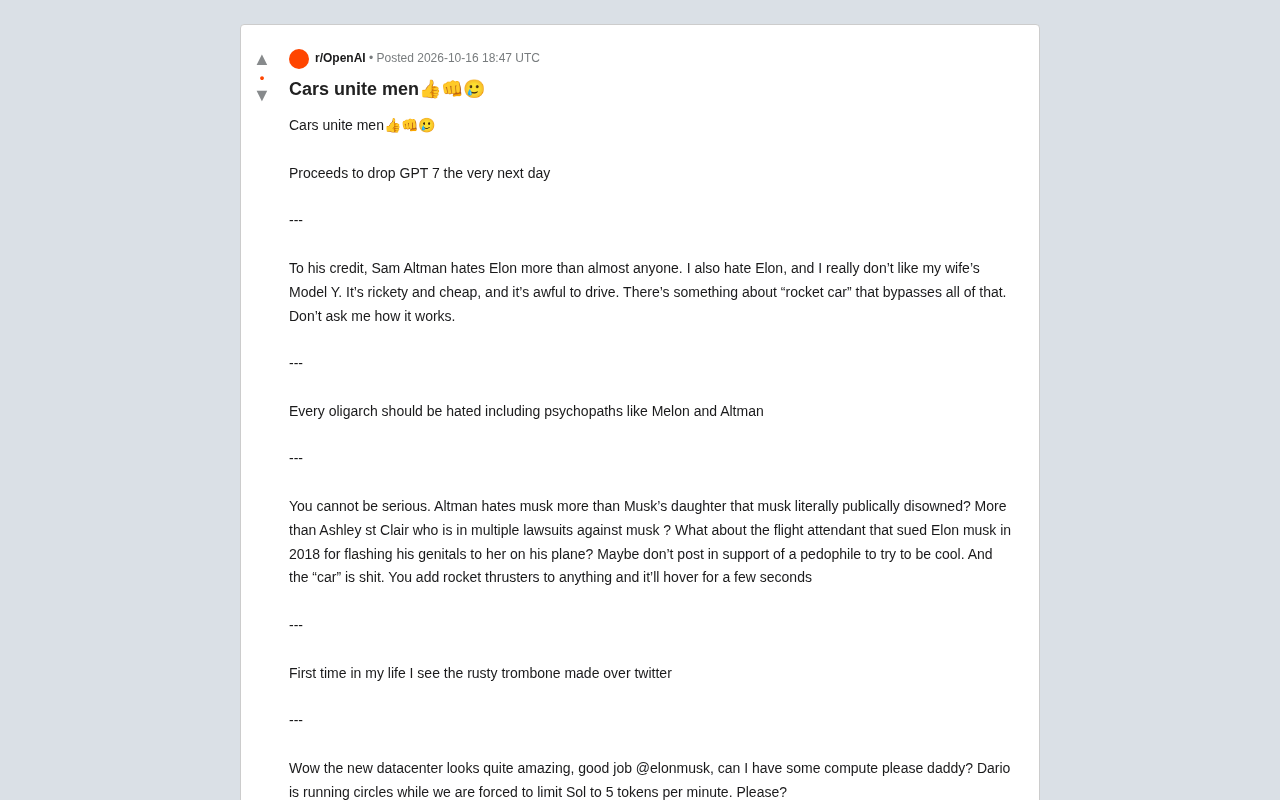
A Performance of "Cars Uniting Men"
A Reddit post summed up the whole thing in one line: "Cars unite men👍👊🥲," immediately followed by "and the next day they released GPT 7."
The scene this post points to isn't complicated: Musk and Altman—two tech giants who have long been publicly at odds—had a rare friendly interaction on some occasion, and almost simultaneously, OpenAI released its next-generation model. The Reddit user's sarcasm is dialed all the way up: on one hand, cars bring men together; on the other, the business moves show no mercy.
This timing coincidence is less a signal of reconciliation than a reminder that in the AI and tech industry, there's often a massive gap between the public narrative and the actual moves being made.
Is the Hatred Real, or Just for Show?
The core disagreement in the comments section is this: just how much does Altman actually hate Musk?
The post author claims "Altman hates Musk more than almost anyone," reasoning that Altman doesn't like Musk either. But a user quickly pushed back: "Are you serious? Altman hates him more than Musk's daughter who publicly disowned him? More than Ashley St. Clair, who has multiple lawsuits against Musk?"
The logic behind this rebuttal: if you're ranking people by "who hates Musk more," Altman doesn't even crack the top ten. Family members, litigants, former employees—these people's hatred is backed by concrete actions, while the "hatred" between two CEOs looks more like a PR posture.
Another highly upvoted comment broadened the scope to all oligarchs: "Every oligarch should be hated, including psychopaths like Musk and Altman." This sentiment represents a significant portion of users—they don't take sides, but remain wary of the entire tech power class.
GPT-7 and OpenAI's Release Cadence
Since releasing ChatGPT (based on GPT-3.5) in 2022, OpenAI has gradually established a convention of naming flagship models by numerical generation: GPT-4 (2023), plus iterative versions like GPT-4o and GPT-4 Turbo. By 2024–2025, industry anticipation for "GPT-5" had been hyped repeatedly, while "GPT-7" in the Reddit post is more of a meme—it's not a real, publicly confirmed product name, but rather a way for netizens to satirize how absurdly fast model iterations are coming. Understanding this matters: "the next day they released GPT 7" isn't stating a fact, but using exaggeration to emphasize that the competitive pace between OpenAI and the Musk camp has become so fast it's numbing.
The Car Experience: From Model Y to "Rocket Car"
One user shared their real experience: "I don't like my wife's Model Y. It's bouncy, cheap, and drives terribly. But the 'rocket car' concept bypasses all those problems. Don't ask me how."
This reveals a key point: some Tesla products are genuinely unsatisfying in real-world use, but the "rocket" symbol itself carries powerful narrative magic that can temporarily override negative feelings at the product level.
Another user was more direct: "This 'car' is garbage. You put rocket thrusters on anything and it can hover for a few seconds." This represents a total rejection of the "rocket car" concept—in their view, it's nothing more than an engineering gimmick, not a usable product.
Data Centers, Compute, and "Call Me Daddy"
One comment pulled the conversation from cars back to AI infrastructure: "Wow, the new data center looks amazing, great job @elonmusk, can I get some compute please daddy? Dario is running laps while we're forced to limit Sol to 5 tokens per minute. Please?"
This comment is dense with information. It touches on three key points:
- Progress on new data center construction
- Dario (Anthropic's CEO) being actively engaged in the compute race
- A product called Sol being rate-limited to 5 tokens per minute
Whether these details are accurate or not, it reflects a real anxiety: in the AI race, compute is becoming the scarcest resource, and the power to allocate it is concentrated in very few hands.
Tokens and Rate Limits
In the AI context, a "token" is the smallest unit of text a model processes, roughly equivalent to one English word or a few Chinese characters. "X tokens per minute" on an API or product interface refers to a rate limit—the amount of compute quota a user can consume per unit of time. This number directly determines how fast and how long a model can respond to users. When the comment says "Sol is limited to 5 tokens per minute," whether true or not, what it's expressing is: compute has been throttled to an almost unusable level. Rate limits are typically determined by a provider's GPU supply, costs, and priority policies, so during periods of compute scarcity, they become a direct indicator of "who gets favored and who gets sidelined."
Dario and Anthropic's Compute Race
The "Dario" mentioned in the comment refers to Dario Amodei, co-founder and CEO of Anthropic, the company known for its Claude series of models and one of OpenAI's main competitors. Anthropic has long emphasized AI safety, but on the commercial side it's equally deep in the compute arms race, having established large-scale compute partnerships with cloud providers like Google Cloud and Amazon. Netizens use "Dario is running laps" to describe him being in an active expansion mode, hinting that in this resource scramble, Anthropic hasn't slowed down just because of its "safety" label. Pairing Dario with Musk's data center serves to highlight one fact: no matter what story a company tells externally, the underlying competition is all about GPUs, power, and data centers.
"The Big Club": The Rules of the Game for Public Figures
The most insightful comment in the entire thread goes like this: "It's a big club, and we're not in it. That's why Musk can call Trump a pedophile—literally accuse him of raping children—and then they go back to being best friends."
It points to a deeper observation: for these public figures, public statements and private interactions may not be "real" at all. Every word has a motive behind it, and they all know the other party is playing the same game.
Another user added: "I think in some sense, for these public figures, it's all a game. Their public statements, their private interactions—none of it is real. It all has hidden motives. They all do it, and they all know others are doing it too."
This "game theory" explains why Musk and Altman can tear into each other one day and interact the next—not because they've reconciled, but because public antagonism and public friendliness are both just part of the strategy.
What "Oligarch" Means in the Tech Context
The word "oligarch" that repeatedly appears in the comments originally described the few wealthy elites who controlled Russia's economy and politics after the Soviet Union's collapse. Today, the English-speaking internet has borrowed it to describe tech leaders who simultaneously command massive capital, platforms, and public opinion influence. Calling Musk, Altman, and others by this term isn't about whether they're actually involved in politics, but about the concentrated power they hold to shape public discourse, market rules, and even national policy. The sentiment in the post that "every oligarch should be hated" reflects precisely this wariness of excessive power concentration—when a few people simultaneously control AI models, social media, and infrastructure, whether they're friends or enemies, ordinary people can hardly exert any influence.
Why This Matters
On the surface, this is just a bunch of Reddit users gossiping. But the emotions reflected in the comments are real: ordinary people have grown tired and skeptical of the "feuds and dramas" between tech oligarchs.
When one user says "this smells bad for the world," they're not expressing like or dislike for any individual, but concern about a power structure—when a few people simultaneously control AI models, compute infrastructure, social media platforms, and car companies, what does their "unity" or "opposition" mean for ordinary people?
No one in the Reddit thread gives an answer. But that title—"Cars unite men👍👊🥲"—already says it clearly: this is a performance, and the audience is waking up.
Related articles

Understanding DeepSeek in 3 Minutes: The Rise from a Quant Hedge Fund to an Open-Source AI Leader
DeepSeek's history in 3 minutes: from High-Flyer Quant's compute build-up to V2's MLA inference cost cuts, V3's $5.576M training bill, R1's open-source global shock, and V4 with a $7B Series A.

Local Creative Writing Model Showdown: Fine-tuned Qwen3.8 27B Wins, DeepSeek v4.1 Underwhelms
Bilibili creator tests seven local creative writing models: Hemingway and HumanLike Chat based on Qwen3.8 27B perform best, DeepSeek v4.1 is plain, Dongfang Shuo ranks last with confused characters. Includes three test prompts, scores, and usage advice.

Liang Wenfeng's Three Big Bets: Why Did DeepSeek Open-Source Its 82% Gross Margin?
Why did DeepSeek open-source DeepInfer, its 82% gross margin inference framework, and then launch a hundred-billion funding round? An analysis of Liang Wenfeng's three big bets and the open-source strategy.