Musk Confirms: Tesla and SpaceX Have Formed Special Committees to Discuss Merger

Tesla and SpaceX formed special committees at shareholders' request to formally discuss a merger, with governance and conflicts of interest in focus.
Musk disclosed at SpaceX's Q3 earnings call that Tesla and SpaceX have each formed special committees of independent directors to formally discuss a potential merger. Though sudden, the news fits Musk's capital operations logic and didn't surprise the market. The business logic lies in Starlink-Tesla fleet synergy, SpaceX engineering complementing Tesla manufacturing scale, and opening public-market financing for SpaceX. The biggest obstacle is governance: Musk's dual CEO role is the core conflict of interest, and the special committees' independence, membership, and authority remain undisclosed. The merger is still early-stage, and its realization depends on passing shareholder and regulatory scrutiny.
Musk dropped a bombshell during SpaceX's Q3 earnings call: Tesla and SpaceX have each formed special committees to formally discuss the possibility of a merger between the two companies. The news came suddenly, but within Musk's consistent logic of capital operations, it seems entirely natural.
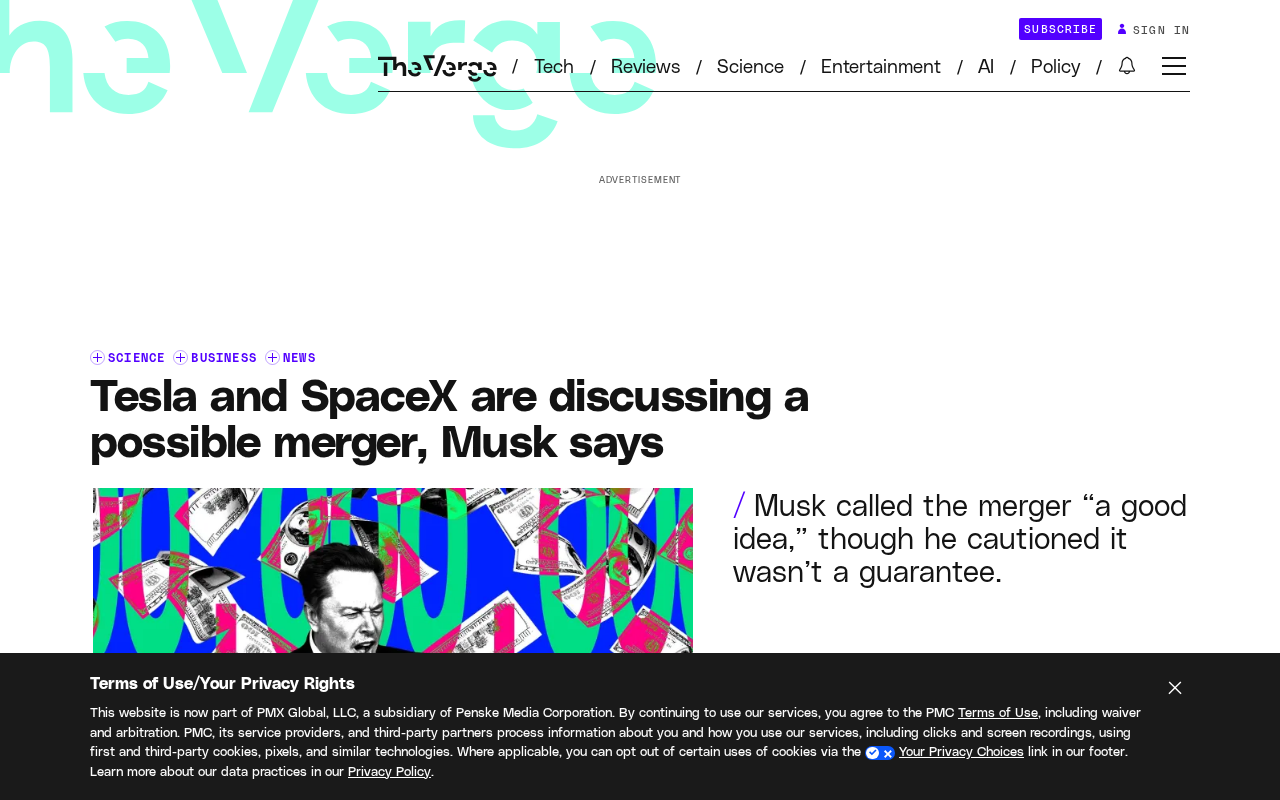
Origins and Mechanism of the Merger Discussions
According to Musk, these two special committees were formed at the request of shareholders and are composed of independent directors, though he did not disclose the specific membership list. This means the merger matter has entered the formal corporate governance process, rather than remaining at the level of Musk's personal verbal musings.
Establishing a special committee is typically a precursor to a major transaction—independent directors assess whether the deal is fair to all shareholders and avoid conflicts of interest. Musk serves as CEO of both companies simultaneously, and this dual role is itself the most sensitive conflict-of-interest point in the merger discussions. Whether the special committee's independence can withstand scrutiny will be the core focus going forward.
A Special Committee is a standard governance arrangement under Anglo-American corporate law for handling major related-party transactions. When management on one or both sides of a transaction has a conflict of interest, the board typically draws from independent directors to form an ad hoc committee, which independently evaluates the transaction terms, retains independent financial and legal advisors, and has the authority to negotiate on behalf of the company. Its core legal significance lies in the fact that related-party transactions approved by a special committee are more likely to be subject to the "Business Judgment Rule" rather than the stricter "Entire Fairness" standard in subsequent shareholder litigation, thereby significantly reducing the board's legal risk. Several recent rulings by Delaware courts have reinforced this logic, requiring that special committees be genuinely independent, fully empowered, and not sidelined by management. Therefore, the committee membership and scope of authority are themselves key information for judging the fairness of a transaction.
Why the Market Isn't Surprised by the Merger
Rumors of a Tesla-SpaceX merger are not new. The two companies share Musk as their central figure and have long had intersections in talent, technology, and capital. SpaceX's Starlink business requires a large number of terminals and user scenarios, and Tesla's fleet and energy network happen to provide ready-made infrastructure; meanwhile, Tesla's investments in autonomous driving and AI training can complement SpaceX's engineering capabilities.
From a capital perspective, SpaceX as a private company has its valuation growth constrained by private-market liquidity; Tesla is a public company with mature financing channels. A merger could open the door to public markets for SpaceX and inject aerospace and satellite communications imagination into Tesla.
The difference in valuation mechanisms between private and public markets is key to understanding the motivation for such mergers. Private companies (like SpaceX) have poor equity liquidity, and valuations typically rely on primary-market financing rounds or secondary-market transfers of existing shares, with far less efficient price discovery than public exchanges; meanwhile, early employees and investors have limited exit channels. By merging with a public company, a private company can achieve a "reverse-merger-style" indirect listing, gaining public-market pricing and liquidity while avoiding the lock-up periods, roadshows, and disclosure pacing constraints of a traditional IPO. Conversely, a public company acquiring high-growth assets can reshape its own valuation narrative—especially when growth expectations for its original core business are flattening, injecting scarce-track assets such as aerospace and satellite communications often brings a re-rating of valuation multiples. This two-way motivation is precisely why the market has reacted calmly to the merger rumors, even viewing them as "natural."
The Challenge of Balancing Interests Under a Dual Role
The biggest obstacle to the merger is not at the business level but at the governance level. Musk helms both companies, and any merger plan must answer one question: how to ensure the deal serves not Musk's personal interests but is fair to all shareholders?
Historically, Musk's compensation package at Tesla has repeatedly triggered shareholder lawsuits, and the Delaware court even overturned his sky-high pay package. With such precedent, the independent directors on the special committee will face even stricter scrutiny. Musk emphasized during the earnings call that the committee is composed of independent directors, clearly intending to address this concern, but the opacity of the specific members and operating methods will still leave questions.
Potential Business Synergies from a Merger
Setting aside governance issues, the business logic of a merger between the two companies deserves serious examination.
Satellite Communications and Smart Vehicles: If Starlink's satellite internet capabilities can be deeply integrated into Tesla vehicles, it would provide owners with connectivity solutions unconstrained by ground networks, which is of great significance for autonomous driving data backhaul and remote diagnostics.
Engineering Capabilities and Manufacturing Scale: SpaceX's engineering culture in materials, propulsion, and rapid iteration, combined with Tesla's large-scale manufacturing capabilities, could create a chemical reaction in spacecraft mass production and cost control.
Capital and Valuation: The merged entity would cover four tracks simultaneously—electric vehicles, energy, aerospace, and satellite communications. The valuation logic would be more complex, but it would also more easily attract thematic capital attention.
Starlink is a low-Earth-orbit satellite internet constellation operated by SpaceX, providing broadband access to areas with weak ground network coverage by deploying thousands of satellites in low Earth orbit. Compared with terrestrial cellular networks, low-orbit satellite communications have the advantage of coverage not limited by terrain and infrastructure, but the disadvantages are per-user bandwidth and latency performance, as well as capacity bottlenecks in dense urban scenarios. For Tesla, integrating Starlink terminals or satellite links into vehicles could provide redundant data channels beyond ground networks for autonomous driving, especially suitable for remote diagnostics, map data updates, and emergency calls in remote road sections. However, such integration involves antenna integration, power management, and automotive-grade certification in engineering terms; in the short term, it is more likely to be an optional feature rather than standard across all models, and the actual depth of synergy still needs to be observed.
What to Watch Next
The merger discussions are still at an early stage, and the establishment of special committees is only the first step. Three signals need attention going forward: whether the committee membership lists are disclosed, whether independent financial advisors are retained, and whether the two companies file formal documents with regulators.
For investors, the short-term impact of this news may be reflected in the valuation expectations of both companies; in the long term, whether the merger can materialize depends on whether the governance plan can pass the dual tests of shareholders and regulators. Musk's own attitude toward the merger is clear, but the capital market's answer has yet to be revealed.
Related articles

Workbuddy for Absolute Beginners: How a Desktop AI Agent Fits Into Real Workflows
A beginner's guide to the Workbuddy desktop AI agent: installation, claiming credits, file management, and building automated workflows—compared with CodeX for fit and cost, helping professionals shift from AI question-askers to AI managers.

OpenAI's New Agent Stack: Computer Use, Decisions API, and Ultra-Fast Workflows
OpenAI Dev Day unveiled a new agent stack: Computer Use outperforms humans, Decisions API delivers ultra-low-latency classification via Luna, Agents API opens the same Computer Use capabilities, and GPT-6.1 Sol costs only one-seventh of Astra. Core updates, benchmark data, and developer insights.

Liang Wenfeng Open-Sources DeepInfo Inference Framework, Takes On U.S. Ban
DeepSeek open-sources its DeepInfo inference framework after its models, featuring GPU/CPU cross-pipelining, small-model prediction with large-model verification, and full Huawei Ascend and NVIDIA chip support—facing the U.S. federal ban head-on. This article analyzes its significance for AI deployment and open-source strategy.