Musk's $276 Million Bet: The Deeper Logic Behind Tech Giants' Political Donations

Musk donated at least $276 million to Republicans, with $158 million going to Senate races, setting a U.S. political donation record.
Since July, Elon Musk has donated at least $276 million to Republican-affiliated groups, becoming the party's largest known donor and the biggest establishment donor of this midterm election cycle. Of that, $158 million flowed into Senate campaign activities, ranking among the largest political donations in U.S. history. The article analyzes the deeper motivations: escalating friction between tech companies and federal regulators in antitrust, autonomous driving, social media content, and space licenses, making direct campaign donations a more direct form of political participation than traditional lobbying. Unlike traditional donors such as Soros and Adelson, Musk heads companies in multiple regulated industries, and his donations target policy issues closely tied to his business interests. The article notes this could trigger a chain shift in the tech industry's political participation model, from behind-the-scenes lobbying to direct campaign donations.
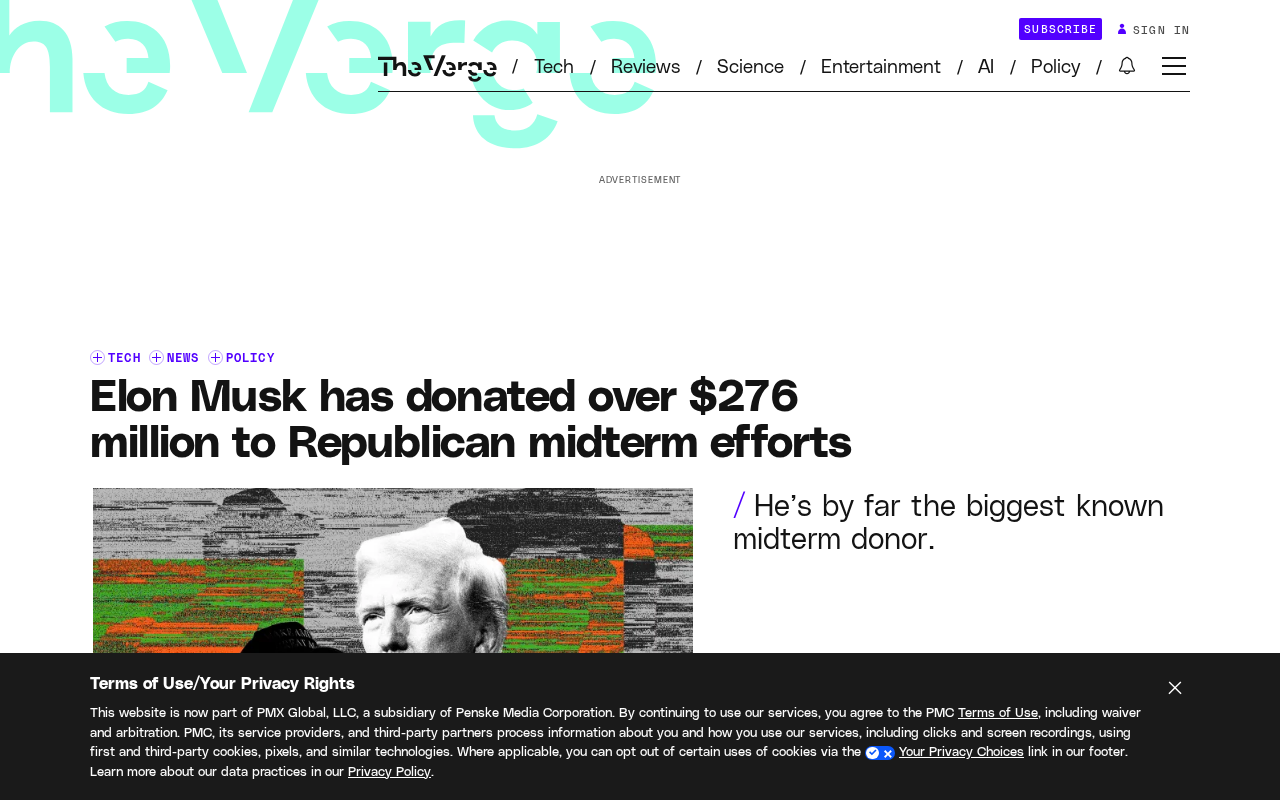
According to The New York Times, since July, Elon Musk has donated at least $276 million to Republican-affiliated groups, making him the party's largest known donor and the biggest establishment donor of this midterm election cycle. Of that total, $158 million flowed into Senate-related campaign activities, ranking it among the largest political donations in U.S. history.
A Record-Breaking Political Bill
What does $276 million actually mean? It exceeds the annual net profit of most publicly traded companies, and far surpasses the常规 budgets of leading political action committees (PACs) in traditional energy, finance, and other industries. More critically, this money was deployed within just a few months—a pace and scale rarely seen in the history of American political giving.
The $158 million directed to Senate races means Musk wasn't spreading support broadly, but rather making precise bets on key seats capable of directly shaping the legislative landscape. Control of the Senate determines whether bills pass and whether regulatory appointments are confirmed—matters that are highly relevant to the core interests of Musk's companies, including Tesla, SpaceX, and X.
Political action committees (PACs) are a central vehicle in the U.S. political donation system. Under federal law, individuals face strict limits on direct contributions to a single candidate ($3,300 per candidate per person in the 2024 cycle), but PACs and "super PACs" can bypass this restriction. Super PACs were born after the 2010 Citizens United v. FEC ruling, which allowed corporations, unions, and individuals to contribute unlimited amounts, as long as those funds are not directly coordinated with a candidate's campaign team. For this reason, the $276 million was not deposited directly into any candidate's account, but distributed across multiple PACs and super PACs. This mechanism enables ultra-wealthy individuals to exert systemic influence over the electoral landscape far beyond that of ordinary voters—and it sits at the heart of ongoing debates over campaign finance reform.
Why Are Tech Leaders Starting to "Go Big" on Politics?
Traditionally, Silicon Valley has preferred to influence policy through industry associations or low-key lobbying. But in recent years, friction between tech companies and federal regulators has escalated: antitrust lawsuits, autonomous driving safety reviews, social media content regulation, space launch licenses... each of these could have a substantive impact on Musk's business empire.
Pouring huge sums directly into campaigns is a more direct form of political participation than lobbying. It not only helps friendly candidates get elected, but also establishes an "unignorable" presence in Washington—when a lawmaker knows a donor has spent tens of millions of dollars supporting their campaign, the threshold and tone of communication between the two sides changes.
Comparison with Historical Donors
American political history has no shortage of major donors, such as financier George Soros and casino magnate Sheldon Adelson. But Musk's uniqueness lies in this: he is simultaneously the head of core companies in multiple regulated industries, and the policy issues his donations target are highly correlated with his own business interests. This "entrepreneur as donor" model is still rare in the tech sector.
The Koch Brothers are an important reference point for understanding the scale of this donation cycle. Charles Koch and the late David Koch, through networks such as Americans for Prosperity, invested hundreds of millions of dollars cumulatively between 2012 and 2020 to support conservative candidates and causes, and are widely regarded as the most systematic donor network behind the Republican Party. Unlike Musk, the Koch family's political investment was built on the energy and chemical industries, and formed a complete policy influence infrastructure through long-established think tanks and grassroots organizations. Musk's current approach leans more toward "concentrated firepower, rapid deployment," and has not yet built a durable political architecture comparable to the Koch network. In addition, Sheldon Adelson invested about $100 million in a single cycle in 2012, once regarded as the benchmark for individual political donations; Musk's $276 million this round has pushed that record substantially higher.
Controversy and Concerns
Such concentrated political donations inevitably spark discussion. On one hand, supporters see it as entrepreneurs exercising their civic rights; on the other, critics worry that a single individual's influence over election outcomes may be too great, potentially distorting policymaking toward specific commercial interests.
Interestingly, the specific allocation of the $158 million flowing into Senate races, the list of beneficiary candidates, and the issues on which those candidates would intersect with Musk if elected remain key points worth tracking going forward.
For observers focused on the intersection of tech and policy, this donation marks a turning point: tech giants are no longer content to influence policy behind the scenes, but are choosing to step into the political spotlight.
Federal campaign finance law has obvious structural loopholes in regulating individual donations. Although the law prohibits donations from foreign nationals and requires disclosure of donor identities, in practice super PACs can route funds through nonprofit organizations (such as 501(c)(4) social welfare groups) as "dark money," making the source of funds difficult to fully trace. Critics point out that when a single individual can pour hundreds of millions of dollars into multiple super PACs, the existing disclosure system is effectively hollow—voters cannot fully understand who is really standing behind a candidate. The Supreme Court's 2010 Citizens United ruling recognized political donations as "free speech" protected by the First Amendment, which fundamentally limits Congress's room to legislate strict caps. Therefore, the controversy surrounding Musk's donations is essentially not just about one person's actions, but about whether the entire system can still effectively prevent excessive wealth from permeating politics.
The Demonstration Effect on the Tech Industry
Musk's big spending could trigger a chain reaction. When one tech leader proves that massive political investment can buy policy influence, will other company founders follow suit? Will the tech industry's model of political participation shift from "lobbying first" to "campaign donations first"?
The answers to these questions will determine the direction of U.S. tech regulation in the coming years. What is certain is that $276 million is only the beginning—the boundary between tech and politics is being redefined.
Senate control became the focus of this donation cycle because of the special power structure of the U.S. legislative branch. The Senate has the power to confirm cabinet members, federal judges, and regulatory agency heads nominated by the president, and also holds the final vote on legislation. For Tesla and SpaceX, the Senate determines the personnel direction and budget scale of key regulatory agencies such as the Federal Trade Commission (FTC), the National Highway Traffic Safety Administration (NHTSA), and the Federal Aviation Administration (FAA)—agencies directly responsible for antitrust review, autonomous driving safety standards, and space launch licenses. Compared with the House, the Senate has fewer seat changes and each seat carries greater policy leverage, so the concentrated deployment of $158 million can be understood as a kind of "leverage investment": using a limited number of seats to maximize regulatory influence.
One-line Summary
Musk donated at least $276 million to Republicans, with $158 million going to Senate races, setting a U.S. political donation record.
Paragraph Summary
Since July, Elon Musk has donated at least $276 million to Republican-affiliated groups, becoming the party's largest known donor and the biggest establishment donor of this midterm election cycle. Of that, $158 million flowed into Senate campaign activities, ranking among the largest political donations in U.S. history. The article analyzes the deeper motivations: friction between tech companies and federal regulators continues to escalate in areas such as antitrust, autonomous driving, social media content, and space licenses, making direct campaign donations a more direct form of political participation than traditional lobbying. Unlike traditional donors such as Soros and Adelson, Musk is simultaneously the head of companies in multiple regulated industries, and the policy issues his donations target are closely tied to his own business interests. The article notes that this move could trigger a chain shift in the tech industry's model of political participation, from behind-the-scenes lobbying to direct campaign donations.
Related articles

@ai-sdk/vue 3.0.306 Patch Release Syncs with [email protected] Update
@ai-sdk/vue 3.0.306 released, synced with [email protected]. A routine patch release for the Vercel AI SDK ecosystem with no public API changes; the Vue adapter layer stays version-aligned with the core package.

Gemini 4 Argon API Launches: The Era of Million-Token Output Begins
Google launches Gemini 4 Argon with sparse MoE architecture, up to 1M output tokens, and a 68.90% Vals Index score, available across API, AI Studio, and the Gemini app.

DukaanAI: Turning Product Photos into Inventory Lists with Open-Source AI
DukaanAI is an AI inventory tool for small retailers that turns product photos into inventory entries using the open-source Gemma 3 model, with local inference, editable fields, and CSV export.