Musk's $60B Cursor Acquisition: AI Coding Data Becomes the New Battleground for Superintelligence

Musk's $60B Cursor acquisition reveals coding data has become a strategic asset in the superintelligence race.
Using Musk's $60 billion Cursor acquisition as a starting point, the article argues high-quality coding data has upgraded from training material to strategic asset, with only OpenAI, Anthropic, and Cursor truly holding enough. It covers AI coding tools' high adoption and rapidly reshuffling market, cites Harvard research revealing rising code commits but review bottlenecks and stagnant delivery. It also analyzes layoffs and skill polarization, US-China ecosystem differences, argues coding is the touchstone and fuel for superintelligence, and advises developers to stay flexible and deepen business judgment.
Musk's $60B Cursor Acquisition: AI Coding Data Becomes the New Battleground for Superintelligence
When Musk acquired Cursor for $60 billion, the competitive logic of the entire AI coding track underwent a fundamental shift. Behind this deal is an industry consensus that high-quality coding data has upgraded from "training material" to "strategic asset." According to an in-depth analysis by a Bilibili tech creator, only three organizations globally truly possess sufficient coding training data: OpenAI, Anthropic, and Cursor—with Google barely qualifying as a player.
Why Coding Data Is More Precious Than the Model Itself
Musk's explanation for the acquisition was straightforward: advancing superintelligence requires massive training data, and coding data sits at the core. This judgment is not unfounded—high-quality code makes up an extremely small fraction of internet text. What's truly valuable is the decision-making process of "why write it this way," code review comments, and the complete thought process behind bug fixes. The vast majority of this data is buried in enterprise private repositories and is nearly impossible to obtain externally.
What makes Cursor special is that it's embedded directly in developers' IDEs, generating 150 million lines of enterprise code daily, with more than two-thirds of Fortune 500 companies using it. It doesn't just record the final code—it captures every decision, modification, and feedback throughout the development process. This full-chain data is irreplaceable for improving AI coding capabilities.
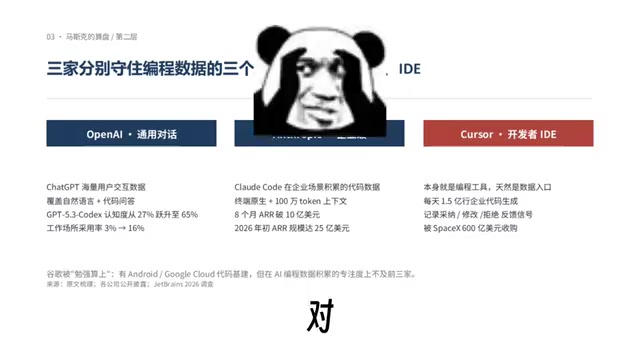
The three companies Musk named happen to represent the three core sources of coding data: OpenAI relies on the massive user conversation interaction data accumulated through ChatGPT; Anthropic focuses on enterprise-grade code assistants, holding extensive real-world company code usage data; Cursor, as an IDE-embedded tool, directly captures the complete context and workflow of developers as they write code. Although Google possesses code infrastructure like Android and Google Cloud, it lacks comparable focus on specifically collecting and leveraging AI coding data.
"Coding training data" does not merely refer to public code repositories (such as open-source projects on GitHub). For training AI with engineering capabilities, what's more valuable is the "process data" behind the code: commit messages, discussions and modification suggestions in code reviews, problem localization and fix records in issue tracking systems, and multi-turn conversations between developers and AI assistants. This type of data reveals tacit knowledge such as "why write it this way," "where errors are likely," and "how to refactor more reasonably"—things that pure code text cannot provide. Such data in enterprise private repositories is typically subject to compliance and security constraints, making it difficult to circulate publicly. Therefore, companies that control the entry point hold a structural advantage.
AI Coding Adoption Far Exceeds Imagination
If you still think AI coding is a novelty, you may already be behind industry reality. The AI4SE Industry Status Survey Report released by the China Academy of Information and Communications Technology in 2026 shows that about 85% of developers worldwide have integrated AI coding tools into their daily work, and 55% frequently use AI Agent mode for development. AI-assisted code now accounts for 42% of all new code. There are approximately 108 million developers worldwide, about 40 million are willing to pay for AI tools monthly, and 90% of Fortune 100 companies are using them.
A 2026 JetBrains survey of over 15,000 professional developers worldwide further confirms this trend: about 90% use AI coding agents at least once a week, and 68% use them daily. This adoption speed is extremely rare in the history of software tools.
The market size is also expanding rapidly. Model Intelligence predicts the global AI coding tools market will grow from $9.3 billion to $30 billion by 2031, with a compound annual growth rate of 26%. Research and Markets forecasts the AI code generation segment will grow at a 37.39% CAGR from $11.8 billion in 2025 to $78.97 billion by 2031.
Competitive Landscape Rapidly Reshuffling
CB Insights statistics show that the top three companies have already captured over 70% of the market: Microsoft GitHub Copilot, Anthropic's Claude Code, and AnySphere's Cursor, all with annualized recurring revenue exceeding $1 billion. But their positions are not stable—Claude Code's usage surged from 18% in January 2026 to 39% in May-July of the same year, while GitHub Copilot dropped from 29% to 21%, and Cursor slid from 18% to 12%. Such dramatic changes within a few months indicate the market landscape is rapidly reshaping.
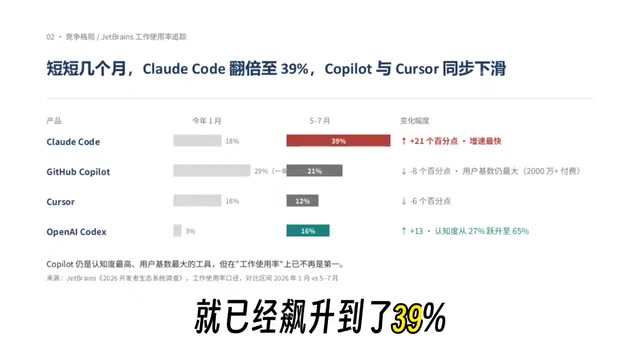
GitHub Copilot still leads in user volume with over 20 million global paying users, deeply integrated with VS Code and JetBrains, with about 90% coverage among Fortune 100 companies. But the JetBrains survey found that despite Copilot's highest brand awareness, its actual usage share is no longer first. Claude Code, with its terminal-native architecture and 1 million token context window, can understand an entire codebase at once, making it particularly suitable for large-scale project refactoring and architecture adjustments.
Among startups, Cognition—the company behind Devin—completed a $2 billion funding round at a post-money valuation of $48 billion, with annualized revenue rising to $900 million. The approaches of various companies are clearly diverging: Devin focuses on autonomous agents, Cursor emphasizes collaborative editing experience, Claude Code places its core competitiveness on model capabilities themselves, and GitHub Copilot takes an ecosystem gateway strategy—no single company has achieved absolute dominance.
Annual Recurring Revenue (ARR) is the core metric for measuring the business health of SaaS-type AI coding tools. It refers to the annualized value obtained by multiplying current monthly recurring revenue by 12, used to smooth seasonal fluctuations and facilitate cross-comparison. ARR exceeding $1 billion is typically regarded as a marker of "unicorn-level" business scale. It should be noted that ARR does not equal actual recognized revenue, nor does it reflect gross margin—AI coding tools may have significantly lower gross margins than traditional software due to high inference costs, so high ARR does not necessarily equate to high profitability.
The Real Picture of Efficiency Gains
AI coding tools do make writing code faster, but Harvard researchers analyzing data from over 700 companies and more than 700,000 developers found that after introducing AI coding agents, code commit volume increased by an average of 30%, but code review time lengthened by 49%, pull requests requiring modification nearly doubled, comments per pull request increased by 35%, and ultimately software feature delivery showed no significant improvement—nor did developer headcount change.
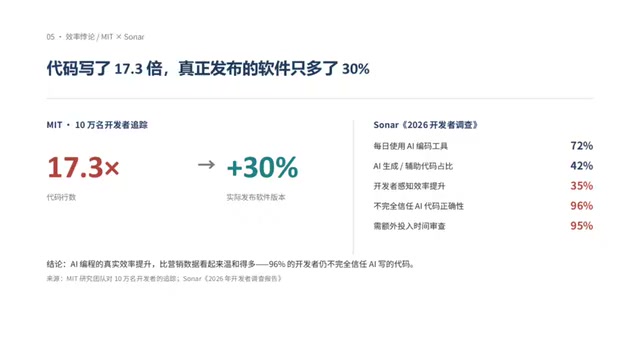
The coding phase became cheaper, but verification and review became the new bottleneck. Developers still spend about a quarter of their time on low-efficiency tasks—they've just shifted from repeatedly writing code to repeatedly checking code. A Sonar survey shows 72% of developers use AI coding tools daily, with AI-generated or assisted code accounting for 42%, but the actual perceived efficiency gain is only 35%. 96% of developers do not fully trust AI-generated code, and 95% say they need extra time to review it. An MIT team tracking 100,000 developers found that with AI, lines of code can reach 17.3 times the original, but software release versions only increased by 30%—a lot of code written, but not that many new features actually shipped.
A "Pull Request (PR)" is a core mechanism in code collaboration: after a developer completes changes on a separate branch, they initiate a merge request to the main repository, where colleagues conduct code review, comment, and approve. The number of PRs, comment counts, and review duration are often used as metrics for development process efficiency. After AI coding agents dramatically increase code commit volume, PR numbers swell accordingly, and the review phase becomes the new bottleneck—reviewers need to understand more AI-generated code in less time, leading to longer review times and more revision rounds. This explains why code commit volume rises while final feature delivery does not grow in tandem.
Developer Jobs and Skill Polarization
According to layoffs.fyi, global tech industry layoffs exceeded 120,000 in the first half of 2026, already matching the full-year total for 2025, with most directly related to AI technology adoption. Google revealed at its 2026 Cloud Next conference that nearly 75% of internally written code is now AI-generated, compared to just 15% two years ago.
An Anthropic report points out that the programmer profession will not disappear, but those who can only write code will be gradually phased out. AI has taken away the most basic coding work from junior programmers. What's truly valuable in the market is the ability to understand the business, know what problems need solving, and handle system architecture and technology selection.
AI's impact on developers at different levels varies significantly: less active developers can improve efficiency by 85% with AI, while those who are already highly skilled and commit large amounts of code daily see only a 21% improvement. AI is leveling the capability gap, but the judgment and creativity of top programmers remain difficult for machines to replace.
Ecosystem Differences Between China and US Markets
The biggest difference between the Chinese and US markets is that the US has startups and big tech competing together, while China is almost entirely dominated by big tech. In 2025, China's AI coding market was 399 million yuan, projected to reach 1.173 billion yuan by the end of 2026. Alibaba's Tongyi Lingma holds a 47.6% share—more than the combined total of the second through fifth place. Zhipu CodeGeeX, SenseTime Raccoon, Tencent CodeBuddy, and Baidu Comate all lag far behind. There are almost no independent startups that have grown large in China, because the core remains large model R&D capability, and these capabilities are almost entirely in the hands of big tech.
Big tech's promotional results are impressive: Coder's global users exceed 5 million, serving hundreds of thousands of enterprises including FAW, CITIC Securities, and AsiaInfo; over 90% of Tencent's engineers use AI coding assistants, with more than half of new code completed by AI, and average coding time reduced by over 40%; over 92% of Kuaishou employees use the company's self-developed AI Agent products, with 60% of R&D staff code generated by AI.

Whether in China or the US, AI coding tools are transitioning from simple code completion plugins to full-lifecycle software productivity platforms, covering requirements analysis, coding, testing, deployment, and operations. IDC analysts emphasize that future AI coding will not just help you write code, but participate in every stage of software development.
The Touchstone and Fuel for Superintelligence
Coding capability is crucial to superintelligence because it is an easily quantifiable and verifiable domain—whether code runs, whether bugs decrease, whether development cycles shorten are all clear metrics. If an AI cannot even code well, it's hard to believe it can perform well in more complex domains.
More critically, coding data is the core fuel for training superintelligence. When AI can write high-quality code, it can automatically adjust model parameters, optimize training processes, and even design entirely new architectures, forming a positive feedback loop: more powerful AI produces more data, and more data trains more powerful AI. OpenAI conducted an experiment where, without retraining the model or having engineers manually optimize code, merely letting the AI system self-improve over six weeks raised model accuracy from 25% to 86%. The release notes for GPT-5.3 Codex also mention that earlier versions of the model were already used by the team to debug training processes, manage deployments, and diagnose test results—AI is already helping humans build better AI.
"AI self-improvement" refers to the process by which a model or agent system improves performance on specific tasks through self-generated data, self-evaluation, and self-correction without retraining the base model. OpenAI's experiment is a typical case of "inference-time self-improvement": letting the model repeatedly generate candidate solutions, execute verification, and adjust strategies based on feedback over six weeks, raising accuracy from 25% to 86%. This capability is strongly correlated with coding because coding tasks naturally provide executable verification signals (whether code passes tests), enabling AI to form a "generate—verify—correct" loop. If this loop can be replicated in more complex domains, a positive feedback cycle of accelerating capability improvement could emerge.
How Developers Should Respond
In the face of rapid change, whether you're a large company, small team, or individual developer, the most important thing is to stay flexible, not limit yourself, and be ready to try new tools at any time. MongoDB CEO CJ Desai said he will not be locked into any single AI tool vendor long-term, and will switch based on market performance, using multiple products to meet needs.
Industry changes are too fast—code editors may have disruptive updates next month, the way we write code may completely change, and even the definition of coding itself is constantly evolving. But one thing will not change: understanding of the business, judgment, and the willingness to take responsibility for results will always be the most valuable.
Related articles

Chain of Thought Isn't Just for AI: How Humans Can Use CoT to Improve Thinking Quality
Chain of Thought isn't just a prompt trick for large models. Starting from a Hacker News discussion, this article analyzes why CoT works for human thinking too, breaks down actionable ways to transfer it, and highlights the key differences between human CoT and machine CoT.
Cloudflare Teams Up with OpenAI: Closi…
Cloudflare Teams Up with OpenAI: Closing the Loop from Vulnerability Discovery to Defense with AI
Cloudflare uses OpenAI Daybreak to investigate security vulnerabilities and generate reviewable remediation plans, while developers use Codex to boost coding efficiency and quality.

Orca Multi-Agent Orchestration in Practice: A Guide to Parallel Collaboration with Claude and Codex
Orca is Stable AI's free open-source agent workbench supporting 34 agents like Claude Code and Codex in parallel. Learn its Git worktree isolation, multi-model orchestration, and mobile management.