Must-Read for Quality Engineers: A Practical Guide to Structured Data Extraction with Generative AI
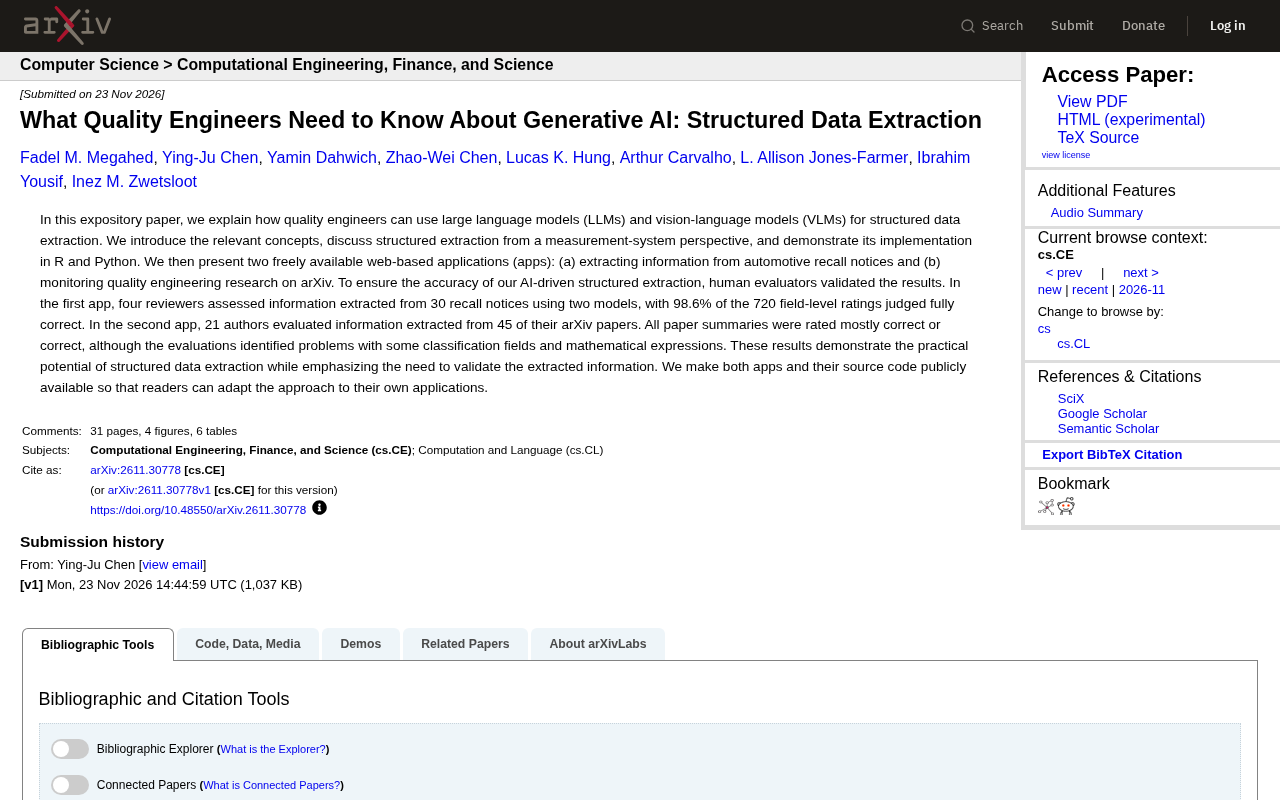
The paper examines generative AI structured extraction from a measurement perspective and stresses human validation.
This article introduces a paper on how quality engineers can use generative AI to extract structured data from unstructured text. The paper treats AI extraction as a measurement process, with the model as the measuring instrument, and extraction results must be validated by humans. The authors developed two free web applications: one extracts information from automotive recall notices, where 98.6% of 720 field-level ratings across 30 notices were completely correct; the other monitors quality engineering papers on arXiv, where abstracts were mostly correct but classification fields and mathematical expressions had some issues. The paper provides R and Python implementations and public source code, emphasizing MSA-like processes for continuous quality monitoring and using AI extraction as an auxiliary tool rather than a full replacement for human review.
Generative AI is moving from experimentation to engineering practice. How can quality engineers use it to extract reliable structured data from unstructured text? A paper provides the answer. The authors not only explain the relevant concepts but also examine structured extraction from a measurement system perspective, demonstrate implementations in R and Python, and finally validate the results through two free web applications.
Viewing AI Extraction from a Measurement System Perspective
The paper treats structured data extraction as a measurement process: the model is the measuring instrument, and the extraction results are the measured values. This perspective reminds us that every measurement has error and must be validated through human evaluation. The authors emphasize that the accuracy of LLM and VLM outputs must be checked by humans and cannot be trusted directly.
Measurement System Analysis (MSA) is a core method in quality management used to assess whether the variation of the measurement system itself is within an acceptable range. A typical MSA includes repeatability (the consistency of multiple measurements of the same object by the same operator) and reproducibility (the consistency of measurements of the same object by different operators), often quantified through Gage R&R studies. When treating LLMs/VLMs as measuring instruments, model versions, prompt design, temperature parameters, and other factors all introduce sources of variation analogous to "operators" and "equipment." Therefore, the "human evaluation validation" recommended by the paper is essentially an Attribute Agreement Analysis—having multiple reviewers independently judge the extraction results and then computing inter-rater agreement metrics (such as Cohen's Kappa or Krippendorff's Alpha) to determine whether the reliability of the AI extraction system meets quality requirements.
Two Application Cases
The authors developed two web applications: one extracts information from automotive recall notices, and the other monitors quality engineering research on arXiv. In the first application, four reviewers used two models to evaluate the extraction results of 30 recall notices. Of 720 field-level ratings, 98.6% were judged completely correct. In the second application, 21 authors evaluated the extracted information from their own 45 arXiv papers. All paper abstracts were rated as "mostly correct" or "correct," but the classification fields and mathematical expressions had some issues.
Automotive recall notices are typically issued by manufacturers or regulatory agencies (such as the U.S. NHTSA) and contain fields such as recall number, affected vehicle models, production years, defect description, risk level, and remedial measures. This information is scattered across unstructured text, making manual compilation time-consuming and error-prone. arXiv is a preprint server for fields such as physics, mathematics, and computer science. Quality engineering papers are distributed across multiple categories (such as stat.AP and eess.SY), requiring continuous monitoring of new submissions. The two cases represent two typical scenarios—"batch structuring of historical documents" and "streaming literature monitoring"—covering the common information extraction needs of quality engineers.
Implementation and Tools
The paper provides example implementations in R and Python and releases the application source code so readers can adapt it to their own scenarios. Although specific code details are not given, the authors emphasize that these tools are freely available and designed to be reproducible.
The paper uses dual-language implementations in R and Python, mainly because both languages are widely used in the quality engineering community: R has a mature ecosystem for statistical analysis and MSA (such as the SixSigma package), while Python is more convenient for calling LLM APIs (such as the OpenAI and Anthropic SDKs) and building web applications (such as Streamlit and Shiny). Although the article does not show specific code, the source code released by the authors typically includes prompt templates, API call wrappers, and result parsing and scoring scripts; readers need to configure their own API keys and model endpoints. The reproducibility design means that random seeds are fixed in the source code (e.g., setting temperature=0) and model version numbers are recorded for subsequent reproduction and auditing.
Key Lessons
These results demonstrate the practical potential of structured data extraction but also highlight the necessity of validation. When deploying such AI tools, quality engineers should establish processes similar to Measurement System Analysis (MSA) to continuously monitor extraction quality.
The paper ultimately recommends using AI extraction as an auxiliary tool rather than a complete replacement for human review, especially when critical quality data is involved.
One-line Summary
The paper examines generative AI structured extraction from a measurement system perspective, validates it with two web applications, and emphasizes the necessity of human validation.
Paragraph Summary
This article introduces a paper on how quality engineers can use generative AI to extract structured data from unstructured text. The paper treats AI extraction as a measurement process, with the model as the measuring instrument, and the extraction results must be validated by humans and cannot be trusted directly. The authors developed two free web applications: one extracts information from automotive recall notices, where 98.6% of 720 field-level ratings across 30 notices were completely correct; the other monitors quality engineering papers on arXiv, where 21 authors evaluated 45 papers and abstract extraction was mostly correct, but classification fields and mathematical expressions had some issues. The paper provides R and Python implementations and public source code, emphasizing that processes similar to Measurement System Analysis (MSA) should be established to continuously monitor extraction quality, and that AI extraction should be used as an auxiliary tool rather than a complete replacement for human review.
Related articles

From 0 to 1: Vibe Coding an AI Knowledge Base — A Practical Retrospective and Tech Stack Breakdown
A retrospective on building the AI knowledge base OilBook from scratch with Vibe Coding: Next.js+Neon stack, Oil Dev Skill workflow, Stripe paywall security, interview-style writing, AI-flavor control, and Vercel deployment.

GLM-5.4 Hands-On: Native Vision Meets a New Vibe Coding Workflow
Hands-on with Zhipu GLM-5.4: native vision tested across a 3D product demo, pure-code video generation, and remote-control Vibe Coding, compared with GPT-6.2 and Gemini Neon.

AI and Humans Claim to Prove the Riemann Hypothesis: Machine-Verified, Yet Nobody Can Understand It
Anthropic mathematician and AI Claude claim to prove the Riemann Hypothesis with 17 million lines of Lean code, machine-verified but unreadable by humans. This article analyzes the event, the zero proportion record from 41.6% to 67.2%, and the gap between machine verification and human understanding.