Mxc 1.0.0 Released: A First Look at Microsoft Execution Containers

Mxc 1.0.0 quietly debuted on Hacker News — minimal info, but its secure sandbox direction is gaining relevance with AI code execution.
A project called Mxc (Microsoft Execution Containers) made its 1.0.0 debut on Hacker News with only 13 upvotes, zero comments, and virtually no public documentation. The article analyzes the broader "execution containers" space: lightweight isolated runtimes that sit between traditional VMs and standard Docker containers, designed to safely run untrusted code. As AI Agents increasingly generate and execute code autonomously, demand for such sandbox infrastructure continues to rise. A mature solution must balance isolation, performance, and usability. With no benchmarks or comparisons to gVisor, Firecracker, or Kata Containers available, Mxc should be treated as an early-stage project until community feedback emerges.
Background: Mxc 1.0.0 Release
Recently, a project called Mxc (Microsoft Execution Containers) appeared on Hacker News, marked as a 1.0.0 official release. Based on its name, this appears to be a technical solution built around the concept of "execution containers," targeting scenarios that require running code or workloads inside isolated environments.
Publicly available information remains extremely limited — the Hacker News post received only 13 upvotes and 0 comments, with no detailed project description, documentation screenshots, or architecture diagrams attached. The specific technical details of Mxc have yet to be disclosed. This article offers a preliminary overview based on existing information, supplemented by a broader analysis of the "execution containers" technical direction.
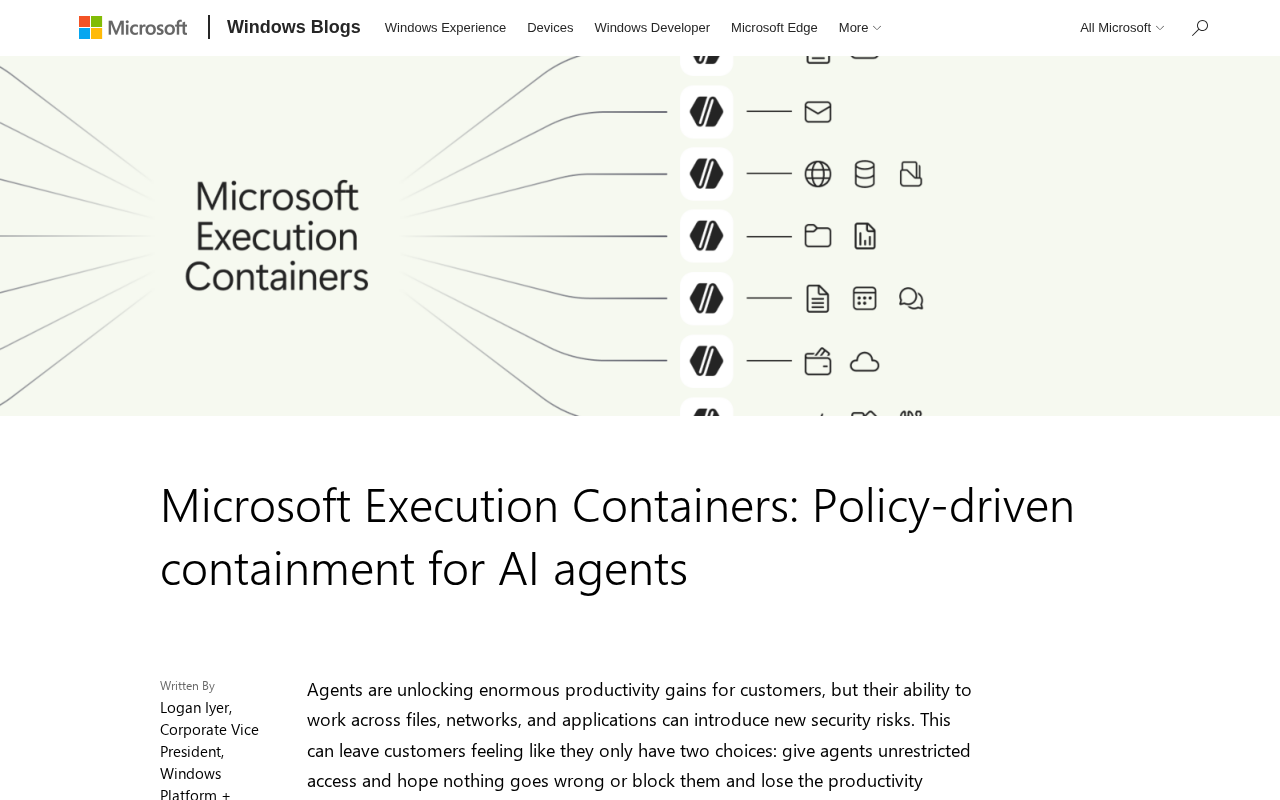
What Are Execution Containers?
"Execution Containers" typically refer to lightweight, isolated runtime environments designed to safely execute untrusted code or resource-constrained workloads. Compared to traditional virtual machines, these containers generally prioritize faster startup times and lower resource overhead. Compared to standard Docker containers, they may incorporate additional design choices around security boundaries, sandbox isolation, or integration with specific platforms.
Judging by Mxc's full name, it likely has ties to the Microsoft ecosystem and targets the need to rapidly spin up isolated execution environments in the cloud or on-premises. This type of technology is especially common in the following scenarios:
- Underlying runtimes for cloud functions and Serverless platforms
- Isolated code execution in multi-tenant environments
- Scenarios requiring temporary sandboxes, such as AI code execution, online judging systems, and CI/CD pipelines
It's worth emphasizing that the above are reasonable inferences based on naming and technical category — they are not officially confirmed capabilities of the Mxc project.
Why Execution Containers Deserve Attention
With the rise of AI Agents and automated code execution, "how to safely run code generated by models or submitted by external parties" has become an increasingly pressing engineering challenge. Execution containers are one of the key pieces of infrastructure that address this pain point.
A mature execution container solution typically needs to strike a balance across three dimensions:
Isolation
Ensuring that executed code cannot break out of the sandbox to access the host system or other tenants' data — this is the core of security.
At the implementation level, isolation mechanisms generally fall into several layers: process-level isolation using Linux namespaces and cgroups (as used by standard Docker containers); sandboxes that intercept system calls via a user-space kernel (such as gVisor's ptrace/KVM modes); and VM-level isolation backed by hardware virtualization (such as Firecracker and Kata Containers). The security boundary strengthens progressively across these three approaches, but so do startup overhead and scheduling complexity. The choice of layer fundamentally comes down to a trade-off between "attack surface size" and "runtime efficiency." For multi-tenant environments or scenarios executing untrusted code, relying solely on namespace isolation is generally considered insufficient, as the kernel's attack surface remains exposed to tenant code.
Performance
Startup latency, memory footprint, and throughput directly determine whether a solution can support highly concurrent, short-lived workloads — a hard requirement in Serverless scenarios.
Usability and Integration
Compatibility with existing toolchains, orchestration systems (such as Kubernetes), and development workflows often determines whether a project sees widespread adoption.
If Mxc can find a competitive balance among these three dimensions, it will hold real practical value in this space.
Limitations of Current Information
As of now, public discussion around Mxc 1.0.0 remains sparse, and the community has yet to conduct any in-depth evaluation. Without documentation, code examples, or benchmark data, it's impossible to accurately compare its performance, security model, or differentiation from similar projects such as gVisor, Firecracker, and Kata Containers.
For developers interested in this direction, the recommendations are:
- Follow the project's official repository and documentation for updates
- Wait for the community to accumulate real-world feedback before evaluating whether to adopt it in production
- Compare it against existing mature solutions based on your own isolation and performance requirements
As a reference point, several relatively mature execution container and sandbox solutions are worth knowing about: gVisor is Google's open-source user-space kernel sandbox that achieves isolation by intercepting system calls — it excels in security but incurs some performance overhead. Firecracker, also from AWS, is a microVM monitor built for Lambda and Fargate that achieves hardware-level isolation via KVM, with startup times compressible to under 125 milliseconds, balancing both security and performance. Kata Containers combines the OCI container interface with lightweight virtual machines, aiming for seamless compatibility with the Kubernetes ecosystem. The common trend across all three is the convergence of VM-level security boundaries with the lightweight experience of containers. For Mxc to differentiate itself in this space, it will need to present compelling data on startup latency, memory baseline, and depth of integration with the Windows/Azure ecosystem.
Summary
The release of Mxc 1.0.0 reflects continued interest in "secure execution containers" as a foundational infrastructure direction. As the wave of AI-driven automated code execution grows, the importance of tools like this will only increase. However, based on currently available information, Mxc is still in its early exposure stage — its true capabilities and positioning require further validation through official documentation and community practice. We will continue to follow the project's progress.
Related articles

Chain of Thought Isn't Just for AI: How Humans Can Use CoT to Improve Thinking Quality
Chain of Thought isn't just a prompt trick for large models. Starting from a Hacker News discussion, this article analyzes why CoT works for human thinking too, breaks down actionable ways to transfer it, and highlights the key differences between human CoT and machine CoT.
Cloudflare Teams Up with OpenAI: Closi…
Cloudflare Teams Up with OpenAI: Closing the Loop from Vulnerability Discovery to Defense with AI
Cloudflare uses OpenAI Daybreak to investigate security vulnerabilities and generate reviewable remediation plans, while developers use Codex to boost coding efficiency and quality.

Orca Multi-Agent Orchestration in Practice: A Guide to Parallel Collaboration with Claude and Codex
Orca is Stable AI's free open-source agent workbench supporting 34 agents like Claude Code and Codex in parallel. Learn its Git worktree isolation, multi-model orchestration, and mobile management.