Mycel: One Past Deliverable, Every Future One Automated

Mycel automates service deliverable drafting with AI, sandbox isolation, and mandatory human approval.
Mycel is an AI automation platform for service businesses that topped Product Hunt on launch day. It learns from historical deliverables to auto-draft future ones — shifting human work from creation to review. Each task runs in a disposable, credential-free sandbox destroyed after use, preventing cross-client data leakage. All output requires human approval before reaching clients. Pricing starts at $299/month with a free self-hosting option.
The heaviest cost for service businesses isn't customer acquisition — it's completing similar projects from scratch, over and over: client communication, deliverable production, approvals, invoicing. Mycel, which topped Product Hunt on launch day, aims to automate this entire chain with AI while architecturally addressing the two most sensitive issues in service outsourcing: data isolation and human oversight.
What Problem Does Mycel Solve?
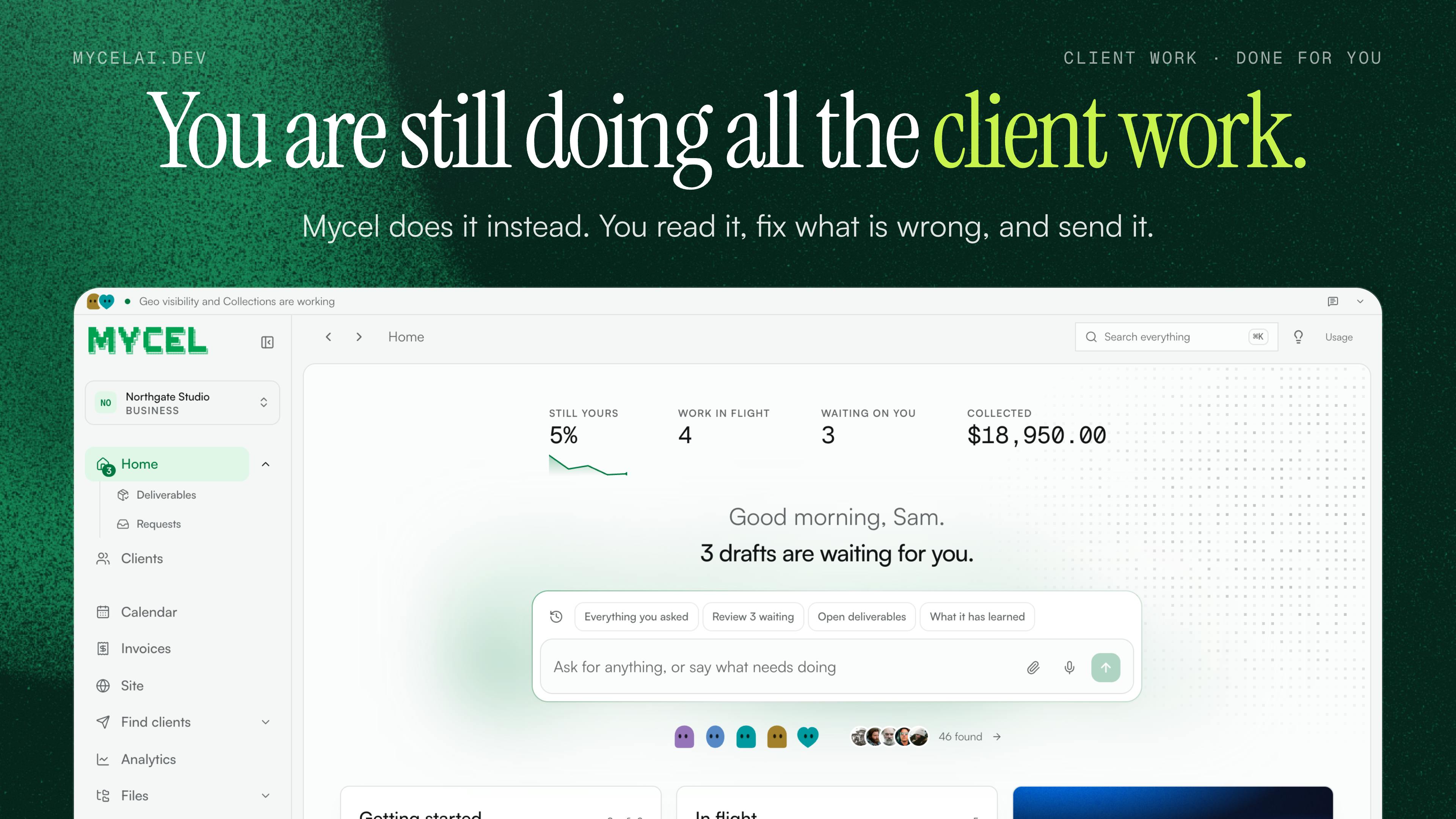
Mycel is an automation platform built for service businesses, designed to run the core workflows they sell directly to clients: client management, deliverable production, approval flows, and invoicing. Its product tagline is refreshingly direct — "Bring one past deliverable. Mycel drafts every future one."
This captures the platform's core logic: many service businesses are fundamentally repetitive. Consulting reports, design drafts, marketing plans, and legal documents tend to be highly similar in structure and style. Mycel learns from a company's existing historical deliverables, uses them as templates and style references, and automatically drafts the initial version of every subsequent similar project — shifting human effort from "creating from scratch" to "reviewing and refining."
Disposable Sandboxes: The Standout Security Design
For service businesses, client data confidentiality is non-negotiable. Mycel's approach here is worth noting: every task runs inside a disposable sandbox that never holds a credential.
This means that even if a task environment is compromised, attackers can't extract reusable API keys, account passwords, or other sensitive credentials. Once the task ends, the sandbox is destroyed — leaving no persistent attack surface. For agencies serving multiple clients simultaneously and requiring strict data separation, this "per-task isolation, zero credential persistence" model is far more robust than a traditional single high-privilege backend.
This also reflects a broader trend: as AI agents are granted increasingly real execution permissions, security boundary design is shifting from "after-the-fact auditing" to "default isolation at the architecture level."
The concept of a disposable sandbox draws from the "Principle of Least Privilege" in systems security. Traditional multi-tenant SaaS platforms often use a shared backend credential pool to connect external services (email systems, CRMs, cloud storage) — if credentials leak, attackers can potentially pivot across all customer data. The sandbox isolation approach dynamically generates a separate, permission-limited runtime environment for each task, destroys it completely after execution, and limits the attack surface to a single task's lifetime. This design has become more practical with the proliferation of containerization technologies (like Docker and gVisor) and FaaS (Function as a Service) architectures: each invocation is a stateless, independent instance that naturally carries no persistent cross-task state. For service businesses in law, finance, and consulting that handle highly sensitive client documents, this architecture more fundamentally cuts off data leakage paths than "after-the-fact permission auditing."
Human in the Loop: Mandatory Approval Before Delivery
Mycel's other hard rule: nothing reaches a client until you approve it.
This is a pragmatic choice. Current generative AI output still carries risks of factual errors, tonal inconsistencies, and formatting issues — sending AI-drafted deliverables directly to clients can cause serious commercial and reputational damage. Mycel positions itself as a "drafter," not a "decision-maker." AI handles the heaviest part — the initial draft — while humans retain final quality control and accountability.
This human-in-the-loop design preserves the efficiency gains of automation while keeping uncontrollable risk locked behind the client-delivery gate. It's currently one of the more mature deployment patterns for AI productivity tools.
"Human-in-the-Loop" (HITL) is a collaborative paradigm in AI system design where human intervention is mandated at critical decision points in automated workflows, rather than letting AI execute end-to-end autonomously. The concept was widely applied in machine learning model annotation and training, and has since extended — as generative AI enters business processes — to mean "reviewing and approving AI-generated content." The contrasting approach is "Human-on-the-Loop" — AI executes autonomously while humans provide only post-hoc supervision, suited to low-risk, easily reversible scenarios. Mycel's choice of the former is essentially using human approval as a backstop for AI uncertainty: current large language models still have systemic deficiencies in hallucination, stylistic consistency, and professional terminology accuracy. When a client-facing deliverable goes wrong, the cost of remediation and reputational damage far outweighs the saved labor. This design also makes Mycel easier to sell to conservative enterprise clients, because it doesn't ask them to "trust AI" — only to "let AI help draft."
Pricing and Deployment: SaaS and Self-Hosting Side by Side
Mycel offers two usage models:
- Cloud subscription: Starting at $299/month, ideal for teams that want out-of-the-box functionality without managing infrastructure.
- Self-hosting (free): The product listing references GitHub, indicating open-source or self-deployable capabilities — teams with strong technical resources or strict data sovereignty requirements can deploy it themselves and avoid subscription fees.
This dual-track model is increasingly common among developer-friendly tools: use free self-hosting to attract technical early adopters and build credibility, then monetize through managed hosting for enterprises that don't want to deal with operations. For service businesses, the self-hosting option also reinforces the data security narrative — data can stay entirely on your own servers.
Quick Take: A Product That Targets a Clear Pain Point
Mycel topping Product Hunt on launch day (151 upvotes, 20 comments) signals that it's addressing real demand. Service industry automation has long stalled at the project management and CRM layer, while the actual production of deliverables has remained labor-dependent. Mycel cuts AI directly into this most time-consuming step, and addresses enterprises' biggest concerns — security and quality — with sandbox isolation and human approval as two layers of defense.
One thing to watch: the product's effectiveness is heavily dependent on how well it generalizes from historical deliverables. Whether "one past deliverable" can reliably produce high-quality future drafts is the key value driver, and that requires real-world validation. For businesses with highly standardized deliverables (fixed-format reports, templated designs), Mycel's value could be immediately apparent. For highly customized, creativity-driven work, the practical benefit of AI-drafted output remains to be seen.
Overall, Mycel is a clearly positioned, security-conscious AI service automation effort — well worth the attention of service-oriented teams looking for something to try.
Related articles

JobRunner MCP Server: AI Agents Can Now Fix Failed Java Jobs
JobRunner launches an open-source MCP server enabling AI agents to view cluster status, diagnose failures, and recover Java jobs—incident response from any cloud coding environment or existing agent.

MLAI Digital Launches 9 Security Agents: MCP Server Safeguards the Full Lifecycle of Agentic AI
MLAI Digital launches Security MCP Server with nine built-in specialized security agents covering vulnerability discovery, attack simulation, prompt injection detection, API and infrastructure assessment, and accelerated remediation—embedding security validation across the full Agentic AI lifecycle from development to production.

Running Isaac Lab on H100 GPUs: Exploring Better Approaches
Exploring optimization methods for running Isaac Lab on NVIDIA H100 GPUs, including MIG configuration, mixed precision, TensorRT acceleration, and community experience to improve robotics simulation and reinforcement learning efficiency.