MyLens: AI-Powered One-on-One Live Presentations That Scale and Personalize
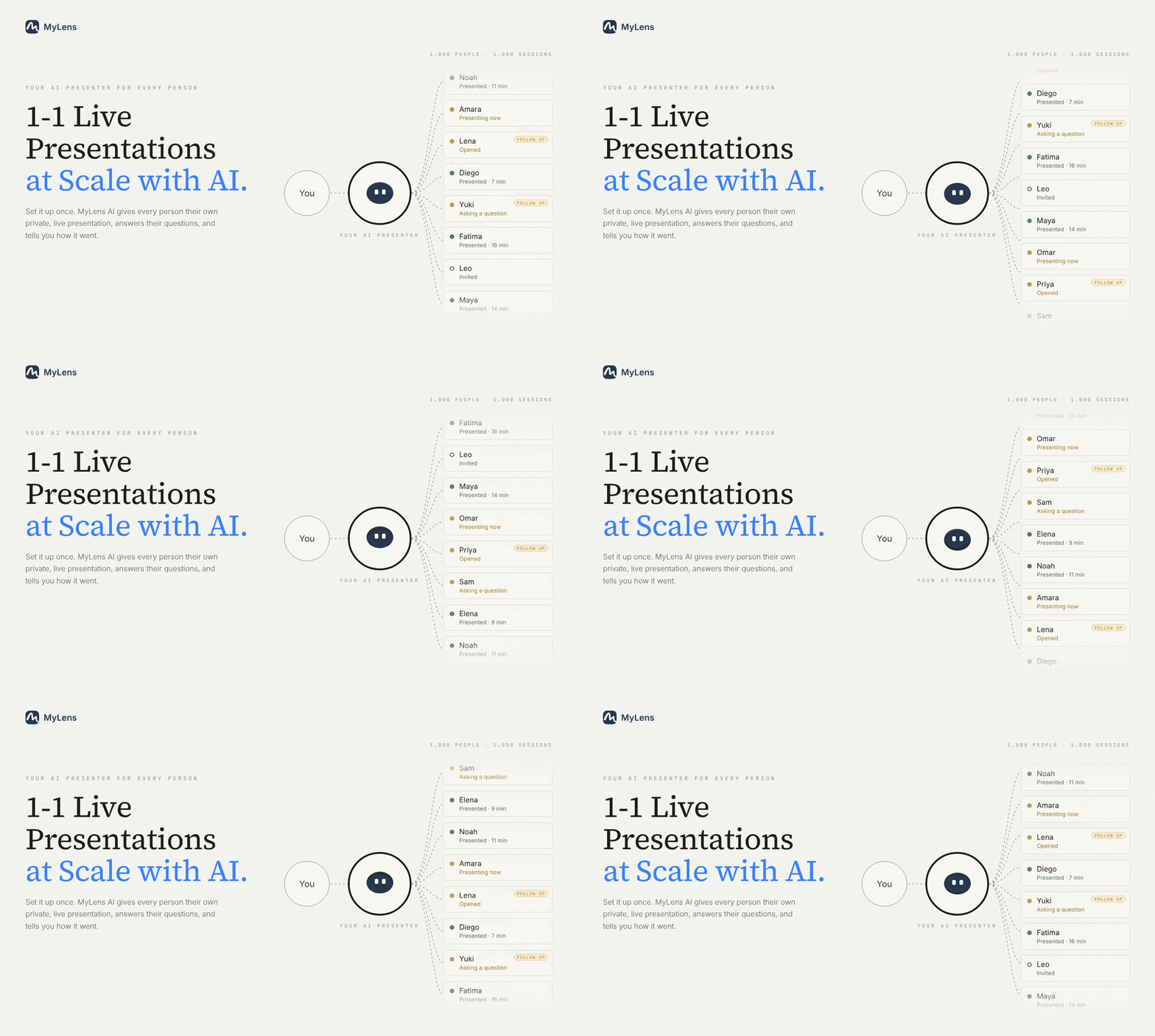
MyLens uses AI to generate personalized live presentations for each listener and closes the feedback loop.
MyLens is the second-ranked new product on Product Hunt, focusing on AI-powered one-on-one live presentations. After users upload documents or data, the AI generates a personalized presentation for each listener, dynamically adjusts content during the session, answers questions, and even creates new slides in real time. Afterward, the system provides performance analysis for each audience member, forming a closed loop from content generation to outcome evaluation. It targets online education, sales presentations, and corporate training. The article notes that unlike tools such as Tome and Gamma that focus on automatic slide generation, MyLens emphasizes real-time interaction and personalization, but real-time generation quality, dependence on source materials, and answer accuracy remain its main challenges.
In traditional presentations, speakers often deliver a one-size-fits-all talk to a group, making it hard to address each person's needs. MyLens, the second-ranked new product on Product Hunt, aims to change that: it uses AI to generate a private live presentation for each audience member, dynamically adjusting content, answering questions, and even creating new slides during the presentation.

Core Features: From Static Presentation to Dynamic Dialogue
MyLens's workflow is straightforward: users upload source materials (such as documents or data), specify what's important, and invite their audience. The AI then generates a personalized live presentation for each listener and answers their questions based on the uploaded materials. What's more distinctive is that the AI can create new slides and content layers in real time during the presentation, turning it from a one-way broadcast into a two-way interaction.
According to the Product Hunt page, MyLens's AI provides a detailed analysis report after the presentation, showing how each audience member performed: who grasped the material well, who struggled, and what to do next. This closed-loop feedback lets presenters continuously refine their content and strategy.
Multi-Source Cross-Validation: A New Direction for AI Presentation Tools
Although MyLens is a new product on Product Hunt, its concept aligns with recent trends in AI presentation tools. Other AI presentation tools (such as Tome and Gamma) focus mainly on automatically generating slides, whereas MyLens emphasizes real-time interaction and personalization. Based on Product Hunt comments and voting data (107 votes, 20 comments), early users have shown interest in its real-time generation and feedback features.
A detail worth noting: MyLens's claimed "real-time creation of new slides" is technically quite challenging, and its actual performance needs more user validation. Nevertheless, its closed-loop design—integrating materials, generating presentations, answering questions, and analyzing feedback—does offer new ideas for online education, sales presentations, and personalized training.
Tome and Gamma are AI presentation generation tools that emerged in 2022-2023, with core capabilities centered on automatically producing complete slide structures and visual designs from prompts or short text. The key difference from MyLens lies in the interaction model: Tome and Gamma follow an offline "generate once, edit afterward" paradigm, where presentation content is essentially fixed before playback begins; MyLens embeds generation capabilities into the presentation execution process, allowing content to change instantly with audience feedback. This difference imposes different requirements on the underlying architecture—the former can tolerate generation delays of tens of seconds, while the latter must complete inference and rendering within the pace of a conversation, relying more on streaming generation, incremental rendering, and low-latency inference services.
Use Cases: Education, Sales, and Training
MyLens positions itself as "one-on-one live presentations," making it particularly well-suited for the following scenarios:
- Online education: Teachers can generate customized lesson presentations for each student and supplement content in real time based on student questions.
- Sales presentations: Salespeople can deliver highly personalized product introductions to customers and answer their questions on the spot.
- Corporate training: Trainers can provide targeted training materials for each employee and track learning outcomes.
Product Hunt categorizes it under Productivity, Education, and Artificial Intelligence, which also confirms its applicability across multiple scenarios.
Challenges and Outlook
Although MyLens's concept is compelling, it faces several key challenges. First, generating high-quality slides in real time requires powerful AI models and low-latency infrastructure, setting a high technical bar. Second, the effectiveness of personalized presentations depends heavily on the quality and structure of the source materials. Finally, ensuring the accuracy of AI answers to avoid misleading the audience is another issue that needs to be addressed.
Currently, MyLens's specific pricing and availability are not detailed on its Product Hunt page, but the makers include Amin Zamani and others. As remote work and personalized learning needs grow, tools like MyLens could become an important addition to the presentation space.
The technical difficulty of real-time slide generation isn't just about model inference speed. A slide must simultaneously achieve reasonable layout, image-text alignment, and clear information hierarchy, which typically requires multi-stage processing—"content planning—layout selection—element arrangement"—and any step that takes too long will disrupt the coherence of the presentation. A common industry compromise is pre-generated templates and component libraries, letting the model handle only selection and filling rather than drawing from scratch; but this also limits generation flexibility. In addition, real-time Q&A requires the system to perform retrieval-augmented generation (RAG) on uploaded materials, first locating relevant passages before organizing answers, to reduce hallucination risk. These engineering constraints together mean such products often exhibit fluctuations in generation quality and response delays in early versions.
Conclusion
MyLens scales one-on-one live presentations through AI, attempting to find a balance between personalization and efficiency. Its real-time generation, Q&A, and closed-loop feedback design bring new possibilities to presentation tools. Although technical implementation and actual performance still need market validation, its direction is worth watching.
Related articles

Last Week Tonight Exposé: The Dangerous Ties Between Politicians and White Supremacy
Last Week Tonight investigates Georgia Senate candidate Mike Collins and Florida candidate Marshall Rawson, exposing their multiple ties to white supremacists and the Republican Party's silent response.
AI Buzz Weekly: GPT-6.5 Leak, New Claude Model, and MiniMax's Cost-Effectiveness
This week's AI buzz roundup: suspected GPT-6.5 leak, Microsoft configs showing GPT-6.1 Tera, Anthropic's new model that can identify entire classes of bugs, disappointing early Gemini 4 Carbon results, and MiniMax M3.1 Flash beating Claude Opus 5 and GPT-5.6 Sol in benchmarks at extremely low cost.

AI Briefing: Gemini 4 Carbon Released, Ant Open-Sources Ling-3.1
AI Briefing: Google releases Gemini 4 Carbon qubit model, claiming to surpass Opus 5.5 with half-price tokens; Ant open-sources Ling-3.1-1019 for real-task Personal Agents; domestic AI drug discovery succeeds in 18 of 19 projects, hitting all 6 GPCR targets; zero-revenue company valued at $20B raises another $1B; Sichuan convenience store robot sales fail.