n8n AI Lead Qualification Workflow: Import, Test, and Debug in Practice

An importable n8n workflow with five synthetic leads demonstrates a lead qualification design of AI judgment plus code policy.
The article provides a directly importable n8n workflow JSON file that fully demonstrates the end-to-end AI lead qualification process using five synthetic leads. Its core philosophy is "AI handles judgment, code handles policy": validation runs before model calls, invalid records are rejected without consuming AI calls; business match scores are deterministic code, and AI can only classify ambiguous intent without rewriting scores; automatic routing requires both confidence ≥0.9 and score ≥80, otherwise it goes to manual review or nurture. The workflow also demonstrates retry limits, backoff, and trace ID observability through a controlled timeout, and uses assertion nodes to verify all routing counts. Compared with unsafe direct routing, incorrect automatic routes drop from 4 to 0 in this fixture.
Why Do You Need a Testable AI Lead Qualification Workflow?
Most AI-driven sales automation demos stop at the screenshot level — they look pretty but can't be verified. When something goes wrong in the system, you don't even know which part failed. That's the starting point of this article: providing a directly importable n8n workflow JSON file that fully demonstrates the end-to-end process from validation to routing using five controlled leads.
The design philosophy of this workflow is clear: AI handles judgment, code handles policy. Before actually sending leads to the language model, structured validation is performed first; the model's output confidence serves only as evidence reference, not an automatic pass. All numbers come from fixed test fixtures for these five leads, are reproducible, and do not constitute general conversion rate claims.
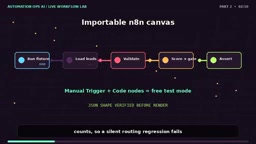
The downloaded file is not a screenshot, but a complete workflow JSON containing a manual test trigger, real code nodes, connections, and assertions.
n8n is an open-source workflow automation tool that uses a node-based canvas, where each node represents an action or logic unit, and data is passed between nodes through connection lines. It supports code nodes (where you can write JavaScript/Python directly), HTTP requests, conditional branches, retries, and error handling, and can export an entire workflow as a JSON file. Because workflows are purely data descriptions, they can be imported, version-managed, and diff-compared like code. This explains why the original text emphasizes that "the downloaded file is not a screenshot, but a complete workflow JSON" — only structured workflows can be truly executed and asserted, while screenshots can only be believed by the human eye.
The Design Logic of the Five Test Leads
When the workflow starts, it loads five synthetic companies, each with different budgets, intents, and confidence values:
- Atlas Robotics: Clear demo request, high-quality lead
- Birch Studio: Asking about pricing, medium intent
- Cinder Labs: Still in research phase, low intent
- Delta Freight: Simulates a transient timeout scenario
- Broken Import: Intentionally missing email address
This design covers common edge cases in real business. No customer data, no external model calls — testing is completely free, private, and repeatable. The final assertion node knows the expected routing counts for each route, so any silent routing regression will cause the workflow to fail rather than quietly flow into production.
Test fixture is a classic concept in software testing, referring to a set of pre-constructed test data with fixed inputs and expected outputs. Its value lies in reproducibility: each run starts from exactly the same starting point, so differences in results must come from the logic being tested, not from data fluctuations. In AI workflows, fixtures are especially important because language model outputs carry randomness — if even the inputs are changing, you simply can't tell whether a failure is the model's problem or the workflow's problem. The five synthetic leads in the original text are exactly such a fixture: no customer data, no external calls, so tests are free, private, and comparable each time.
Three Core Lines of Defense: Validation, Scoring, and Confidence Gating
First Line of Defense: Complete Validation Before Calling AI
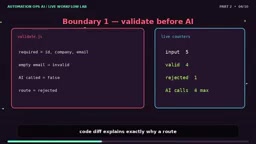
Required fields are ID, company, and email; empty strings are treated as missing. The invalid Broken Import record is immediately rejected — it doesn't consume a model call and can't receive a fabricated qualification score. The four valid leads continue to flow through.
The evidence counter shows: 5 inputs, 4 valid, 1 rejected, at most 4 AI calls. This is cheaper and safer than sending every raw form submission directly to the language model. In production, you can also add schema validation at the webhook layer, but keep this workflow boundary for defense in depth.
Second Line of Defense: Deterministic Business Match Scoring
Employee count, budget, and declared intent generate scores through explicit rules. Atlas reaches 100, Delta also reaches 100, Birch and Cinder each score 40. The model is not allowed to rewrite this score.
AI can classify ambiguous intent, but normal code holds the auditable business policy. Sales managers can review these weights, version-manage them, and test them directly without reverse-engineering a prompt. If the policy changes next month, a single code diff explains why routing changed.
Third Line of Defense: Confidence Is Evidence, Not Permission
Automatic transfer to sales requires a confidence of at least 0.9 and a score of at least 80. Atlas passes both gates, making it the only lead automatically routed to sales. Birch has medium confidence, Delta has 0.83, and both enter manual review — even though Delta's match score is high. Cinder falls below 0.65 and enters the nurture process.
Low confidence never turns into automation that looks confident. These thresholds are examples only; before enabling consequential actions, calibrate them with labeled outcomes from your own business.
Confidence is a self-assessed score often returned by language models in structured output, indicating the model's degree of certainty about its own judgment, usually ranging from 0 to 1. What you need to be wary of is that this number is not a calibrated probability — the model may give high confidence to a wrong answer, or a low score to a correct answer. Therefore, treating it as "evidence" rather than "permission" is the safer engineering practice. The original text uses 0.9 as the automatic release threshold and 0.65 as the boundary between nurture and manual review. These specific values are only examples; the truly reliable approach is to calibrate thresholds using historical results that have already been manually reviewed in your business, see how accurate the model actually is in which score ranges, and then draw the line accordingly.
Controlled Failures: Retries and Observability
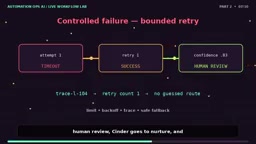
After triggering a controlled failure, Delta's first classification attempt simulates a timeout. The workflow records one retry, preserves the trace identifier, and succeeds on a limited second attempt.
If the retry also fails, the safe production behavior is manual review rather than guessing intent or looping infinitely. Retries need limits, backoff strategy, and observability — otherwise a small-scale provider outage can turn into a cost spike.
Delta's complete trace chain connects validation, scoring, timeout, retry, confidence, and the final manual review decision.
Trace ID is a unique identifier used in modern distributed systems to connect the steps of a request across its full lifecycle. When an operation passes through validation, scoring, model calls, retries, routing, and other stages, looking only at one step's logs makes it hard to reconstruct the full causal chain. Assigning each lead a trace ID and letting it travel with the data through every node makes it possible afterward to assemble each step's decision, latency, and result into a complete timeline. This is exactly the meaning of the original statement that "Delta's complete trace chain connects validation, scoring, timeout, retry, confidence, and the final manual review decision." When storing trace IDs, be careful to let dashboards expose only decision metadata, not prompt content or personal data.
Assertion Mechanism: Proving Behavior, Not Just Looking Correct
After executing the entire fixture, leads are routed as expected. The assertions check the following counts: 5 inputs, 4 valid, 1 rejected, 4 possible AI calls, 1 retry, 0 invalid records escaping. It also checks exactly 1 automatic sales route, 2 manual reviews, and 1 nurture route.
When every expected value matches, the terminal prints pass. If any count unexpectedly changes, the script exits with an error. This is the difference between a demo that looks correct and automation that can prove its own behavior.
Comparison with the Unsafe Baseline: From 4 Misroutes to 0
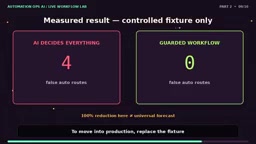
Compare this with the unsafe pattern of automatically routing all 5 records directly through AI: in this fixture, there would be 4 incorrect automatic routes. After adding validation, deterministic scoring, and confidence gating, incorrect automatic routes drop from 4 to 0.
This is a 100% reduction for this controlled dataset only. Do not copy this percentage, or you will lose the accuracy of business forecasting. The meaningful production metrics are reviewed outcomes over time: false positive rate, manual override count, retry rate, latency, and model cost. Store trace IDs with every decision, and dashboards can explain what happened without exposing prompts or personal data.
How to Migrate to Production
The downloaded JSON uses only manual triggers and code nodes, and imports cleanly in test mode without credentials. Steps for migrating to production:
- Replace the fixture loader with a webhook or CRM trigger
- Replace simulated intent fields with structured model output
- Keep the same validation, deterministic scoring, confidence thresholds, retry limits, trace IDs, and assertion tests around model calls
Never put credentials in exported workflow JSON. Configure them through the n8n credential system, granting only the minimum permissions the workflow needs. Before activation, replay with labeled leads, inspect every manual override, and choose thresholds from evidence rather than copying someone else's.
Reusable Automation Design Principles
Import workflow.json, click run test fixture, and confirm the pass result before connecting any real lead source. This is a pattern you can reuse: let AI act where judgment is valuable, keep policy as deterministic code, and let every automatic route prove why it was allowed through.
If a third part is made, the useful next step would be replacing the fixture with a real webhook while keeping personal data out of logs.
One-line Summary
Using an importable n8n workflow with five synthetic leads, this demonstrates a lead qualification design of AI judgment plus code policy.
Paragraph Summary
The article provides a directly importable n8n workflow JSON file that fully demonstrates the end-to-end process of AI lead qualification using five synthetic leads. Its core design philosophy is "AI handles judgment, code handles policy": field validation is performed before calling the model, invalid records are immediately rejected without consuming model calls; business match scores are calculated by deterministic code, and AI can only classify ambiguous intent without rewriting the score; automatic routing must satisfy both a confidence threshold of ≥0.9 and a score threshold of ≥80, otherwise the lead enters manual review or nurture. The workflow also demonstrates retry limits, backoff, and trace ID observability through a controlled timeout failure, and uses assertion nodes to verify all routing counts, so any silent regression causes the script to error. Compared with the unsafe pattern of direct automatic routing, incorrect automatic routes in this fixture drop from 4 to 0.
Related articles

JobRunner MCP Server: AI Agents Can Now Fix Failed Java Jobs
JobRunner launches an open-source MCP server enabling AI agents to view cluster status, diagnose failures, and recover Java jobs—incident response from any cloud coding environment or existing agent.

MLAI Digital Launches 9 Security Agents: MCP Server Safeguards the Full Lifecycle of Agentic AI
MLAI Digital launches Security MCP Server with nine built-in specialized security agents covering vulnerability discovery, attack simulation, prompt injection detection, API and infrastructure assessment, and accelerated remediation—embedding security validation across the full Agentic AI lifecycle from development to production.

Running Isaac Lab on H100 GPUs: Exploring Better Approaches
Exploring optimization methods for running Isaac Lab on NVIDIA H100 GPUs, including MIG configuration, mixed precision, TensorRT acceleration, and community experience to improve robotics simulation and reinforcement learning efficiency.