n8n Beginner's Guide: A Complete Tutorial for Building AI Automation Workflows from Scratch

A comprehensive beginner's guide to building AI automation workflows with the n8n low-code platform.
This guide introduces n8n as a powerful open-source low-code workflow platform with 500+ nodes, explaining its three core features: node integration, flexible process design, and deep AI capabilities. It covers n8n's three AI pillars — AI Agent nodes, Chain nodes, and Tool nodes — plus RAG system building, and provides a recommended learning path from basic workflows to advanced AI applications.
What is n8n? Understanding Workflows Before AI
Before discussing how n8n integrates with AI, we need to establish a correct understanding: n8n is fundamentally a workflow platform, not a tool specifically built for AI.
This distinction is crucial. Many people immediately associate n8n with AI workflows, but that's putting the cart before the horse. From its inception, n8n was designed to handle all kinds of automation tasks. Whether you want to build a data cleaning pipeline, automatically publish videos, scrape web links, or analyze video comments — all of this can be accomplished through n8n, and none of it has anything to do with AI.
Simply put, n8n is a low-code platform where you can build all kinds of workflows: from ordinary task automation pipelines to deeply integrated AI-powered intelligent applications. Low-code platforms are a category of tools that lower the barrier to software development through visual interfaces and pre-built components. Users don't need to write extensive code — they can build applications by dragging, dropping, configuring, and writing minimal scripts. This concept was formally introduced by Forrester Research in 2014. Current mainstream platforms in this space include Microsoft Power Automate, Zapier, Make (formerly Integromat), and others. What makes n8n unique is that it's open-source — users can deploy it on their own private servers, which is particularly important for enterprises with high data security requirements. Understanding this foundational logic will keep your learning on the right track.
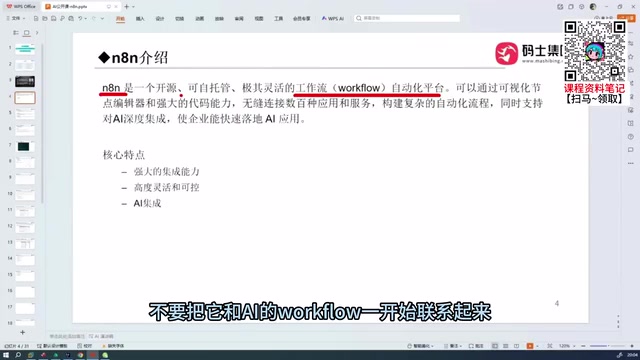
Three Core Features of n8n
Powerful Node Integration Capabilities
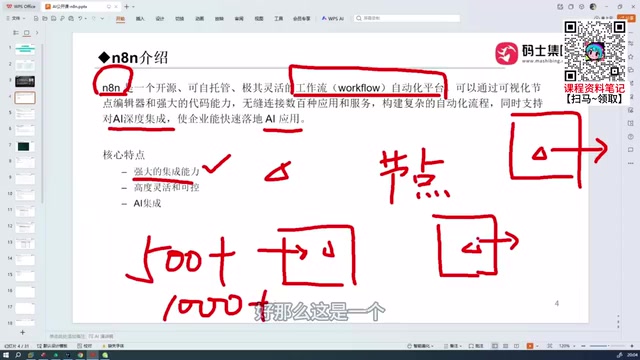
The most impressive aspect of n8n is its node system. Each node handles a different function — similar to nodes in Coze or Dify. For example, some nodes publish content on video platforms, some scrape data from web pages, and some fetch news and information.
In the workflow automation field, "nodes" are a core abstraction concept. Each node represents an independent functional unit or operational step, and nodes pass data to each other through connections, forming Directed Acyclic Graphs (DAGs) or more complex execution topologies. This design pattern originates from Dataflow Programming concepts, first widely applied in Unix pipes, ETL tools, and scientific computing platforms. n8n's nodes are divided into Trigger Nodes (responsible for starting workflows) and Action Nodes (responsible for executing specific tasks). This classification allows workflows to be triggered on a schedule or driven by external events.
n8n supports an extremely rich number of nodes — at least 500+, with some estimates exceeding 1,000. In comparison, the native node count of Dify or Coze falls far short of this scale. This massive node ecosystem means n8n can interface with virtually any mainstream service you can think of.
Highly Flexible and Controllable Process Design
The second feature is flexibility. When building workflows in n8n, you can design highly complex logic: branch nodes, loop nodes, error handling, data transformation, data writing, and more.
This means a single workflow can accommodate extremely high business complexity. No matter how intricate your business logic, it can almost always be implemented through combinations of nodes. This level of control is something many "plug-and-play" automation tools simply cannot offer.
Deep AI Integration Capabilities
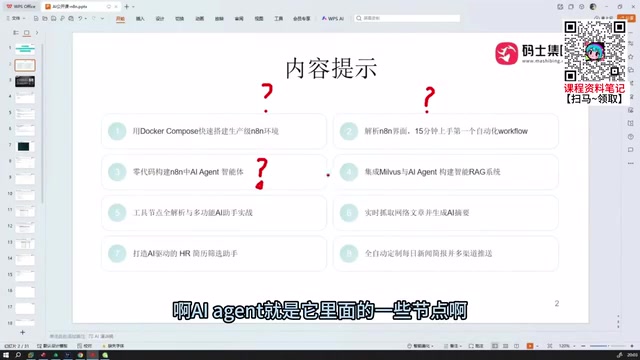
The third feature — and the focus of this article — is AI integration. With n8n, you can build full-fledged AI Agents and RAG (Retrieval-Augmented Generation) systems. This elevates n8n from a pure automation tool to a platform capable of supporting AI application development.
Three Key Areas of n8n's AI Integration
n8n's integration with AI can be broken down into three core components. Once you understand these three areas, you'll have grasped the skeleton of n8n AI development.
AI Agent Nodes
This is the most critical capability. Through AI Agent nodes, you can build your own AI agents. Agents can understand tasks, perform reasoning, and invoke the appropriate tools to accomplish objectives. This is also one of the hottest directions in current AI application development.
AI Agents represent one of the most cutting-edge paradigms in artificial intelligence application development today. Unlike traditional single-turn Q&A AI, Agents possess the ability to autonomously plan, call tools, and perform multi-step reasoning. The core idea comes from the ReAct (Reasoning + Acting) framework — at each step, the model first reasons and thinks, then decides what action to take. Companies like OpenAI, Anthropic, and Google are all actively advancing the Agent ecosystem. In n8n, the AI Agent node encapsulates this complex logic. Users only need to configure the large language model, available tools, and system prompts to build an agent with autonomous decision-making capabilities, significantly lowering the technical barrier to Agent development.
Chain Nodes
n8n provides several types of Chain nodes that can also integrate with AI models for handling different types of tasks. They lean more toward fixed-process chain-style processing, suitable for scenarios where the logic is relatively determined and doesn't require autonomous Agent decision-making.
The Chain node design in n8n is heavily influenced by the LangChain framework. LangChain is an open-source framework launched in late 2022 that abstracts LLM calls into the concept of "chains" — multiple processing steps executed in a fixed sequential order. Common Chain types include: LLM Chain (basic model invocation chain), Sequential Chain, Summarization Chain, and QA Chain. Unlike an Agent's autonomous decision-making, a Chain's execution path is predetermined, making it more predictable and better suited for production environments that demand high stability.
Tool Nodes
Tool nodes are an extension of Agent capabilities. The key to a truly powerful AI Agent lies in whether it can call external tools. n8n provides a rich set of tool nodes that allow Agents to search the web, query databases, call APIs, and more. The combination of Agent + Tool nodes is the essence of building practical AI applications.
Additionally, building RAG systems also involves certain Chain nodes. RAG (Retrieval-Augmented Generation) is a technical architecture proposed by Facebook AI Research in 2020, designed to address the knowledge limitations and hallucination problems of large language models. Its core principle is: before generating an answer, first retrieve relevant document fragments from an external knowledge base, then provide these fragments as context to the model, resulting in more accurate and well-grounded responses. A complete RAG system typically includes document splitting, vector embedding, vector database storage (such as Pinecone, Qdrant), semantic retrieval, and answer generation. Building a RAG system in n8n requires a combination of vector store nodes, text splitting nodes, and Chain nodes.
Together, AI Agents, Chain nodes, and Tool nodes form the foundation of n8n's AI capability system.
Why Do Few Chinese Companies Use n8n?
If n8n is so powerful, why isn't it widely adopted in China? There's a very practical reason behind this: n8n is a foreign platform, and its node ecosystem is heavily centered around overseas applications.
For example, among n8n's 500 to 1,000+ nodes, you can find nodes for directly publishing YouTube videos, sending messages via Telegram, or integrating with Instagram. But want a node that directly posts to Weibo? There isn't one. Want a node that directly sends WeChat messages? Also unavailable.
This significantly limits n8n's use cases in China. Most services it supports are mainstream international platforms, while domestic ecosystems like Weibo and WeChat cannot be natively connected. Although workarounds using HTTP Request nodes are possible, the barrier is noticeably higher for users who prefer out-of-the-box solutions.
Specifically, when n8n doesn't provide a native node for a particular service, developers can use the HTTP Request node to directly call that service's API. This requires developers to understand basic RESTful API concepts, including HTTP methods (GET, POST, PUT, DELETE), request headers, request bodies, and authentication methods (such as OAuth 2.0, API Key, etc.). For Chinese platforms, WeChat Official Accounts provide developer APIs, DingTalk has an open platform interface, and Feishu (Lark) also has comprehensive API documentation. However, this approach requires additional configuration work compared to native nodes and involves handling authentication refreshes, error retries, and other details — presenting a significant barrier for non-technical users.
Learning Path and Summary
For developers and enthusiasts looking to get started with AI automation, n8n remains a highly worthwhile tool to learn. Its value lies not only in building AI applications but also in cultivating workflow thinking — breaking complex tasks into individual nodes and connecting them through logic.
The recommended learning path is:
- Set up your environment first — familiarize yourself with n8n's basic operations and node concepts;
- Start with ordinary workflows — such as data scraping, content publishing, and other non-AI scenarios to understand node combination logic;
- Then enter the AI section — progressively master AI Agents, Chain nodes, and Tool nodes;
- Finally, try building a RAG system — complete the full pipeline for knowledge base Q&A.
Even though n8n's application in China is limited, the low-code + AI integration approach it represents is the mainstream direction for future automation development. Mastering n8n means mastering a universal automation methodology.
Key Takeaways
Related articles

Chain of Thought Isn't Just for AI: How Humans Can Use CoT to Improve Thinking Quality
Chain of Thought isn't just a prompt trick for large models. Starting from a Hacker News discussion, this article analyzes why CoT works for human thinking too, breaks down actionable ways to transfer it, and highlights the key differences between human CoT and machine CoT.
Cloudflare Teams Up with OpenAI: Closi…
Cloudflare Teams Up with OpenAI: Closing the Loop from Vulnerability Discovery to Defense with AI
Cloudflare uses OpenAI Daybreak to investigate security vulnerabilities and generate reviewable remediation plans, while developers use Codex to boost coding efficiency and quality.

Orca Multi-Agent Orchestration in Practice: A Guide to Parallel Collaboration with Claude and Codex
Orca is Stable AI's free open-source agent workbench supporting 34 agents like Claude Code and Codex in parallel. Learn its Git worktree isolation, multi-model orchestration, and mobile management.