n8n Error Handling: Error Trigger vs. Try-Catch — How to Choose

Error Trigger is the global alert safety net; Try Catch is node-level fault tolerance and recovery — complementary, not interchangeable.
The article compares two mechanisms for handling node errors in n8n: the Error Trigger Node and Try Catch inline handling. Error Trigger is a workflow-level global safety net that catches any unhandled failure and triggers a dedicated notification workflow, focusing on observability and alerting; Try Catch is node-level inline fault tolerance that catches errors on the spot and attempts degradation or fallback, focusing on recovery and fault tolerance. Using a hospital emergency room vs. portable first-aid kit analogy, it explains the cost difference and notes that misusing one as the other either lets workflows break or silently swallows exceptions. It recommends a layered approach: handle self-healing errors locally, and let the global trigger catch anomalies requiring human intervention, while deciding whether to rethrow based on business semantics.
Title
n8n Error Handling: Error Trigger vs. Try-Catch — How to Choose
Meta Description
An analysis of the difference between the Error Trigger Node and Try Catch inline handling in n8n: the former is a global error safety net and notification mechanism, while the latter is node-level fault tolerance and fallback. Using the analogy of a hospital emergency room versus a portable first-aid kit, this article explains their applicable scenarios, cost differences, and how to layer them together in practice.
Article Content
Getting an automation workflow running is easy; keeping it stable is hard. In n8n, the two most commonly compared mechanisms for handling node errors are the Error Trigger Node and Try Catch inline handling. The former is a global safety net, the latter is local first aid. Choose wrong, and either alerts drown in noise, or a single node failure takes down the entire workflow with it.
The Essential Difference Between the Two Mechanisms
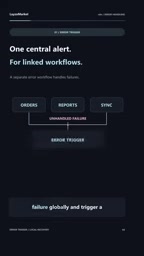
According to an explanation from a YouTube automation tutorial channel, the role of the Error Trigger Node is to catch any unhandled failure across the entire workflow and trigger a dedicated error notification workflow. It doesn't care which node caused the problem — as long as the workflow terminates in an error state, it takes over the subsequent actions.
Try Catch inline handling is the opposite: it locally isolates risky nodes within the workflow, catches errors on the spot as soon as they occur, and immediately attempts degradation or fallback. Its control granularity is at the node level, not the workflow level.
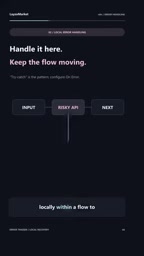
This difference determines that their use cases are completely different. A global safety net suits scenarios where "failures must never go unnoticed silently," while inline handling suits scenarios where "a certain node may fail, but the failure shouldn't interrupt the entire chain."
Workflow-level errors and execution context: In n8n, a workflow execution (Execution) is an independent runtime instance, and each node executes in sequence or along branches. When a node throws an uncaught exception, that execution terminates in an error state, and the Error Trigger Node is precisely what listens for this kind of "execution-level failure" event. It is itself an independent workflow trigger: when the monitored workflow fails, n8n triggers this error-handling workflow and passes in error information (such as the node name, error message, and execution ID). Therefore, the trigger condition for Error Trigger is "the entire execution failed," not "a single node reported an error." Understanding this is crucial: if a node error is caught and handled by Try Catch, the execution will not terminate in an error state, and the Error Trigger will not fire.
Understanding It Through Hospital Emergency Rooms and Portable First-Aid Kits
The original video gives a very apt analogy: the Error Trigger Node is like the emergency room of a city's central hospital, handling serious accidents that occur anywhere in the city; Try Catch is like a portable first-aid kit, treating small wounds on the spot without having to make a trip to the hospital.
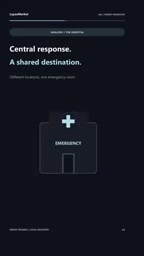
This analogy highlights the cost difference between the two. Going through the global Error Trigger means the workflow has already failed and terminated, and what you get is an "after-the-fact alert," requiring manual intervention or downstream processes to recover; going through inline Try Catch means the workflow is still alive and can continue within the same execution context.

In other words, Error Trigger is a means of observability and notification, while Try Catch is a means of recovery and fault tolerance. Use an observability mechanism as a fault-tolerance mechanism, and the workflow will still break when it should; use a fault-tolerance mechanism as an observability mechanism, and exceptions will be swallowed — you won't even know they happened.
How to Combine Them in Practice
A relatively robust approach is to use both layers. Configure an Error Trigger Node on the outer layer to catch all the slip-throughs that weren't handled locally, and push error information to notification channels; add Try Catch on the inner layer for known high-risk nodes (such as external API calls and parsing nodes with unstable data formats), performing retries or degradation on the spot.
The benefit of this division of labor is that alert noise drops significantly. Predictable, self-healing errors are absorbed locally, and the global error trigger only fires when human intervention is genuinely needed. Conversely, if you wrap every node in Try Catch, the workflow becomes bloated and hard to maintain; if you only use a global trigger, you lose the opportunity to recover gracefully within the workflow.
A detail that's easy to overlook: whether to rethrow an error after catching it locally depends on the business semantics. Errors that can be degraded can simply be absorbed on the spot; errors that cannot be degraded should continue to be thrown upward and handed to the global trigger, to avoid errors being silently swallowed.
The semantics of rethrow: In a Try Catch structure, "rethrowing an error" means that after catching and handling it locally, you actively throw the error again so that the workflow execution terminates in an error state. The purpose is to let the error continue to propagate upward, ultimately taken over by the global Error Trigger. In n8n's Try Catch node, this is typically achieved by configuring the "Throw Error" option or manually throwing an error in the Catch branch. Whether to rethrow depends on business semantics: errors that can be degraded (such as cache misses or missing non-critical fields) can be absorbed on the spot; errors that cannot be degraded (such as authentication failures or loss of core data) should be rethrown to avoid being silently swallowed. This mechanism is the key connecting point of layered error handling.
Selection Advice
The criterion can be simplified into one sentence: When this error occurs, can the workflow still meaningfully continue? If yes, use Try Catch inline handling; if no, let it fail and hand it to the Error Trigger for alerting and subsequent actions. The global safety net ensures nothing is missed, and inline handling ensures recoverability — the two are not substitutes but complements.
One-line Summary
Error Trigger is the global alert safety net; Try Catch is node-level fault tolerance and recovery — the two are complementary and irreplaceable.
Paragraph Summary
The article compares two mechanisms for handling node errors in n8n: the Error Trigger Node and Try Catch inline handling. Error Trigger is a workflow-level global safety net that catches any unhandled failure and triggers a dedicated notification workflow, focusing on observability and alerting; Try Catch is node-level inline fault tolerance that catches errors on the spot and attempts degradation or fallback, focusing on recovery and fault tolerance. The article uses the analogy of a hospital emergency room versus a portable first-aid kit to illustrate the cost difference between the two, and points out that using an observability mechanism as a fault-tolerance mechanism means the workflow will still break when it should, while using a fault-tolerance mechanism as an observability mechanism means exceptions get swallowed. In practice, it recommends layered combination: handle self-healing errors locally, let the global trigger catch anomalies requiring human intervention, and note that whether to rethrow an error after local capture depends on business semantics.
Related articles

Chain of Thought Isn't Just for AI: How Humans Can Use CoT to Improve Thinking Quality
Chain of Thought isn't just a prompt trick for large models. Starting from a Hacker News discussion, this article analyzes why CoT works for human thinking too, breaks down actionable ways to transfer it, and highlights the key differences between human CoT and machine CoT.
Cloudflare Teams Up with OpenAI: Closi…
Cloudflare Teams Up with OpenAI: Closing the Loop from Vulnerability Discovery to Defense with AI
Cloudflare uses OpenAI Daybreak to investigate security vulnerabilities and generate reviewable remediation plans, while developers use Codex to boost coding efficiency and quality.

Orca Multi-Agent Orchestration in Practice: A Guide to Parallel Collaboration with Claude and Codex
Orca is Stable AI's free open-source agent workbench supporting 34 agents like Claude Code and Codex in parallel. Learn its Git worktree isolation, multi-model orchestration, and mobile management.