N8N in Practice: Building an AI Email Automation Workflow with Human-in-the-Loop Review

Build an N8N AI email workflow with human review nodes to balance automation efficiency and output control.
This article walks through a Human-in-the-Loop marketing email automation workflow built on N8N. Starting from a form-based lead capture, the AI drafts an outreach email and sends it to the operator for review. The operator can approve and send, or decline and provide natural-language revision instructions — triggering a Revision Agent that rewrites the draft and loops it back for another round of review. This continues until the operator is satisfied. The core value: AI handles repetitive content generation while human approval acts as a quality gate, ensuring every client-facing email is verified before delivery.
What Is a "Human in the Loop" Workflow
Automation doesn't have to mean giving up human control entirely. A YouTube creator shared a "Human in the Loop" (HITL) workflow built on N8N, and the core idea is straightforward: let AI handle the heavy lifting of content generation, while keeping humans in charge of critical decisions.
The target use case is client email outreach for a marketing agency. The system chains together lead capture, AI email drafting, human review, iterative revision, and final delivery into a single automated pipeline — preserving the efficiency of AI generation while using human approval to ensure the quality and professionalism of every outgoing email.
For teams worried about AI "firing off emails on autopilot," inserting human confirmation at key decision points is a practical compromise.
Overall Workflow Structure
The entire process starts with a form. The creator demonstrates how to use N8N's built-in form functionality to create a "New Lead" intake page. Clients fill in their name and other details, and once submitted, the data flows directly into the workflow.
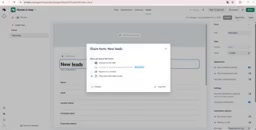
Publishing the form generates a shareable link. When a prospective client fills it out and submits, the lead data is immediately captured by the workflow. This step replaces manual data entry, pulling leads into the automation pipeline right from the source.
The workflow then uses that lead data to generate a draft email addressed to the client. The creator shows the output — a polished marketing email on behalf of "Nima Agency" with the subject line "Bringing Your Vision to Life with AI Solutions," containing all the information the client needs along with a calendar link for booking a meeting.
How the Human Review Step Works
This is the most distinctive part of the workflow. Once the AI generates an email draft, it doesn't get sent immediately. Instead, the draft is forwarded to the creator's own Gmail inbox for review.
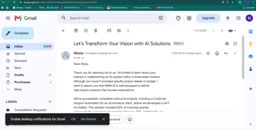
At this review node, the operator reads the draft and chooses one of two paths: Approve or Decline. If the email looks good, submitting something like "yes it's good" sends the email directly to the client. If it's not satisfactory, the workflow takes the decline branch.
The value of this design is that it demotes AI from "executor" to "assistant" — the human always makes the final call. For formal outbound communications to clients, this level of control matters. A poorly worded email can directly damage a business relationship.
The Revision Agent and the Loop Mechanism
When the operator rejects a draft, the workflow triggers a "Revision Agent." This is another key point where the system's AI value really shows.
The Revision Agent operates as a loop: the operator can give natural-language instructions like "make it shorter" or "expand the content," and the agent will revise the email accordingly before sending it back into the review stage.
This loop continues until the operator is satisfied and approves. In other words, human review and AI revision form a closed iterative cycle — the human requests changes, the AI revises, the human reviews again — repeating until the result is right. Only emails that pass final approval get sent to the client.
The "Revision Agent" in N8N's context is typically an AI node configured with a specific system prompt. It takes the original draft and the operator's natural-language revision instructions as input, combines them into a new prompt, and calls the language model again to generate a revised version. The key to this "agent" design is context retention — revision instructions aren't a fresh task from scratch, but targeted adjustments built on top of the existing content. N8N natively supports this kind of iterative logic through its Loop node, which can route review outcomes back upstream in the workflow to create true conditional loops rather than linear, single-pass executions. This is one of the key differences between N8N and traditional RPA (Robotic Process Automation) tools: modern workflow platforms like N8N can seamlessly integrate conditional branching and loop structures with AI calls, dramatically lowering the technical barrier to building these kinds of iterative feedback loops.
Practical Value and Takeaways
From the demo, this system isn't particularly complex — but it clearly illustrates N8N's flexibility for building human-AI collaborative automation. Several design choices are worth noting:
- Form as the entry point standardizes lead capture and eliminates manual data entry;
- AI handles content generation, removing the repetitive work of drafting marketing emails over and over;
- Human approval acts as a quality gate, preventing AI mistakes from reaching clients directly;
- The Revision Agent creates an iterative loop, using natural-language instructions to rapidly refine content.
That said, as a demo-style walkthrough, the video keeps implementation details relatively light — it doesn't go deep into the specific node configurations, which AI model is used, or how the form and Gmail integrations are set up. Anyone looking to replicate this will need to fill in quite a few technical gaps themselves.
Overall, "Human in the Loop" represents a mature approach to deploying AI automation in practice: rather than chasing 100% fully automated execution, it finds a balance between efficiency and control. For use cases like marketing, customer service, and content operations — where output quality is paramount — a human-reviewed workflow like this is often more reliable than a fully automated solution.
Background: What Is "Human in the Loop"?
"Human in the Loop" (HITL) is a foundational concept in machine learning and automated systems design. It refers to introducing human judgment at specific nodes in an automated process to compensate for AI limitations in contextual understanding, risk assessment, or creative quality. The idea was first widely applied during the model training phase of machine learning — using human-annotated data to continuously correct model bias — and has since extended into the design of automation workflows at the inference and execution stage.
In practice, HITL isn't a compromise born from insufficient technical capability. It's a proactive risk management strategy. For high-stakes or relationship-sensitive outputs — such as business communications directed at real clients — even when AI generation quality is already quite high, inserting a human approval step can significantly reduce the probability of errors. It also helps teams continuously develop their intuition for AI output quality and calibrate their expectations over time.
Related articles

EgoOmniWorld: Unifying Egocentric Video Understanding via Ego-Action-World Interaction
EgoOmniWorld proposes the Ego-Action-World interaction loop as a unifying principle, reorganizing egocentric video understanding evaluation around Node, Edge, Chain, and Loop, with 24,166 QA groups revealing structural gaps in MLLMs.

STCNet: Dual-Domain Spatiotemporal Consistency Learning for Sparse-View 4D CBCT Reconstruction
STCNet proposes a sparse-view 4D CBCT reconstruction framework requiring only 16 projections per respiratory phase, achieving superior PSNR and SSIM over traditional and deep learning baselines on TCIA-LUNG and CIRS datasets through dual-domain spatiotemporal consistency learning.

Lifting: A New Framework for Quantum State Discrimination in Mid-Circuit Measurements
Lifting is a quantum state discrimination framework for mid-circuit measurements, using repetition encoding, neural decoding, and in-situ calibration to improve MCM reliability on superconducting quantum processors.