STCNet: Dual-Domain Spatiotemporal Consistency Learning for Sparse-View 4D CBCT Reconstruction

STCNet achieves high-quality 4D CBCT reconstruction with 16 projections, balancing low dose and spatiotemporal consistency.
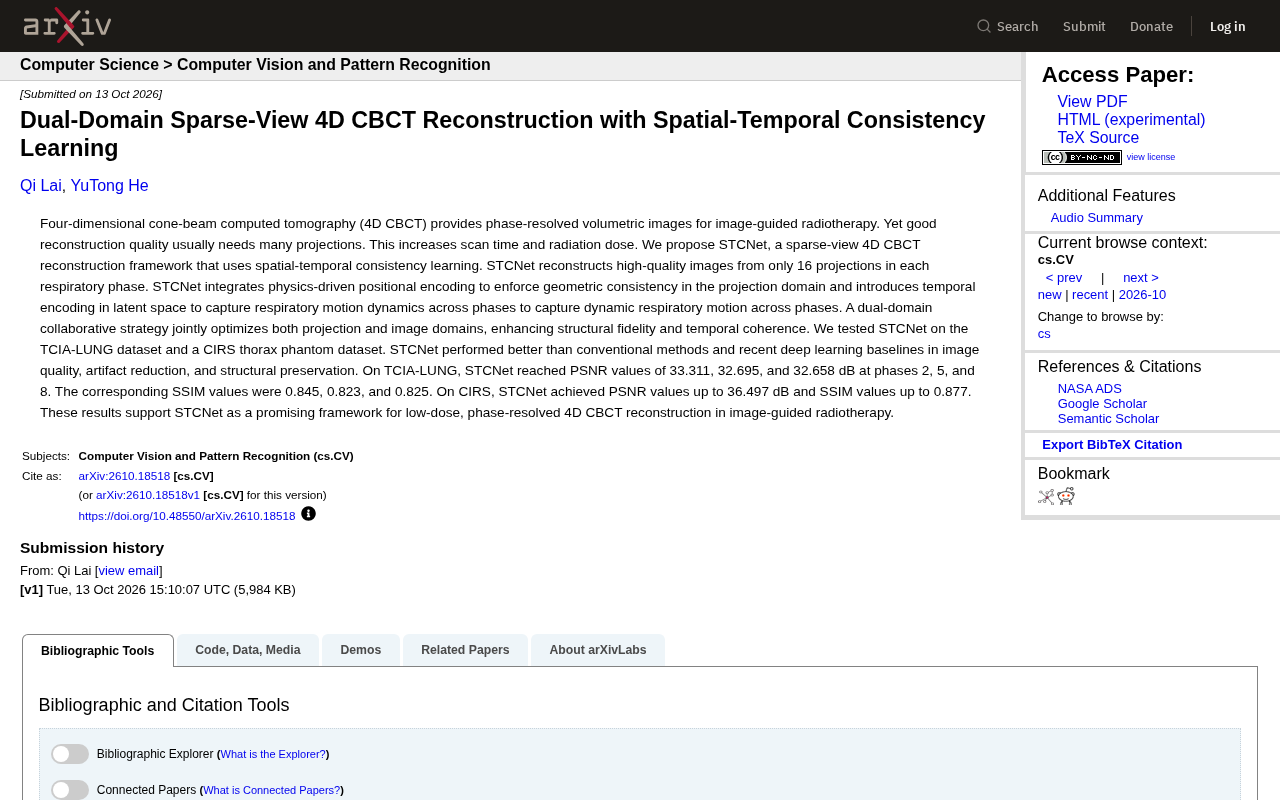
STCNet is a sparse-view 4D CBCT reconstruction framework for image-guided radiotherapy that needs only 16 projections per respiratory phase, significantly reducing scan time and radiation dose. Its dual-domain collaborative strategy combines physics-driven positional encoding in the projection domain with temporal encoding in latent space, mutually correcting both domains during training. It achieves PSNR of 33.311/32.695/32.658 dB and SSIM of 0.845/0.823/0.825 at phases 2/5/8 on TCIA-LUNG, and up to 36.497 dB PSNR and 0.877 SSIM on the CIRS chest phantom. Validation remains limited to public datasets and phantoms.
In image-guided radiotherapy, four-dimensional cone-beam CT (4D CBCT) provides volumetric data resolved by respiratory phase, helping clinicians precisely localize tumors. However, high-fidelity 4D reconstruction typically requires dense projection sampling, which means longer scan times and higher radiation doses. A new study proposes the STCNet framework, which attempts to resolve this trade-off using sparse views combined with spatiotemporal consistency learning—reconstructing high-quality images with only 16 projections per respiratory phase.
Core Idea: Learning Physical Constraints and Temporal Dynamics Together
STCNet's design logic can be broken into two threads: one introduces physics-driven positional encoding along the projection domain, using geometric consistency to constrain the reconstruction process; the other introduces temporal encoding in latent space to capture motion dynamics across different respiratory phases. The two threads are jointly optimized through a dual-domain collaborative strategy that operates on both the projection domain and the image domain, ultimately improving structural fidelity and temporal coherence simultaneously.
This differs fundamentally from traditional methods. Conventional sparse-view reconstruction typically performs post-processing only in the image domain or interpolation-based completion only in the projection domain, whereas STCNet lets the two domains mutually correct each other during training—geometric consistency in the projection domain prevents over-smoothing in the image domain, while structural priors from the image domain in turn constrain noise in the projection domain. This bidirectional constraint is particularly important for the chest region, where respiratory motion is severe.
Positional Encoding was first widely used in the Transformer architecture, where its role is to inject order information about sequence elements into the model, since the pure attention mechanism itself is insensitive to order. In STCNet, positional encoding is transplanted to the projection domain: each projection view corresponds to a specific geometric angle in the CT scan, and encoding this angle information enables the network to perceive the spatial geometric relationships between projections, thereby allowing it to infer reasonable values for missing views even under sparse sampling. This is formally similar to sequence encoding in natural language processing, but its physical meaning is entirely different—what is encoded here is the spatial geometric configuration of the X-ray source and detector, hence the term "physics-driven."
Latent-space temporal encoding, on the other hand, acts on the feature representations in the network's intermediate layers. The respiratory phases of 4D CBCT exhibit continuous motion evolution, and reconstructing each phase independently tends to lose dynamic coherence between phases. Temporal encoding maps the phase index into a continuous vector and injects it into the latent-space features, enabling the network to "know" where in the respiratory cycle a given phase sits when reconstructing it, thereby leveraging information from adjacent phases as a constraint. This design is related to temporal modeling in video frame interpolation, but it deals with X-ray projection data rather than natural images.
Experimental Results: Quantitative Performance Under Sparse Views
The research team validated the method on the TCIA-LUNG dataset and the CIRS chest phantom dataset. On TCIA-LUNG, STCNet achieved PSNR of 33.311 dB, 32.695 dB, and 32.658 dB at phases 2, 5, and 8, respectively, with corresponding SSIM values of 0.845, 0.823, and 0.825. On the CIRS phantom, PSNR reached as high as 36.497 dB and SSIM as high as 0.877.
These numbers are more meaningful in the context of sparse views. Using only 16 projections per phase means that, compared with conventional protocols requiring hundreds of projections, radiation dose and scan time are dramatically reduced. STCNet outperforms both traditional methods and recent deep learning baselines in image quality, artifact suppression, and structural preservation. For radiotherapy workflows that require multiple scans, this low-dose approach has direct value for controlling cumulative patient risk.
PSNR (Peak Signal-to-Noise Ratio) and SSIM (Structural Similarity Index) are the two most commonly used metrics for evaluating image reconstruction quality. PSNR is calculated based on mean squared error, expressed in dB, with higher values indicating smaller pixel-level error; in the CT reconstruction literature, values above 30 dB are generally considered to have good clinical usability. SSIM measures the similarity between a reconstructed image and a reference image across three dimensions—luminance, contrast, and structure—with values ranging from 0 to 1, where values closer to 1 indicate better structural preservation. The two metrics have different emphases: PSNR is sensitive to global noise, while SSIM is more sensitive to structural distortion.
In sparse-view CT reconstruction, the field generally considers reducing the number of projections per phase from the conventional hundreds to dozens or even a dozen or so as "sparse." Sixteen projections implies an extremely high undersampling rate, and traditional filtered back-projection (FBP) would produce severe streak artifacts under such conditions. The advantage of deep learning methods lies in their ability to use prior knowledge from training data to compensate for missing information, but purely data-driven methods are prone to structural hallucinations. STCNet's reported PSNR in the 33 dB range and SSIM above 0.82 represent a leading level in the current literature under 16-projection conditions, though it should be noted that these values were obtained on specific datasets, and cross-dataset generalizability still needs verification.
Why It's Worth Attention: Reading the Technical Signal from a Single Source
The value of this work goes beyond metric improvements. It provides an engineered combination of the two directions of "sparse views" and "spatiotemporal consistency," delivering a reproducible training framework. Radiotherapy scenarios demand extremely high interpretability and stability from reconstructions; purely data-driven black-box methods struggle to pass clinical validation, whereas the physics-driven positional encoding introduced by STCNet provides the necessary inductive bias.
Of course, the current results are still limited to public datasets and phantoms. Complex factors such as real-patient respiratory variability, setup errors, and metal artifacts have not yet been covered. The computational cost of the dual-domain collaborative strategy is also not discussed in detail in the paper—under clinical real-time requirements, this could become a bottleneck for deployment.
Inductive Bias refers to the prior assumptions or constraints that a model relies on during learning. In the medical imaging field, purely data-driven deep networks are theoretically universal function approximators, but precisely because of this, they may produce outputs that violate physical laws outside the training distribution—for example, "fabricating" anatomical structures in CT reconstruction. Introducing inductive bias is equivalent to adding a "guardrail" of physical common sense to the model: the geometric consistency constraint in STCNet ensures that the reconstruction result does not contradict the geometric relationships of X-ray projections, while temporal encoding constrains motion between phases to conform to respiratory dynamics. This design philosophy is in line with physics-informed neural networks (PINNs), with the core goal of keeping deep learning models reliable and interpretable even in data-scarce or out-of-distribution scenarios—particularly critical for medical AI that needs to pass clinical validation.
Applicable Boundaries and Future Directions
From a technical positioning standpoint, STCNet represents a cross-disciplinary attempt between sparse-view reconstruction and dynamic sequence modeling. It does not aim to replace fully sampled CT, but rather to provide a viable approach for low-dose, phase-resolved 4D CBCT. If it can be validated on larger-scale clinical data and its inference speed optimized in the future, this type of dual-domain spatiotemporal learning method may enter the practical workflow of image-guided radiotherapy.
One-line Summary
STCNet achieves high-quality 4D CBCT reconstruction with 16 projections, balancing low dose and spatiotemporal consistency.
Paragraph Summary
STCNet is a sparse-view 4D CBCT reconstruction framework for image-guided radiotherapy that requires only 16 projections per respiratory phase to reconstruct high-quality volumetric data, significantly reducing scan time and radiation dose. Its core innovation lies in a dual-domain collaborative strategy: the projection domain introduces physics-driven positional encoding to impose geometric consistency constraints, while latent space introduces temporal encoding to capture motion dynamics between respiratory phases, with the two domains mutually correcting each other during training. On the TCIA-LUNG dataset, PSNR at phases 2/5/8 reaches 33.311/32.695/32.658 dB, with SSIM of 0.845/0.823/0.825; on the CIRS chest phantom, PSNR reaches up to 36.497 dB and SSIM up to 0.877, outperforming both traditional methods and deep learning baselines. Currently, validation is limited to public datasets and phantoms, and complex clinical scenarios and real-time inference efficiency still need evaluation.
Related articles

JobRunner MCP Server: AI Agents Can Now Fix Failed Java Jobs
JobRunner launches an open-source MCP server enabling AI agents to view cluster status, diagnose failures, and recover Java jobs—incident response from any cloud coding environment or existing agent.

MLAI Digital Launches 9 Security Agents: MCP Server Safeguards the Full Lifecycle of Agentic AI
MLAI Digital launches Security MCP Server with nine built-in specialized security agents covering vulnerability discovery, attack simulation, prompt injection detection, API and infrastructure assessment, and accelerated remediation—embedding security validation across the full Agentic AI lifecycle from development to production.

Running Isaac Lab on H100 GPUs: Exploring Better Approaches
Exploring optimization methods for running Isaac Lab on NVIDIA H100 GPUs, including MIG configuration, mixed precision, TensorRT acceleration, and community experience to improve robotics simulation and reinforcement learning efficiency.