n8n in Practice: Connecting Forms, AI, and Databases to Build an Automated Inquiry Processing Workflow

Building an automated inquiry pipeline with n8n by connecting forms, AI, and databases in 8 nodes.
This article demonstrates how to use n8n, an open-source workflow automation platform, to build an end-to-end inquiry processing system. Eight nodes automatically handle form capture, completeness checks, AI-powered information extraction via LLM, database storage, and reply draft generation. The piece also covers the importance of data persistence for long-term value, practical automation boundary guidelines, and additional n8n use cases.
Why Inquiry Processing Is a Perfect Fit for Automation
Many repetitive tasks don't need to be done manually, step by step. As long as something can be described as "when X happens, do Y in sequence," it has the prerequisites for automation. This is exactly the core value of n8n, a workflow automation tool — it takes that simple rule and actually makes it run.
n8n is an open-source workflow automation platform created in 2019 by German developer Jan Oberhauser. Unlike commercial SaaS automation tools such as Zapier and Make (formerly Integromat), n8n supports self-hosted deployment, allowing users to install it on their own servers for complete control over data flow and privacy. It features a node-based visual editor where users can build automated workflows by dragging and connecting nodes with different functions — no coding required. Currently, n8n has over 400 built-in integration nodes covering mainstream SaaS services, databases, messaging platforms, and AI model APIs. Its open-source community has earned over 50,000 stars on GitHub, making it one of the fastest-growing projects in this space.
A content creator on Bilibili demonstrated through a small experiment with overseas inquiry processing how to connect forms, AI, and databases — previously scattered across different tools — into a fully automated end-to-end workflow. Overseas inquiries are a core business process in foreign trade and cross-border e-commerce. Companies receive consultation requests from potential customers through independent websites, B2B platforms (such as Alibaba International), or social media. A typical inquiry includes product requirement descriptions, quantities, delivery timeline requirements, destination country, and other information — but customer writing styles vary wildly. Some write lengthy emails; others send just three lines. Traditional processing relies on sales reps to manually read, classify, and enter data into CRM systems before drafting a reply. The average handling time per inquiry is 15–30 minutes. According to industry statistics, the conversion rate for inquiries that receive a response within 1 hour is more than 7 times higher than those responded to after 24 hours — response speed directly impacts business outcomes. After the customer clicks submit, the creator "didn't touch a thing," and the entire pipeline ran on its own.
The significance of this kind of experiment isn't the complexity of the product itself, but the fact it reveals: the barrier to entry is dropping fast. A single person can use n8n to connect multiple tools into a genuinely functional automated system.
The Complete Automation Pipeline: Eight Nodes
This inquiry automation project consists of eight nodes that execute automatically in sequence. The logic of the entire n8n workflow is crystal clear:
- Form Node captures the inquiry and serves as the entry point for the entire workflow;
- Completeness Check verifies whether the customer's submitted information is complete;
- AI Understanding Node transforms a chunk of natural language description into clearly identified requirements, urgency levels, and contact information;
- Database Storage records the results of each processing run;
- Draft Generation produces a reply draft for human review and confirmation.
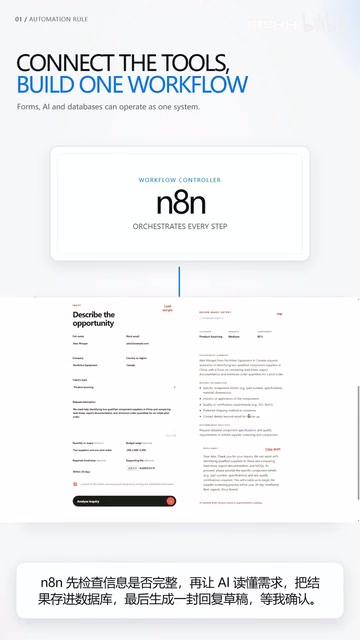
The technical principles behind the AI understanding node deserve a closer look. This node is essentially a structured call to a large language model (LLM). When unstructured natural language input (such as a customer's product requirements written in English) enters the node, n8n sends it along with a preset prompt to an LLM API like GPT-4 or Claude. The prompt typically includes explicit output format requirements — for example, asking the model to return fields like "product requirements," "quantity," "urgency level," and "contact information" in JSON format. This process of converting unstructured text into structured data is known as Information Extraction in the NLP field. Compared to traditional keyword matching or regex-based approaches, LLMs can understand semantic context and handle real-world scenarios like multilingual content and ambiguous phrasing, significantly improving accuracy.
In this architecture, AI plays the role of the "brain," responsible for turning chaotic input into structured information, while n8n acts more like a "workflow controller" — it knows when to start, who handles the next step, where results are stored, and when to stop if something goes wrong. This "brain + orchestration" division of labor is a key perspective for understanding modern workflow automation. It's worth noting that workflow automation as represented by n8n and RPA (Robotic Process Automation) are two distinct automation paradigms. RPA completes tasks by simulating human actions like clicking and typing on screen, making it suitable for legacy systems without API interfaces. Workflow automation, on the other hand, connects different systems directly at the data layer via APIs, offering higher efficiency and stability. For modern SaaS tools that provide standard APIs, workflow platforms like n8n are more efficient; for traditional enterprise software with only graphical interfaces, RPA tools may be needed. Understanding this distinction helps in choosing the right automation approach for each scenario.
From Manual Data Shuffling to Rule-Driven Execution
Before automation, all these actions were scattered across different tools, requiring people to manually shuttle data back and forth: copying form submissions, organizing requirements, saving records, then crafting a reply. Every step consumed attention and was prone to errors or omissions.
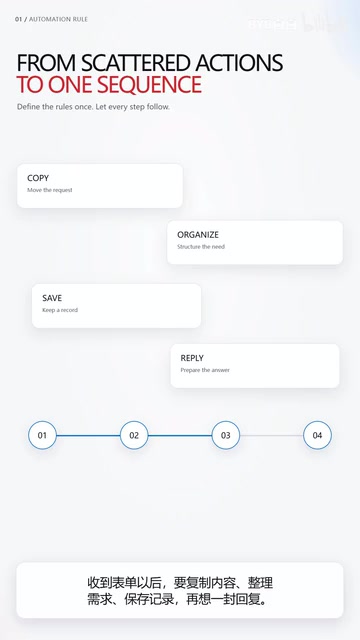
After introducing n8n, the way of working fundamentally changed: you only need to define the rules, and the remaining steps execute automatically in the preset order. This isn't simply "saving a few clicks" — it transforms the human role from "executor" to "rule designer." People only need to intervene at critical review points; everything else is handled by the n8n workflow.
The Database Layer: The Key to Long-Term Value from Automation
One easily overlooked yet critically important component in this design is the database layer. The creator specifically emphasized: automation shouldn't "run and forget."
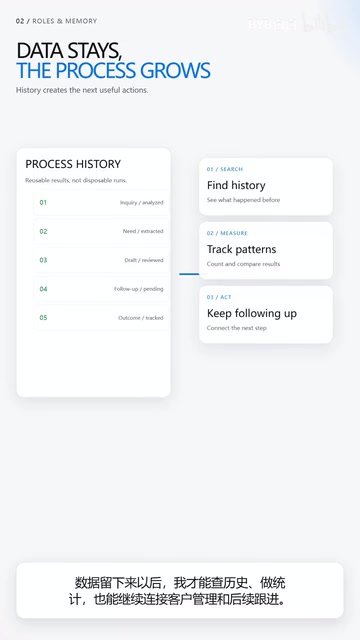
Persisting every processing result means you can later review history, run analytics, and connect to customer management and follow-up workflows. With this database layer for data accumulation, automation evolves from a "one-time action" into "a process that continuously compounds."
Data Persistence refers to saving data generated during program execution to long-term storage media, making it retrievable and analyzable after the workflow ends. Common persistence solutions in automation scenarios include relational databases like PostgreSQL and MySQL, as well as lightweight online databases like Airtable and Notion Database. As historical data accumulates, it can generate value far beyond a single automation run: for example, analyzing which countries have the highest inquiry conversion rates, which product categories show rising demand trends, or the average cycle from first inquiry to closed deal. These insights can feed back into product development, marketing strategy, and inventory management, creating a positive feedback loop of data-driven decision-making.
This is the dividing line between whether an automation system can produce long-term value. Automation without data retention merely speeds up manual operations; automation with persistent records truly begins to build data assets and business compounding.
More Typical Use Cases for n8n
Processing overseas inquiries is just one of n8n's many applications. Here are several typical workflow automation scenarios that demonstrate the tool's versatility:
- Scheduled Information Scraping and Push Notifications: Automatically scrape industry information on a daily schedule, have AI filter and classify it, then push noteworthy content to Feishu (Lark) or other collaboration tools;
- Smart Form Routing: After a customer completes a form, n8n automatically determines the type, saves the record, and notifies the appropriate person to follow up;
- Order Status Synchronization: Automatically sync data when order statuses change, generate daily reports, and alert the responsible person when anomalies occur.
From these examples, it's clear that what n8n truly connects isn't just a few pieces of software — it's "the complete path of a task from start to finish." It fills the gaps between tools, enabling previously isolated systems to work together.
The Boundaries of Automation: What to Delegate to Machines, What to Keep for Humans
Credit to the creator for not falling into the trap of "automate everything." Instead, he offered a clear-headed framework for boundary judgment.
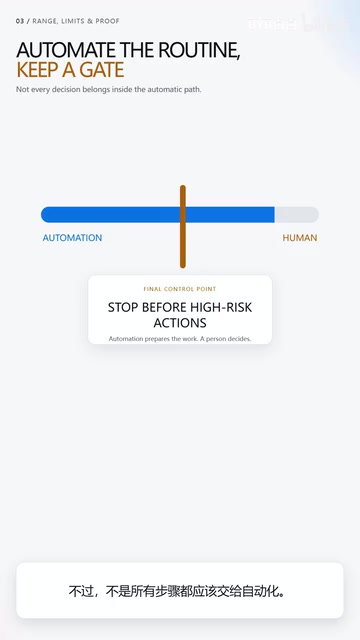
His principle: tasks with clear rules, that occur repeatedly, and whose results are easy to verify are best suited for n8n automation. For steps involving pricing design, external commitments, or important judgment calls, the final decision should still be made by a human.
This standard is highly pragmatic and aligns with the industry consensus on automation. The goal of automation isn't to replace human judgment but to free people from mechanical labor so they can focus on decisions that truly require experience and accountability. In a human-machine collaboration framework, machines handle speed and consistency while humans handle flexibility and responsibility — this division of labor is also a core principle repeatedly emphasized in current research on AI Agent and human collaboration.
What a Prototype Can Teach Us
It should be noted that this project is currently just a working prototype with 8 test records and no actual deals closed yet. What it proves isn't commercial success, but a possibility — that ordinary people can start from a very small process and use n8n to connect forms, AI, databases, and human judgment into a system that actually runs.
As the creator summarized: the most valuable thing about automation isn't saving you a few clicks — it's making previously scattered tools start working together under the same set of rules. For individuals and small teams dealing with repetitive, tedious tasks every day, n8n workflow automation might be a worthwhile starting point.
Key Takeaways
Related articles

JobRunner MCP Server: AI Agents Can Now Fix Failed Java Jobs
JobRunner launches an open-source MCP server enabling AI agents to view cluster status, diagnose failures, and recover Java jobs—incident response from any cloud coding environment or existing agent.

MLAI Digital Launches 9 Security Agents: MCP Server Safeguards the Full Lifecycle of Agentic AI
MLAI Digital launches Security MCP Server with nine built-in specialized security agents covering vulnerability discovery, attack simulation, prompt injection detection, API and infrastructure assessment, and accelerated remediation—embedding security validation across the full Agentic AI lifecycle from development to production.

Running Isaac Lab on H100 GPUs: Exploring Better Approaches
Exploring optimization methods for running Isaac Lab on NVIDIA H100 GPUs, including MIG configuration, mixed precision, TensorRT acceleration, and community experience to improve robotics simulation and reinforcement learning efficiency.