n8n or Hermes? A Deep Dive into AI Email Butler Architecture Selection

An email butler system should split into a deterministic classification pipeline and an intelligent summary agent, with a hybrid architecture balancing reliability and flexibility.
A Reddit user debated whether to build an email butler with n8n or Hermes Agent, sparking a broader discussion on workflow engines versus autonomous agents. The article splits the email butler into two tasks: automatic classification is a deterministic pipeline requiring high reliability, where n8n's visual debugging and stable execution fit better; summary briefings need dynamic reasoning and context understanding, where agent frameworks have the edge. A pure agent approach is too risky for classification, while fixed workflows struggle to cover summary decisions. Thus, a hybrid architecture—n8n for classification, an agent for summaries—is the pragmatic choice, evaluated across reliability, determinism, and debugging complexity.
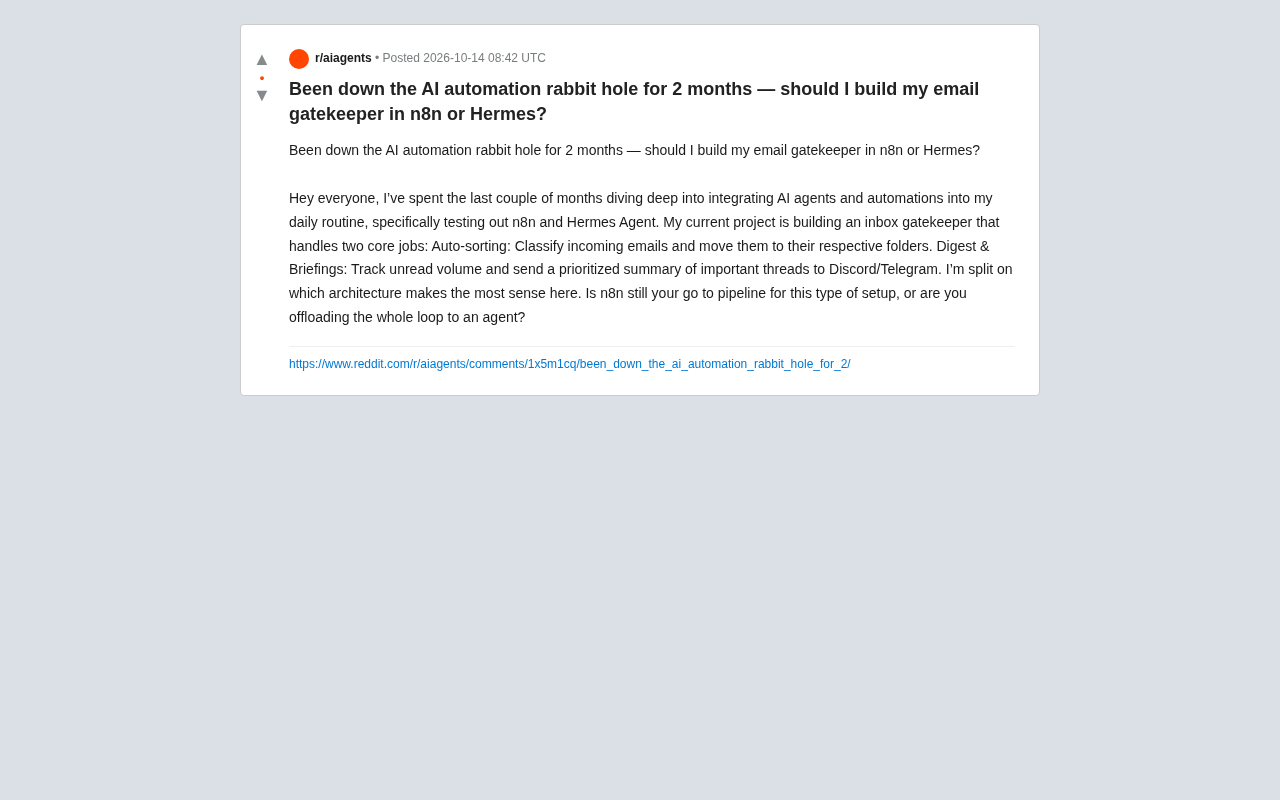
After two months of exploring the AI automation rabbit hole, a Reddit user raised a fairly representative question: they want to build an email butler system whose core features include automatically classifying the inbox and generating priority summaries pushed to Discord or Telegram, but they can't decide between n8n and Hermes Agent. This dilemma actually reflects a core divide in today's AI automation community — between workflow engines and autonomous agents, which is better suited for this kind of continuously running "gatekeeper" task?
Breaking Down the Two Core Tasks of an Email Butler
Let's first break this project down. Automatic email classification is essentially a deterministic pipeline of input → judgment → execution: an email comes in, the AI determines which folder it belongs to, and the move operation is executed. This type of task demands extremely high reliability — the cost of misclassifying an important email into the spam folder can far exceed the setup cost.
The summary and briefing feature is different. It needs to track the volume of unread emails, understand thread context, judge priority, generate a human-readable summary, and push it to the specified channel. This part is closer to an intelligent process of perception → reasoning → generation, with higher demands on context understanding and output quality, but also greater tolerance for latency in any single execution.
The difference in the characteristics of these two tasks directly determines that architecture selection should not be a single-choice question.
The core difference between a deterministic pipeline and an intelligent process lies in whether the execution path is fixed in advance. In a deterministic pipeline, each input corresponds to a preset output path, similar to conditional branching in traditional programming, with predictable and reproducible behavior. An intelligent process, by contrast, relies on model reasoning; the same input may produce different outputs depending on context changes, offering flexibility but making it difficult to exhaustively enumerate all edge cases. Email classification belongs to the former — rules and classification criteria are relatively fixed, and what is needed is stable execution. Summary generation belongs to the latter — it requires understanding semantics, judging priority, and organizing language, which cannot be exhaustively enumerated with fixed nodes. Understanding this distinction is the first principle for deciding whether to use a workflow engine or an agent framework.
Where n8n's Deterministic Advantages Lie
As a workflow automation platform, n8n's greatest value lies in being visual, debuggable, and controllable. You can see the execution status of each step on the canvas, pinpoint exactly which node failed when an error occurs, and retry mechanisms are built in. For tasks like email classification that need stable 24/7 operation, n8n's pipeline model has a natural advantage — a trigger comes in, it follows a fixed path, outputs a result, and the whole process is visible.
Many users in the community report that when building email processing flows with n8n, combined with IMAP nodes and conditional branches, very fine-grained rule control can be achieved. The AI node (for example, connected to OpenAI or a local model) is only responsible for classification judgment at one stage of the pipeline, while the skeleton of the entire flow remains deterministic. The benefit of this approach is that even if the AI makes a wrong judgment, you can quickly find the problematic node in the flow and adjust the prompt or rules.
n8n is an open-source workflow automation platform that builds automation flows by connecting various nodes (triggers, API calls, conditional branches, data processing, etc.) on a visual canvas. Its core features are self-hosting, rich nodes, and support for custom code injection. In AI automation scenarios, n8n usually plays the role of an "orchestration layer" — embedding AI model calls as one node in the flow rather than letting AI control the entire flow. This design means that even if an AI node outputs something abnormal, subsequent conditional judgment and error-handling nodes can still provide a fallback. For email butler tasks that require long-term unattended operation, this observability and fault tolerance are key advantages.
What Scenarios Suit Hermes Agent's Autonomy
Hermes Agent represents another paradigm — letting the agent decide how to do things on its own. You give it a goal ("help me manage my inbox and summarize the highlights every day"), and it plans the steps itself, calls tools, and decides when to push the summary. This model is more flexible when handling unstructured, multi-step reasoning tasks.
Take the summary briefing feature, for example. The agent can dynamically decide, based on that day's email content, how detailed or brief the summary should be, whether it needs to @ you about an urgent thread, or even automatically draft reply suggestions. These decisions are very difficult to exhaustively enumerate with fixed workflow nodes.
But autonomy also means uncertainty. The agent may get stuck in a loop at some stage, call the wrong tool, or produce unpredictable behavior in a given execution. For scenarios like email classification that require 100% reliability, the risk exposure of a pure agent solution is rather large.
An agent's autonomous planning capability is usually based on ReAct (Reasoning + Acting) or a similar paradigm: after receiving a goal, the agent independently decides which tools to call, in what order to execute, and when to stop. This forms a sharp contrast with the "preset paths" of a workflow engine. The agent's advantage lies in handling open-ended problems — for example, judging whether an email is urgent may require synthesizing multiple signals such as the sender's identity, historical interaction frequency, and the tone of the email content, which are hard to cover with fixed rules. But every decision the agent makes depends on model reasoning, which introduces uncertainty: it may repeatedly call tools, misunderstand the goal, or drift off course during multi-step reasoning. Therefore, agents are better suited to task scenarios with higher tolerance for occasional failure and steps that cannot be enumerated in advance.
A Hybrid Architecture Is the Pragmatic Answer
Returning to this user's question, rather than choosing one or the other, consider a division-of-labor architecture: n8n handles the deterministic pipeline for email receipt, classification, and folder movement, while Hermes Agent (or a similar agent framework) handles the intelligent parts of summary generation and push decisions. The two are connected through webhooks or a message queue.
The benefits of doing this are obvious. The reliability of the classification stage is guaranteed by n8n's pipeline mechanism, and problems can be quickly located; the flexibility of the summary stage is provided by the agent, which can dynamically adjust according to content quality. Moreover, this architecture allows you to migrate gradually — first get n8n's classification flow working, then introduce the agent in the summary stage, reducing debugging complexity.
Some users in the community have also mentioned that n8n itself is strengthening its AI Agent node capabilities, and in the future it may be possible to implement a hybrid model within the same platform, but its current maturity is still not enough to fully replace dedicated agent frameworks in complex reasoning scenarios.
A Reference Framework for Selection Decisions
If you are also facing a similar architecture choice, you can judge from three dimensions:
Reliability requirements — Does the task tolerate occasional failure? Email classification does not, while a summary delayed by a few minutes is acceptable.
Process determinism — Are the steps fixed? The steps of classification rules are basically fixed, while the content organization of a summary differs each time.
Debugging complexity — What do you want to see when a problem occurs? If you want to pinpoint the output of a specific step, choose a workflow engine; if you can accept troubleshooting from the agent's thought logs, an agent solution is also viable.
Tool selection is never black and white. Understanding the essential characteristics of each task and then matching it to the corresponding architecture is more valuable than arguing about which tool is better.
One-line Summary
An email butler system should be split into a deterministic classification pipeline and an intelligent summary agent, with a hybrid architecture balancing reliability and flexibility.
Paragraph Summary
A Reddit user was torn between using n8n or Hermes Agent to build an email butler system, sparking a discussion about workflow engines versus autonomous agents. The article breaks the email butler into two tasks: automatic classification is a deterministic pipeline requiring high reliability, making n8n's visual debugging and stable execution a better fit; summary briefings require dynamic reasoning and context understanding, where an agent framework's autonomous planning ability has the advantage. A pure agent solution has too much risk exposure in classification scenarios, while fixed workflows struggle to exhaustively enumerate summary decisions. Therefore, a hybrid architecture — with n8n handling the classification pipeline and an agent handling summary generation — is a pragmatic solution that balances reliability and flexibility. Selection can be evaluated from three dimensions: reliability requirements, process determinism, and debugging complexity. The key is to understand the essential characteristics of the task and then match the corresponding architecture.
Related articles

Chain of Thought Isn't Just for AI: How Humans Can Use CoT to Improve Thinking Quality
Chain of Thought isn't just a prompt trick for large models. Starting from a Hacker News discussion, this article analyzes why CoT works for human thinking too, breaks down actionable ways to transfer it, and highlights the key differences between human CoT and machine CoT.
Cloudflare Teams Up with OpenAI: Closi…
Cloudflare Teams Up with OpenAI: Closing the Loop from Vulnerability Discovery to Defense with AI
Cloudflare uses OpenAI Daybreak to investigate security vulnerabilities and generate reviewable remediation plans, while developers use Codex to boost coding efficiency and quality.

Orca Multi-Agent Orchestration in Practice: A Guide to Parallel Collaboration with Claude and Codex
Orca is Stable AI's free open-source agent workbench supporting 34 agents like Claude Code and Codex in parallel. Learn its Git worktree isolation, multi-model orchestration, and mobile management.