n8n vs Lindy: Self-Host Your AI Agent for Free Instead of Paying Monthly

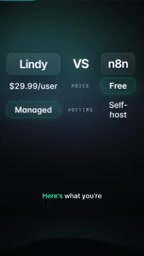
n8n's free self-hosted Community Edition can replace Lindy's $29.99/month AI agent service — if you're willing to manage Docker and bring your own model API keys.
This article frames a practical cost decision: pay $29.99/month for a managed AI agent service like Lindy, or self-host the open-source n8n to get the same capabilities for free. n8n Community Edition (~20.6k GitHub stars) includes a real AI Agent node, MCP protocol support, and human approval on tool calls. The trade-off: you must deploy and maintain your own Docker instance and supply your own LLM API keys (OpenAI, Anthropic, etc.). With no per-seat fees and no monthly credit resets, team growth doesn't drive up platform costs. The conclusion: this isn't about which tool wins — it's about two different cost structures. Managed services sell convenience; self-hosting sells freedom and control.
$29.99/Month or Do It Yourself?
Lindy charges every user $29.99 per month for its AI agent service. The open-source tool n8n, through self-hosting, can build virtually the same types of agents — completely free. The real question here isn't "which one is better," but rather what you're willing to trade for that zero cost.
For small-to-mid-sized teams and independent developers, per-seat SaaS subscriptions are often the biggest cost driver. As teams grow, monthly bills multiply. The n8n Community Edition offers an alternative path: swap operational overhead for zero subscription fees.
What n8n Community Edition Actually Offers
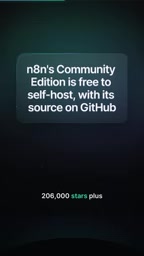
The n8n Community Edition is free to self-host, with source code publicly available on GitHub where it has accumulated roughly 20,600 stars and a fairly active community. This isn't some stripped-down toy — it includes the core capabilities needed to build real AI agents.
Specifically, it comes with three key features:
- A genuine AI Agent node: Gives workflows the ability to autonomously call tools and reason, rather than simple trigger-response automation.
- MCP support: Support for the Model Context Protocol means agents can connect to external tools and data sources in a standardized way — an increasingly important trend in the agent ecosystem.
- Human approval on tool calls: Inserts a manual confirmation step before agents execute sensitive operations, which is critical for production safety.
Taken together, these capabilities are enough to cover the tasks many teams currently rely on paid SaaS agent platforms to handle.
MCP (Model Context Protocol) is an open standard proposed and championed by Anthropic in late 2024, designed to solve the fragmented integration problem between AI models and external tools and data sources. Before MCP, every agent platform had to write separate integration code for each external tool — an extremely high maintenance burden. MCP defines a unified client-server communication spec: AI models act as clients, while tools (databases, APIs, file systems, etc.) expose standardized interfaces as MCP Servers, enabling interoperability after a protocol handshake. This means an agent platform that supports MCP can theoretically "plug and play" with any tool that has implemented an MCP Server, without the platform needing to build a custom adapter for each one. n8n's MCP support allows agents built on it to directly tap into the growing library of tools in the MCP ecosystem — which is also an important metric for evaluating an agent platform's long-term extensibility.
What Does "Free" Actually Cost You?
There's no free lunch. n8n's zero cost is built on the premise that you handle operations yourself — which is exactly what the article means by "what you're really trading."
The first cost is operational responsibility. You need to deploy and maintain your own n8n instance in a Docker environment, including the server, updates, backups, and uptime guarantees. For individuals without infrastructure experience, this is a meaningful barrier to entry.
The second cost is bringing your own model keys. n8n doesn't bundle any pre-packaged LLM call credits — you need to connect your own API keys from providers like OpenAI and Anthropic, and pay separately for actual token consumption. In other words, the orchestration platform is free; the model inference itself is not.

As a trade-off, this model also brings clear benefits: no per-seat pricing and no monthly credit resets. Growing your team doesn't directly drive up platform costs, and you have full control over your usage.
Docker is currently the most mainstream containerized deployment tool. It packages an application and its runtime dependencies into a portable "container image," allowing the same image to run consistently across different operating systems and server environments. The typical path to self-hosting n8n is: install Docker on a cloud server (such as AWS EC2, a DigitalOcean Droplet, or Alibaba Cloud ECS), pull the official n8n image, launch the service using a docker-compose configuration file, then set up a domain and HTTPS reverse proxy. For developers with a Linux background, this process typically takes 1–2 hours. But for users with no server experience, details like database configuration, port forwarding, and SSL certificate provisioning can all become stumbling blocks. Self-hosting also means you're responsible for keeping the instance continuously available — if the server goes down or an upgrade fails, there's no customer support to call. Troubleshooting is entirely up to you, relying on community docs and your own skills. That's what "operational cost" truly means.
How Do You Choose?
The value of managed services like Lindy lies in being "ready out of the box" — they handle deployment, model credits, and maintenance on your behalf, making them ideal for users who want to get started quickly without touching technical details. The monthly fee is what you pay for that convenience.
n8n self-hosting, on the other hand, suits three types of users: those with some technical ability, those who have data sovereignty requirements, and teams large enough that per-seat subscription costs have become prohibitive. You trade operational effort and self-managed API keys for zero subscription fees and complete control.

If you're about to start paying Lindy $29.99 per month, it's worth searching "n8n Community Edition" on GitHub first and spending some time evaluating whether self-hosting better fits your actual needs. For many use cases, the math works out quite favorably.
Takeaway
This isn't a battle where one replaces the other — it's a trade-off between two cost structures. Paid SaaS sells peace of mind; open-source self-hosting sells freedom and cost control. The key is honestly assessing your own technical capabilities and usage scale, then deciding whether your money is better spent on a subscription or on your own time and infrastructure.
Related articles

@ai-sdk/vue 3.0.306 Patch Release Syncs with [email protected] Update
@ai-sdk/vue 3.0.306 released, synced with [email protected]. A routine patch release for the Vercel AI SDK ecosystem with no public API changes; the Vue adapter layer stays version-aligned with the core package.

Gemini 4 Argon API Launches: The Era of Million-Token Output Begins
Google launches Gemini 4 Argon with sparse MoE architecture, up to 1M output tokens, and a 68.90% Vals Index score, available across API, AI Studio, and the Gemini app.

DukaanAI: Turning Product Photos into Inventory Lists with Open-Source AI
DukaanAI is an AI inventory tool for small retailers that turns product photos into inventory entries using the open-source Gemma 3 model, with local inference, editable fields, and CSV export.