n8n Workflow: Build a 24/7 WhatsApp AI Customer Service Bot

n8n workflow uses triggers, an AI agent, memory, and owned data to deliver second-level WhatsApp AI customer service.
The article breaks down an n8n workflow solution circulating on short-video platforms: when a user sends a WhatsApp message, the flow is triggered instantly, and an AI agent reads the content and generates a reply within seconds, enabling 24/7 unattended customer service. It emphasizes three key capabilities—triggers for immediacy, memory to retain conversation context, and replies based on enterprise-owned data for credibility—while noting that actual deployment must address WhatsApp API template restrictions, human fallback, and data privacy compliance.
n8n Workflow: Build a 24/7 WhatsApp AI Customer Service Bot
Customer service response speed directly determines conversion rates. A recently circulated n8n workflow solution on short-video platforms demonstrates how an AI agent can take over WhatsApp messages and deliver instant replies without any human typing. This article breaks down its core logic and practical value.
Core Mechanism: Trigger + AI Agent + Memory
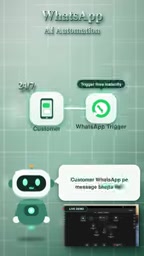
According to the short video, when a user sends a message to WhatsApp, the n8n workflow is triggered immediately, and the AI agent reads the message content and generates an intelligent reply within seconds. The entire process requires no human intervention, giving customers 24/7 uninterrupted responses.

The key to this flow lies in the immediacy of the "trigger"—it starts the moment a WhatsApp message arrives, rather than relying on polling or manual handoffs. For high-frequency inquiry scenarios such as e-commerce and local services, second-level response means lower customer churn.
What is n8n: n8n is an open-source workflow automation tool that uses node-based visual orchestration, where users build automation flows by dragging and connecting nodes. Each node represents an operation, such as receiving a webhook, calling an HTTP API, executing conditional logic, or invoking a large language model. n8n supports self-hosting, so data can remain on your own servers—particularly important for customer service scenarios involving customer conversation content. Compared with closed-source SaaS like Zapier, n8n's open-source nature means lower cost and greater customizability, but it also requires users to have some technical configuration ability.
Trigger mechanism: In n8n, a trigger is the starting node of a workflow, determining when the flow starts. Common types include webhook triggers (external systems invoke the flow via HTTP requests), scheduled triggers (polling on a schedule), and app event triggers. The scenario in this article uses an instant trigger invoked by WhatsApp message events, which differs from scheduled polling—the latter has a latency window, while event-driven processing handles messages as soon as they arrive, which is the technical prerequisite for achieving "second-level response."
How Memory Capabilities Change the Customer Service Experience
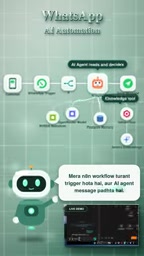
This solution particularly emphasizes the "memory" feature: the bot can remember previous conversation content. This means customers don't need to repeat their purpose, and context remains coherent across multi-turn communication.
From a technical implementation perspective, this typically relies on conversation history storage and retrieval mechanisms. Compared with stateless Q&A bots, an AI agent with memory is closer to the communication experience of a real human customer service representative, with obvious advantages especially in scenarios requiring continuous information, such as order inquiries and after-sales follow-ups.
What "memory" technically means for an AI agent: Large language models are inherently stateless—each call processes input independently and does not automatically retain the previous turn of conversation. So-called "memory" is usually implemented in two ways: first, session history concatenation, where previous conversation records are included in the context of the current request so the model can "see" the prior text; second, external memory storage, where conversation summaries or key information are written to a database or vector store and retrieved when needed. The former is simple to implement but limited by context window length—the longer the conversation, the higher the cost; the latter is better suited for long-term, multi-session customer relationship maintenance. Key entities commonly seen in e-commerce customer service, such as order numbers and shipping information, often need to be explicitly extracted and persisted to maintain coherence across multiple turns or even across days.
Replies Based on Your Own Business Data
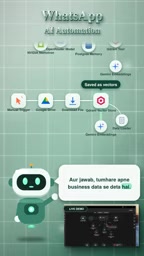
The solution mentions that AI replies are based on "your own business data." This is what distinguishes the workflow from generic chatbots—the reply content is not vague generalities but comes from the enterprise's own knowledge base or data sources.
This design is crucial to real-world results. In customer service scenarios, customers ask about specific products, prices, inventory, and policies, and answers from general models are often unusable. Only by connecting the AI agent to your own data can replies carry business credibility. n8n's node-based architecture allows such data integration to be completed through configuration, lowering the barrier to custom development.
RAG (Retrieval-Augmented Generation): The industry's mainstream approach to making AI answer based on enterprise-owned data is RAG. Its process is: first split product manuals, price lists, FAQs, policy documents, etc. into chunks and convert them into vectors stored in a vector database; when a user asks a question, the system vectorizes the question and retrieves the most relevant chunks, then feeds them together with the question into the large language model to generate an answer. In this way, the model's output is "anchored" to the retrieved real materials, reducing fabrication. Compared with fine-tuning models, RAG's advantages are that data updates take effect immediately without retraining, and answer sources can be traced. In n8n, this chain can be implemented by combining vector database nodes with LLM nodes—this is the common engineering form of "connecting your own business data."
Applicable Scenarios and Considerations
The short video comes from a creator promoting paid customization services, and the solution itself is more of a demonstration. Several points need attention during actual deployment: the official WhatsApp API has message template and review restrictions; AI replies involving price commitments and refund policies require human fallback mechanisms; memory storage involves customer data privacy and must be handled compliantly.
For small and medium teams wanting to validate quickly, n8n's open-source nature and visual orchestration make it a low-cost experimentation platform. A safer path is to first get the minimal loop of "message trigger—AI reply" working, then gradually layer on memory and business data.
Limitations of the WhatsApp Business API: If enterprises want to automate sending and receiving WhatsApp messages through official channels, they must use the WhatsApp Business Platform (Cloud API or on-premises version), not a regular personal account. Key constraints include: the enterprise must complete Meta business verification; proactively initiated conversations must use pre-approved message templates, and templates are approved by category such as marketing, transactional, and authentication; after a user proactively sends a message, a 24-hour customer service window opens, within which free replies are allowed, and beyond the window a template must be used again to re-engage. These rules directly affect workflow design—for example, scheduled follow-ups and order notifications must use templates, while instant Q&A can leverage the customer service window. Understanding these limitations is essential to avoid account bans or undeliverable messages.
Conclusion
The reference value of this n8n workflow solution lies in pulling "AI customer service" from concept down to a reproducible process level: triggers solve immediacy, memory solves coherence, and owned data solves usability. Only with all three in place does it constitute a customer service bot that can truly replace part of human work.
One-line Summary
n8n workflow uses triggers, an AI agent, memory, and owned data to deliver second-level WhatsApp AI customer service.
Paragraph Summary
The article breaks down an n8n workflow solution circulating on short-video platforms: when a user sends a WhatsApp message, the flow is triggered instantly, and an AI agent reads the content and generates a reply within seconds, enabling 24/7 unattended customer service. The solution emphasizes three key capabilities—triggers ensure immediacy, memory mechanisms retain conversation context so customers don't need to repeat their purpose, and replies are based on the enterprise's own business data rather than general model knowledge to ensure answers are specific and credible. The article also points out that the solution is more of a demonstration, and actual deployment must address the template and review restrictions of the official WhatsApp API, human fallback for sensitive scenarios such as pricing and refunds, and customer data privacy compliance. It recommends that small and medium teams first get the minimal loop from message trigger to AI reply working, then gradually layer on memory and business data.
Related articles

Chain of Thought Isn't Just for AI: How Humans Can Use CoT to Improve Thinking Quality
Chain of Thought isn't just a prompt trick for large models. Starting from a Hacker News discussion, this article analyzes why CoT works for human thinking too, breaks down actionable ways to transfer it, and highlights the key differences between human CoT and machine CoT.
Cloudflare Teams Up with OpenAI: Closi…
Cloudflare Teams Up with OpenAI: Closing the Loop from Vulnerability Discovery to Defense with AI
Cloudflare uses OpenAI Daybreak to investigate security vulnerabilities and generate reviewable remediation plans, while developers use Codex to boost coding efficiency and quality.

Orca Multi-Agent Orchestration in Practice: A Guide to Parallel Collaboration with Claude and Codex
Orca is Stable AI's free open-source agent workbench supporting 34 agents like Claude Code and Codex in parallel. Learn its Git worktree isolation, multi-model orchestration, and mobile management.