Nacon Revolution 5 Unlimited: The First PS5-Licensed Controller with a Built-In Screen

Nacon unveils the world's first officially licensed PS5 controller with a built-in screen for real-time tuning and audio mixing.
The Nacon Revolution 5 Unlimited is the world's first Sony-licensed PS5 controller with an integrated screen, allowing players to adjust stick sensitivity, remap buttons, and switch profiles without leaving their game. Its standout audio mixing feature lets users blend sound from both their console and phone through a single headset with real-time volume control, eliminating the need for external mixers. Official licensing ensures better system compatibility and firmware support compared to unlicensed alternatives. The product reflects a growing industry trend of moving more control functionality directly onto the controller itself.
A PS5 Controller That "Thinks" for Itself
Nacon has unveiled what it claims to be the world's first officially licensed PlayStation 5 controller with a built-in screen — the Revolution 5 Unlimited. Unlike high-end controllers that require a PC app or companion smartphone app to adjust settings, this one brings the configuration interface directly onto the controller itself. Players can tweak analog stick sensitivity, remap buttons, and more without ever letting go of the device.
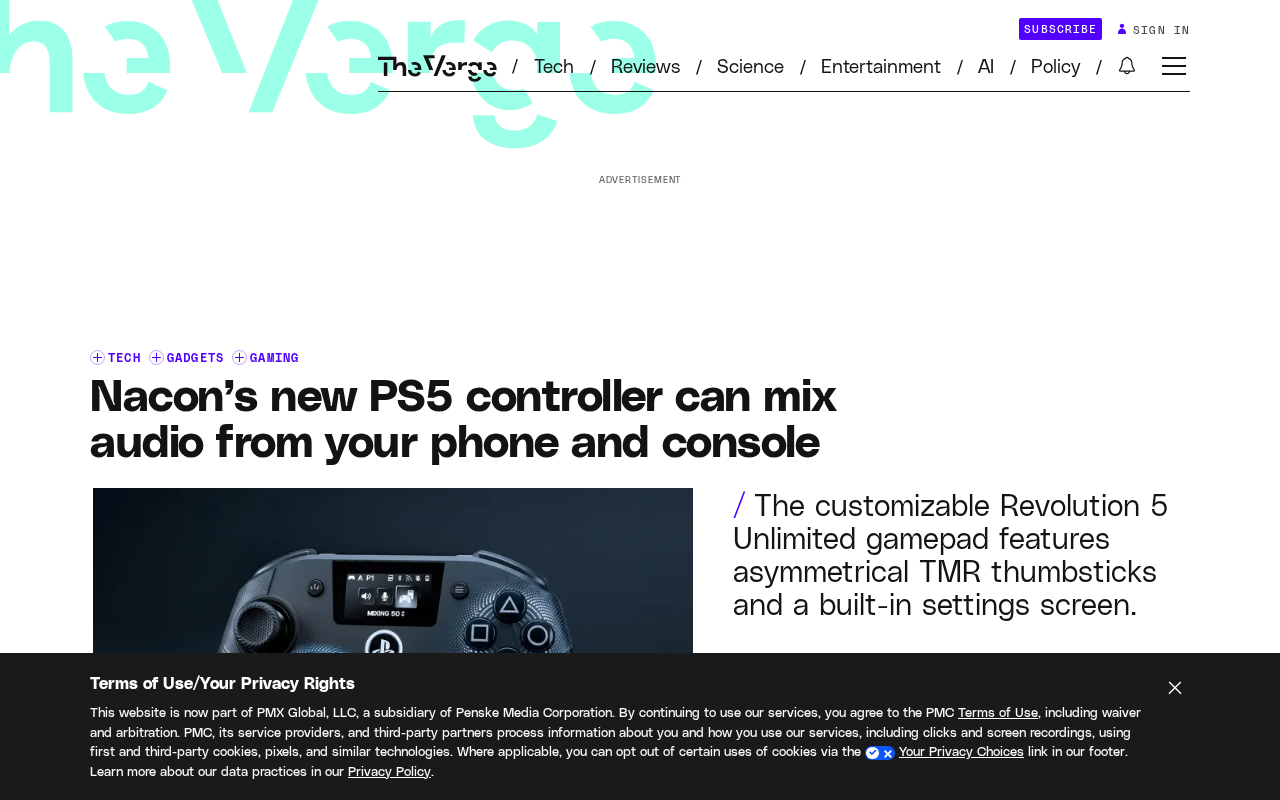
For console gamers, this "what you see is what you get" approach addresses a long-standing pain point. Adjusting settings on a pro controller typically means quitting a game, opening companion software, and navigating menus — a process that's cumbersome and breaks immersion. Integrating a screen into the controller means players can make on-the-fly tweaks without ever leaving the game.
What the Built-In Screen Actually Does
According to Nacon, the Revolution 5 Unlimited's screen primarily serves two purposes.
Real-Time Game Parameter Adjustment
The screen can be used to fine-tune analog stick sensitivity and remap button layouts. For competitive players, stick curves and button configurations often vary significantly between games. Having a screen on the controller makes switching between these setups far more intuitive. Players can save profiles for different games and recall them quickly, without relying on an external device.
Multi-Source Audio Mixing
The other major highlight of this screen is its audio mixing capability. While using a single pair of headphones, players can blend multiple audio sources from both their phone and console simultaneously. This means you can game while listening to a voice call, music, or streaming content from your phone through the same headset — and adjust the volume balance of each source in real time.
This feature targets a very modern use case: gaming while voice chatting with teammates, listening to podcasts, or taking calls on a phone has become completely routine. Integrating audio mixing into the controller itself eliminates the need for a separate audio mixer or sound card.
Built-in audio mixing in a controller typically relies on a dedicated DSP (Digital Signal Processor) chip that handles sample rate alignment, gain adjustment, and blending of multiple audio streams locally before routing the output to the 3.5mm headphone jack. This is functionally identical to how external mixers like the Astro MixAmp work — the difference is that the entire hardware stack has been miniaturized and integrated into the controller. Latency is the most critical metric for this type of solution: if there's a discrepancy of more than a few tens of milliseconds between mixed sources, players will experience noticeable audio positioning errors during gameplay. The actual DSP solution Nacon uses and its measured mixing latency will be the key indicators for evaluating the audio quality of this controller.
Why "Officially Licensed" Matters
Nacon emphasizes that this is the "world's first officially licensed" PS5 controller with a screen. Official licensing matters for compatibility and stability — unlicensed third-party controllers on the PS5 frequently suffer from disconnections, feature limitations, or breaking entirely after firmware updates. Sony's official authorization means the controller receives better support at the system level.
As a veteran gaming peripheral manufacturer, Nacon has long been focused on the high-end controller market. The Revolution series has previously been known for professional-grade features like customizable weights, swappable thumbsticks, and remappable buttons. Adding a screen to the Revolution 5 Unlimited represents Nacon's latest push to further differentiate itself in the pro gaming market.
Sony's PS5 official authorization program — the PlayStation Authorized Peripheral Program — requires third-party manufacturers to submit their hardware designs and firmware implementations to Sony's technical review process, ensuring their products can correctly identify and communicate using PS5's proprietary protocols. The issues with unlicensed controllers are no accident: the PS5 has verification logic in certain game modes (such as when invoking adaptive triggers and haptic feedback) that checks the controller's identity. Unauthorized devices may be downgraded by the system or denied certain permissions entirely. Furthermore, every major PS5 firmware update can alter the controller handshake mechanism — which is precisely why unlicensed controllers frequently "break" after updates. Officially licensed products can participate in Sony's compatibility testing pipeline, and in theory can be updated in sync with firmware changes, offering consumers a longer, more reliable product lifespan.
What This Means for the Controller Market
A screen on a controller isn't an entirely new concept, but its appearance in an officially licensed product for a mainstream console is genuinely unprecedented. It signals a broader trend: peripheral manufacturers are increasingly trying to offload functionality that would normally be handled by the console or software onto the controller itself, improving operational efficiency and user freedom.
From a user experience standpoint, this design is both a convenience and a challenge. The screen raises the controller's functional ceiling, but it may also bring higher costs, a steeper interaction learning curve, and additional strain on battery life. Whether this controller can hold its ground in the high-end market will ultimately come down to build quality, screen responsiveness, and the real-world latency performance of the audio mixing.
For hardcore players who demand ultimate customizability and multitasking capabilities, the Revolution 5 Unlimited offers something new — a configuration hub and audio mixing console, all held in the palms of your hands.
Related articles

Felix Rieseberg Personal Homepage
Felix Rieseberg's personal homepage sparks attention on Hacker News. This article covers the Slack engineer's technical background, the rise and fall of nativefier, and the value of a developer homepage as a tech calling card.

@ai-sdk/vue 3.0.306 Patch Release Syncs with [email protected] Update
@ai-sdk/vue 3.0.306 released, synced with [email protected]. A routine patch release for the Vercel AI SDK ecosystem with no public API changes; the Vue adapter layer stays version-aligned with the core package.

Gemini 4 Argon API Launches: The Era of Million-Token Output Begins
Google launches Gemini 4 Argon with sparse MoE architecture, up to 1M output tokens, and a 68.90% Vals Index score, available across API, AI Studio, and the Gemini app.