Naise AI: The Autonomous Marketing Agent That Actually Executes

Naise AI is an autonomous marketing agent that claims to replace an entire marketing team end-to-end.
Naise AI is an AI tool positioned as an "autonomous marketing agent" for founders and lean teams. Unlike most AI marketing tools that stop at text generation, it focuses on actual task execution. Its three core features are: Persistent Memory for consistent brand voice, Prompt Playbooks to lower the barrier to entry, and full-funnel automation covering KOL outreach, media pitching, and social content scheduling. The platform claims it can take a campaign from cold start to launch in 24 hours and save teams 40+ hours per week. It debuted on Product Hunt with 209 upvotes and ranked #2 for the day — though the quality of AI-driven external outreach, the reliability of its efficiency claims, and actual marketing ROI still need real-world validation.
From "Chat Box" to "Actually Executing": A New Kind of Marketing Agent
Most AI marketing tools stop at generating text — they hand you a blank chat window, you keep typing prompts, and you end up with a pile of drafts that still require human editing. Naise AI aims to break this "hand-holding" pattern by pushing AI beyond just "writing" to actually "doing."
After launching on Product Hunt, Naise AI quickly racked up 209 upvotes and 37 comments, climbing to #2 on the day's leaderboard — featured across the Social Media, Marketing, and Artificial Intelligence categories. For a tool built around autonomous execution, that kind of community response signals it's hitting a real pain point for many founders.
Core Pitch: An Entire AI Marketing Department
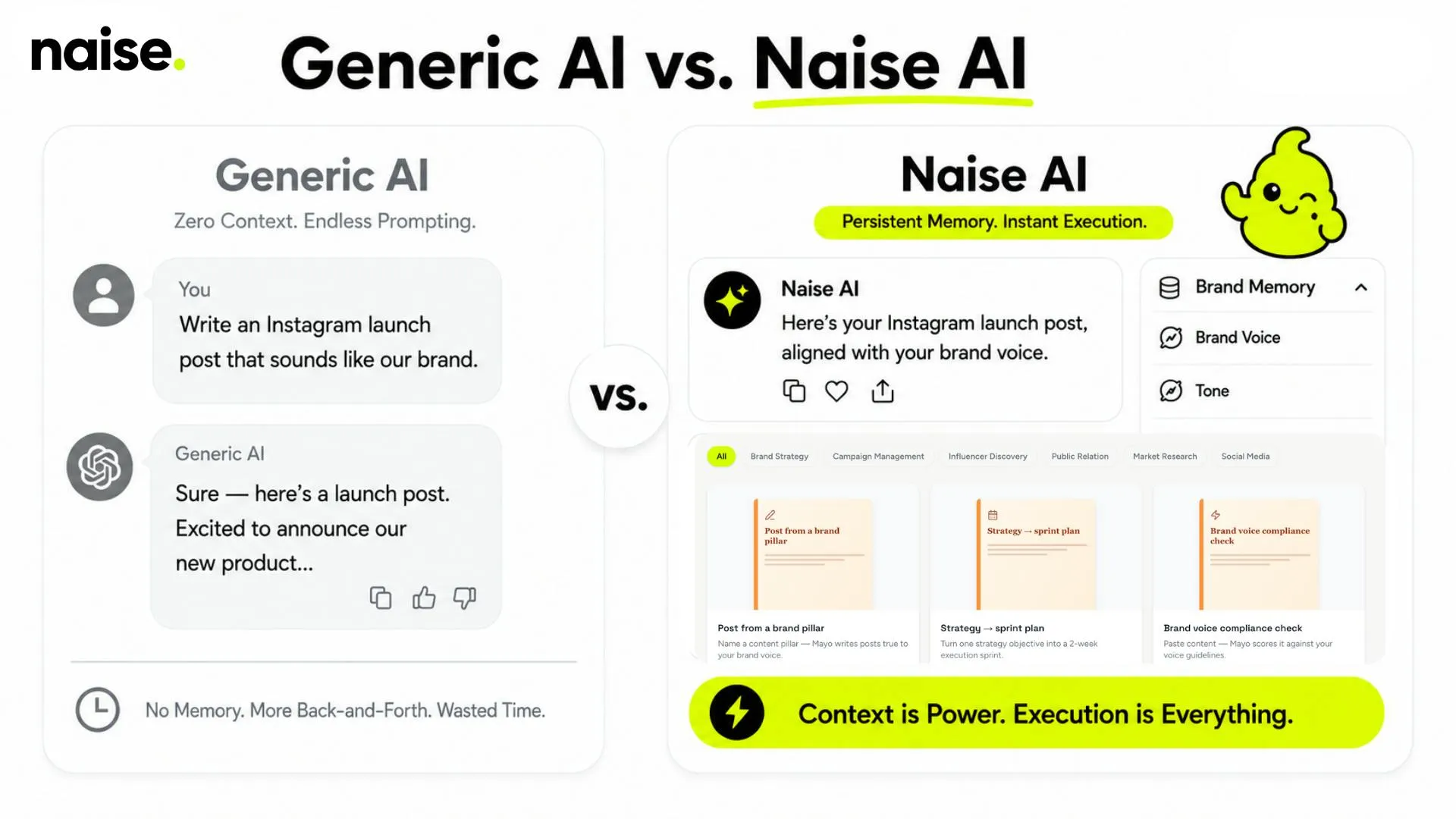
Naise AI's positioning is clear — deliver "the output of an entire marketing department" for founders and lean teams, without the headcount costs. Its official tagline is "Autonomous marketing agents that actually execute," built around three core pillars.
Persistent Memory to Lock In Brand Voice
Brand consistency is one of the easiest things to lose when using AI-generated content. Naise AI introduces a Persistent Memory mechanism that lets users define brand guidelines upfront, so the AI maintains a consistent tone, style, and positioning across all future outputs — no need to re-explain the context every single time.
On a technical level, Persistent Memory is typically implemented in one of two ways: either by vectorizing brand guideline documents and storing them in a vector database (such as Pinecone or Weaviate), retrieving relevant chunks to inject into the prompt context at generation time; or by enforcing brand rules as a structured System Prompt prepended at the start of each session. The former works well for content-heavy use cases with rich stylistic nuance; the latter is simpler to implement but constrained by context window length. For users, the quality of this memory mechanism directly determines whether brand consistency can actually hold up in practice — if memory recall is imprecise or the rules have gaps, the AI can still drift in tone, word choice, or values, which is a particularly high-stakes risk for public-facing content.
Prompt Playbooks to Lower the Barrier to Entry
The platform provides Prompt Playbooks for users to choose from — essentially templatizing common marketing scenarios. Instead of crafting complex prompts from scratch, users pick a pre-built playbook and let the platform handle the execution. This design significantly lowers the learning curve for non-marketers.
End-to-End Automation Across the Entire Campaign Funnel
Naise AI claims to handle multiple real-world marketing execution tasks: sourcing and connecting with real influencers and KOLs, pitching journalists for media coverage, and natively creating and scheduling social media content. From cold start to campaign launch, the platform claims it can all happen within 24 hours.
The Efficiency Promise: 40+ Hours Saved Per Week
The product's most compelling claim is around efficiency. According to Naise AI, teams can save more than 40 hours per week while also cutting marketing spend. For early-stage startups with limited headcount, that means offloading repetitive execution work — the kind that would normally require a dedicated marketing team — to an autonomous agent, freeing founders to focus on strategy and product.
This class of "Autonomous Agents" represents a major trend in AI applications right now: moving from passive, response-driven generation tools toward execution systems capable of breaking down tasks, calling external tools, and completing multi-step workflows. Marketing is a natural fit for agent deployment, given its high degree of process standardization and clear measurable outcomes.
Technically, autonomous agents typically rely on Tool Use and multi-step planning: the model receives a high-level goal, automatically decomposes it into subtasks, calls external tools (search, email, content publishing) in sequence, and dynamically adjusts subsequent steps based on intermediate results. The fundamental difference from traditional chat-based AI is that the latter produces stateless, one-off responses per conversation, while autonomous agents maintain task context across sessions, forming a closed execution loop. Today's leading implementation frameworks include OpenAI's Assistants API, LangChain Agents, and AutoGPT — all tackling the same core challenge: how to make large language models reliably drive real-world actions, not just describe them in text. Marketing has become an early hotspot for agent deployment partly because many of its subtasks (search, copywriting, scheduled publishing) already have mature APIs available, which reduces the risk of AI hallucinations causing serious downstream consequences.
Questions Worth Asking
For all its appeal, a few critical areas deserve a clear-eyed look. First, "sourcing real influencers" and "pitching journalists" both involve external relationships and interpersonal communication — the quality and compliance boundaries of AI-automated outreach are central to whether this actually works. Second, claims like "launch a campaign in 24 hours" and "save 40 hours a week" are vendor-stated figures without independent third-party verification. Third, marketing effectiveness ultimately comes down to conversion and ROI, not the volume of content produced.
For lean teams, Naise AI offers an attractive direction — using agents to fill the execution gap that a marketing hire would otherwise cover. But whether it truly delivers "an entire marketing department" or is better described as "a highly efficient content scheduling assistant" is something that only real-world use can answer. For those interested, it's worth piloting in a narrow use case first, paying close attention to the quality of AI-driven external outreach and the stability of brand voice consistency.
Takeaway
Naise AI represents a meaningful data point in the evolution of AI marketing tools — from generation to execution. Its Persistent Memory, Prompt Playbooks, and full-funnel automation all point toward the same goal: helping founders break free from the cycle of endlessly prompting a chat window, and instead getting marketing outcomes they can actually use. Its strong Product Hunt ranking reflects genuine market appetite for this direction. Whether the promised efficiency numbers hold up in practice, however, will ultimately depend on real-world results from real users.
Related articles

WebMCP Security Guide: Three Hints That Make AI Agents Safer
The Chrome team demonstrates three security hints for WebMCP tools: readOnlyHint eliminates invalid confirmation dialogs, consequentialHint forces human confirmation for high-risk operations, and untrustedContentHint defends against indirect prompt injection—improving AI agent security with one or two lines of code.

Why Turbulence Is the Hardest Problem in Fluid Mechanics — and How AI Could Crack It
Why is turbulence the hardest problem in fluid mechanics? This article, based on a Lex Fridman podcast conversation, explores turbulence's multi-scale nature, comparisons with classical thermodynamics, and how AI might simplify turbulence description by discovering coordinate transformations — examining the intersection of vortex formation with mathematics and physics.

R.L. Stine Google Talk: How the Master of Horror Ignites Kids' Passion for Reading
At a Google talk, R.L. Stine shares his accidental pivot from comedy to horror, his principles for children's horror, how phones impact storytelling, and how Goosebumps motivates kids to read.