Naive RAG Is Lying to You: 7 RAG Architectures That Survive Production
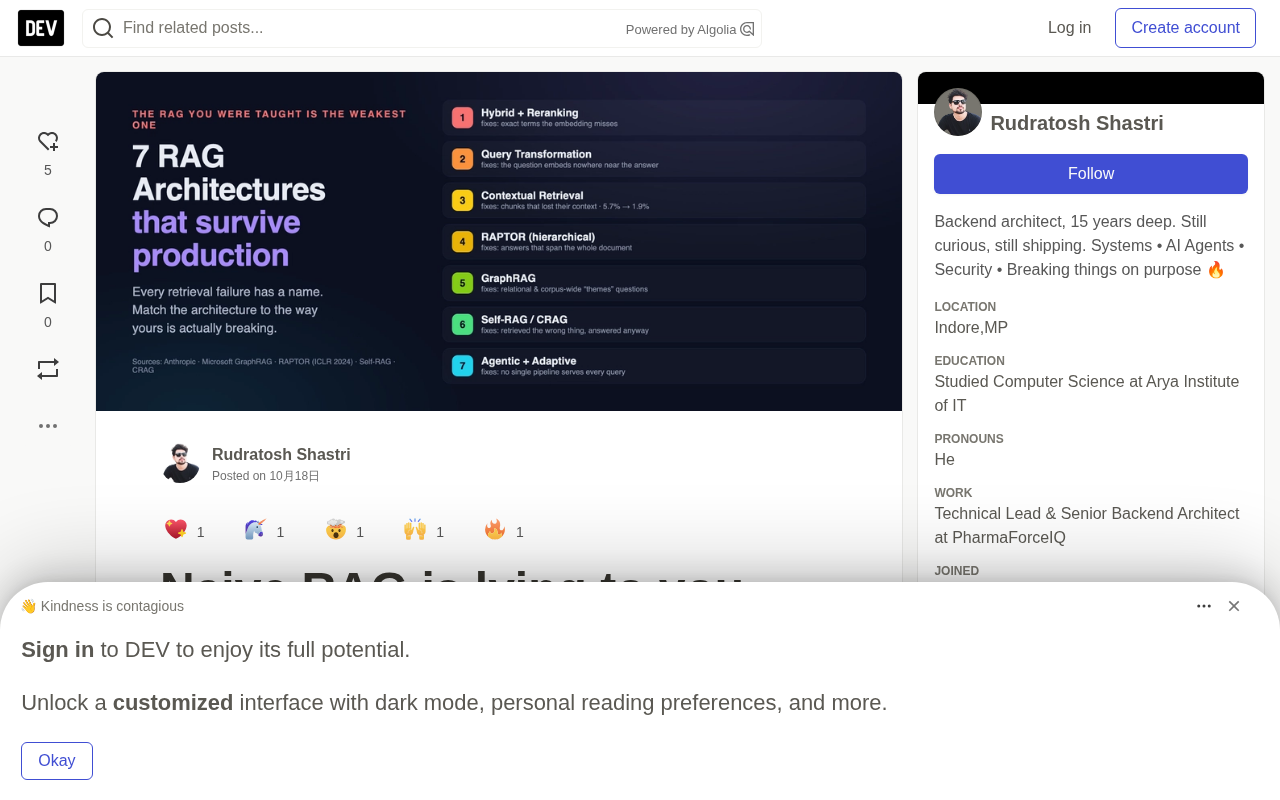
There is no single advanced RAG — seven architectures each fix one retrieval failure; diagnose the failure, then pick the tool.
The article argues that Naive RAG's failure isn't a pipeline malfunction but the fact that it executes the wrong assumption precisely — stuffing documents into a vector store is only the easy half. The core work of production-grade RAG is getting the right information into the context window. It first identifies five retrieval failure modes: vocabulary mismatch, lost context, question-answer embedding distance, answers spanning whole documents, and retrieved-but-still-wrong. It then walks through seven targeted architectures: hybrid search plus reranking (the baseline), query transformation (multi-query, RAG-Fusion, HyDE, step-back prompting), contextual retrieval (Anthropic reports failure rate dropping from 5.7% to 1.9%), RAPTOR hierarchical retrieval, GraphRAG, Self-RAG and Corrective RAG, and agentic RAG with adaptive routing. Finally it gives an ordered set of deployment decision rules and warns that all figures come from their respective papers rather than a unified benchmark, emphasizing testing against real user questions.
Why Does Your Carefully Built RAG Demo Collapse in Production?
Every team's first RAG pipeline looks almost identical: chunk the documents, generate embeddings, take the top-k by cosine similarity, stuff them into the prompt, and let the model answer. The demo looks impressive, the answers sound right, so you ship it.
Then someone asks a question that actually matters, and it retrieves the wrong chunk; or it finds the right document but misses the exact passage you needed; or the answer is sitting right there in the database and the model never saw it.
Nothing is broken — the pipeline is doing exactly what you told it to do, and that is precisely the problem. What you built is Naive RAG, and it isn't useless — it's the starting point. Stuffing documents into a vector store is only the easy half; getting the right information into the model's context window is the real work, and Naive RAG barely attempts it.
The core reframing of this article: there is no single "advanced RAG". There are seven distinct architectures, each of which exists because retrieval fails in a specific way. Pick the wrong one and you're just adding cost and latency for nothing. So before listing architectures, learn to name the failure.
Five Ways Retrieval Fails
The original article lays out five core failure modes:
- Vocabulary mismatch: A user searches "how to cancel" but the document says "terminate subscription." Semantic search helps mitigate this, but exact terms, product codes, and names still slip through.
- Lost context: A chunk says "revenue grew 3%" — but whose? Which quarter? The chunk was torn out of the document, and the embedding knows nothing about it.
- The question isn't the answer: A short question sits far from that long, technical answer text in vector space — the vectors simply don't line up.
- The answer is the whole document: "Summarize the themes across these 400 reports" cannot be answered by any arbitrary 5 chunks; no top-k can reach it.
- Retrieved, but still wrong: The system retrieves plausible chunks that don't contain the answer, and the model confidently answers from them anyway.
Each architecture below targets one or two of these failure modes. Match them up and you can stop blindly piling on complexity you don't need.
1. Hybrid Search + Reranking
Fixes: vocabulary mismatch
This is the upgrade everyone should make before chasing anything fancier, and most people skip it in the rush to agents.
Pure vector search is semantic: great at matching "cancel" to "terminate," but helpless with exact matches like error codes or rare surnames. Hybrid search runs dense vector search and classic keyword search (BM25) and fuses the results, usually with Reciprocal Rank Fusion, which sums 1 / (k + rank) for each document across the lists it appears in. Dense retrieval captures meaning; BM25 captures the literal tokens that embeddings smooth away.
Then you rerank. Retrieval is tuned for speed, so you over-fetch (say, 150 candidates), and a slower cross-encoder rescores them against the query, keeping the best 20. A cross-encoder reads the query and document together, so it catches relevance that bi-encoder embeddings miss.
When to use: always. This is table stakes, not an advanced trick. If your RAG has no reranker, fix that before reading on.
BM25 is a classic term-frequency-based retrieval algorithm in the sparse retrieval family. It scores documents using three factors: how often the query term appears in the document (TF), how rare that term is across the whole corpus (IDF), and document-length normalization. Unlike dense vectors, BM25 does no semantic generalization at all, making it extremely sensitive to exact token matches — error codes, product model numbers, rare surnames. Its limitation is that it can't handle synonyms or paraphrases, which is exactly why it needs to be fused with vector search.
Cross-Encoder differs from the bi-encoder primarily in how it takes input. A bi-encoder encodes the query and document separately into vectors and computes cosine similarity — fast, but it loses fine-grained interaction information. A cross-encoder concatenates the query and document and feeds them together into a Transformer, letting the attention mechanism fully interact between the two and capture much deeper relevance signals. The cost is that document representations can't be precomputed — each query-document pair requires a forward pass — so it's only suited for fine-ranking a small set of candidates.
2. Query Transformation
Fixes: the question isn't the answer
A user types a short, messy question whose embedding sits far from the answer. So rewrite the question before searching. Four variants:
- Multi-Query: have an LLM restate the question 3-4 ways, retrieve separately, and merge, capturing angles the original query missed.
- RAG-Fusion: multi-query plus Reciprocal Rank Fusion of the merged results. Documents that recur across restatements float to the top. Original-work caveat: if the generated queries drift, the answers drift too.
- HyDE (Hypothetical Document Embeddings): instead of embedding the question, have an LLM write a fake answer and embed that for search. A hypothetical answer looks more like a real document than a question does. It can hallucinate a bad hypothesis, so pair it with reranking.
- Step-back prompting: for a narrow question, first ask a more general one ("What is the principle behind X?"), retrieve the background, then answer the specific question.
When to use: when the right document exists but the query can't find it. Low cost — just one extra LLM call.
3. Contextual Retrieval
Fixes: lost context
When you chunk a document, every chunk loses the surrounding story. "Revenue grew 3%" is useless without "ACME Corp, Q2 2026." Anthropic's contextual retrieval prepends each chunk with a short LLM-generated description that puts it back in document context before embedding, so both the vector index and the keyword index carry context.
This is the only architecture in this article with clean public numbers. Share of queries where the correct chunk is not in the top 20:
| Configuration | Failure rate | Reduction |
|---|---|---|
| Baseline (Naive RAG) | 5.7% | — |
| + Contextual embeddings | 3.7% | 35% |
| + Contextual BM25 | 2.9% | 49% |
| + Reranking | 1.9% | 67% |
With prompt caching, the cost is roughly $1.02 per million document tokens, one-time. One honest caveat: these numbers come from Anthropic's tests with the best-performing embedding model, not average ones. Still, a single preprocessing step taking 5.7% → 1.9% is one of the highest returns on this entire list.
Prompt Caching is the key mechanism that makes contextual retrieval affordable. When generating a contextual description for each chunk, the whole document must be fed to the LLM as part of the prompt over and over. If the full text were reprocessed on every call, cost would balloon linearly with document count. Prompt caching lets the document content be cached server-side, so subsequent calls only pay for the newly added chunk — compressing one-time context-generation cost to roughly $1.02 per million document tokens. This mechanism is offered by vendors such as Anthropic and is the precondition for this architecture being economically viable.
4. Hierarchical Retrieval (RAPTOR)
Fixes: the answer is the whole document
Flat chunking assumes the answer lives in one paragraph. For "what's the overall thesis of this 80-page report," no single chunk can hold it. RAPTOR builds a tree: cluster related chunks, generate a summary for each cluster, then cluster and summarize the summaries, all the way up. Queries retrieve across levels, grabbing fine-grained details and high-level synthesis.
The paper reports roughly a 20-point absolute accuracy gain on the QuALITY benchmark (long-document QA) with GPT-4, state of the art at the time. Treat that as the paper's result on its dataset, not a promise for your corpus.
When to use: long structured documents whose questions span chapters — contracts, research papers, financial reports, technical manuals. For an FAQ it's overkill.
5. GraphRAG
Fixes: relational and corpus-level questions
Vector RAG is blind to relationships. "How are these two people connected," "what themes run through all the incident reports" — these aren't similarity questions, and top-k can't find them. Microsoft's GraphRAG uses an LLM to extract entities and relationships into a knowledge graph, then runs community detection (the Leiden algorithm) to cluster the graph structure and pre-summarizes each cluster bottom-up.
Two modes: local search walks the graph from entities near the question (cheap, usually one LLM call). Global search answers "what are the themes" via map-reduce over all community summaries — powerful and expensive: one traced run shows a single global query needs 10+ LLM calls and ~200K tokens, versus ~11,500 tokens for a local query.
The cost: indexing. Building the graph requires hundreds of LLM calls over the corpus, up front. Microsoft later introduced LazyGraphRAG to cut this cost. Use it when relationships and global synthesis are the real job and the corpus is stable enough to amortize indexing. Don't put it in front of a customer service desk.
The Leiden algorithm is a graph clustering algorithm for community detection and an improved version of Louvain. It iteratively optimizes modularity to partition graph nodes into communities such that intra-community connections are dense and inter-community connections are sparse. In GraphRAG, Leiden is used to cluster entities and relationships in the knowledge graph into semantic communities, each corresponding to a topic cluster, from which an LLM generates summaries bottom-up. Compared to Louvain, Leiden guarantees intra-community connectivity, avoiding fragmented and unreasonable groupings — which makes the resulting community summaries higher quality and better suited as retrieval units for global search.
6. Self-RAG and Corrective RAG
Fixes: retrieved, but still wrong
Sometimes retrieval returns confident garbage, and the model swallows it whole. These two architectures add a check.
Self-RAG trains the model to emit "reflection tokens": it decides whether to retrieve, judges whether each passage is relevant, and critiques whether its own answer is actually supported. The judgment lives inside the model.
Corrective RAG (CRAG) puts the judgment outside: a lightweight evaluator scores retrieved documents as correct, ambiguous, or incorrect. On a bad score it doesn't push ahead — it triggers a fallback (usually web search) to find better sources first. It's easier to graft onto an existing pipeline than Self-RAG, which requires training tokens.
When to use: high-stakes answers where a confident error is worse than "I can't verify" — customer service, compliance, medical, legal. Extra latency per query, so save it for the questions that deserve it.
7. Agentic RAG (and Adaptive Routing)
Fixes: no single pipeline serves all queries
The six above are tools; agentic RAG is the process that picks and chains them. Instead of one-shot retrieve-then-answer, an agent plans: decide what to look up, retrieve, check whether it's enough, retrieve again with a better query, maybe call a second index, verify before answering. Multi-step questions become possible.
The danger: running an agent loop on every query is slow and expensive, and most questions don't need it. That's why the emerging 2026 default is adaptive RAG: a cheap classifier sits in front and routes each query to the lightest pipeline that can answer it. Simple lookup → hybrid search; relational → graph; multi-step → agent. Pay for complexity only when the question demands it.
Adaptive RAG centers on a lightweight query classifier, typically run before the LLM call. Based on the query's complexity, type, and required information structure, it routes the request to the most appropriate retrieval pipeline — simple fact lookups go to hybrid search, relational questions to graph retrieval, multi-hop reasoning to an agent loop. The classifier itself can be a small model or a rule system, costing far less than running every query down the heaviest path. The point of this pattern is to turn "pay as you go" from a slogan into an architectural decision: complexity is introduced only when the question truly needs it, rather than enabled by default.
The Full Picture and Deployment Decisions
| # | Architecture | Failure fixed | Cost |
|---|---|---|---|
| 1 | Hybrid + Rerank | Exact terms embeddings miss | Low · always do |
| 2 | Query Transformation | Question embeddings far from answer | Low · +1 call |
| 3 | Contextual Retrieval | Chunks losing context (5.7%→1.9%) | ~$1/M tokens, one-time |
| 4 | RAPTOR (hierarchical) | Answer spans whole document | Medium · indexing |
| 5 | GraphRAG | Relational and corpus-level "theme" questions | High · indexing needs hundreds of calls |
| 6 | Self-RAG / CRAG | Bad retrieval answered anyway | Medium · extra call per query |
| 7 | Agentic + Adaptive | No single pipeline serves all queries | Variable · pay as you go |
The honest decision rule, in order:
- Everyone: hybrid search + reranking. Skip this and nothing else matters.
- Recall still patchy? Add query transformation, one extra call.
- Chunks losing their meaning? Add contextual retrieval — the best value on the list.
- Questions span whole documents? RAPTOR.
- Questions relational or corpus-level? GraphRAG, if you can afford the indexing.
- Confident wrong answers hurt? CRAG or Self-RAG.
- One product with many query types? Put adaptive routing in front and let it dispatch.
One warning about the numbers: contextual retrieval's reduction, RAPTOR's QuALITY gain, and GraphRAG's token costs all come from their respective papers and vendor articles, not a controlled head-to-head benchmark. There is no clean 2026 study running all seven on the same corpus. Treat them as directional guidance and run the only benchmark that decides anything: take ten real questions from your own users, define what counts as a correct answer, and test each architecture against that.
The skill that separates a toy demo from production-grade RAG isn't knowing the fanciest architecture — it's diagnosing which of the five failures you have, then reaching for the tool that fixes it. Naive RAG was failing you silently; the fix starts with naming the failure.
References: Anthropic, "Introducing Contextual Retrieval"; Sarthi et al., RAPTOR (ICLR 2024); Microsoft GraphRAG; Asai et al., Self-RAG (arXiv:2310.11511); Yan et al., Corrective RAG (arXiv:2401.15884); Rackauckas, RAG-Fusion (arXiv:2402.03367); Gao et al., HyDE (2022). All figures are results reported by their respective sources, not a unified benchmark.
Related articles

Former Cursor Engineer: Is Agent Harness Dead? The Data Flywheel and Three Things the Model Can't Absorb
Former Cursor Agent Harness engineer Jediah Katz breaks down Harness evolution: how the data flywheel lets models absorb coding skills, why Harness isn't dead, and why infrastructure, trust, and efficiency can't be absorbed by models.

Cursor Practical Guide: Core Features of the AI Programming Tool and Development Efficiency Comparison
A deep dive into the Cursor AI programming tool from a Bilibili tutorial: AI-native design, intelligent code generation, context awareness, and efficiency comparisons with VS Code across completion, debugging, and refactoring, plus target user analysis.

Trump's Request to Rename the Atlantic Rejected by Google; 1Password Lets AI Agents Log In Securely
The Vergecast roundup: Trump's request to rename the Atlantic the 'Trump Ocean' was politely declined by Google's CEO; 1Password's new feature lets AI agents log into accounts without touching passwords; OPPO launches the world's first 200-megapixel phone, the Find X10 Pro Max. All three point to the boundaries of tech authorization and trust.