Naive RAG vs. Advanced Hybrid RAG: Two Paradigms of Retrieval-Augmented Generation

Naive RAG uses one vector search; Advanced Hybrid RAG stacks BM25, metadata filtering, and re-ranking for far better precision.
RAG comes in two typical flavors. Naive RAG performs a single vector similarity search and feeds results directly to the LLM — simple and fast, ideal for prototyping, but limited in precision for production use. Advanced Hybrid RAG combines vector search, BM25 keyword retrieval, metadata filtering, and cross-encoder re-ranking to deliver significantly higher recall precision and answer reliability at the cost of greater engineering complexity. The two architectures aren't mutually exclusive; Naive RAG suits early validation while hybrid RAG becomes the practical standard once applications move to production.
Retrieval-Augmented Generation (RAG) has become a cornerstone technology for building enterprise-grade LLM applications, enabling language models to generate more accurate, traceable answers grounded in external knowledge bases. In practice, however, RAG isn't a one-size-fits-all solution. A YouTube tech tutorial recently offered a clear breakdown of two archetypal architectures: Naive RAG and Advanced Hybrid RAG. Understanding the difference between them is the first step toward designing a reliable retrieval pipeline.
Naive RAG: Simple, Straightforward Single-Path Retrieval
The Naive RAG workflow is refreshingly direct: when a user asks a question, the system converts the query into a vector, performs a single vector similarity search, retrieves the most relevant chunks, and feeds those chunks along with the original question directly into the LLM to generate an answer.

The entire pipeline has just one retrieval step — no additional filtering, no re-ranking. The original video uses a fitting analogy: Naive RAG is like asking a librarian to glance at the spines and grab the first book off the shelf. Its strengths are simplicity and speed, making it ideal for prototyping and quick demos.
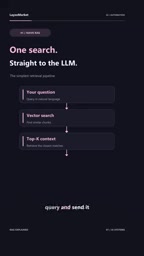
But that simplicity comes with clear drawbacks. Single-pass vector retrieval handles semantically similar but differently phrased queries well, yet it can miss exact keyword matches. The absence of metadata filtering means you can't narrow results by date, source, or access permissions. Without re-ranking, the relevance ordering of retrieved results remains coarse. In production environments with large knowledge bases and complex queries, these shortcomings directly degrade answer quality.
Vector similarity search depends fundamentally on a text embedding model, which maps text chunks into a high-dimensional dense vector space where semantically similar texts sit closer together. Common distance metrics include cosine similarity and dot product. To achieve millisecond-level retrieval across millions of vectors, real-world systems typically use approximate nearest neighbor (ANN) index structures like HNSW or IVF, trading a small amount of accuracy for a dramatic speed boost. This also means the recall ceiling of Naive RAG is largely determined by how well the chosen embedding model represents domain-specific text — if the model lacks understanding of specialized terminology, retrieval results will be systematically skewed even when the retrieval logic itself is correct.
Advanced Hybrid RAG: Combining Multi-Path Retrieval with Precision Re-Ranking
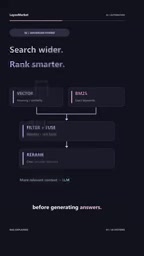
The core idea behind Advanced Hybrid RAG is this: before generating an answer, layer multiple retrieval strategies together with filtering to maximize the quality of context sent to the LLM. According to the video's breakdown, it typically integrates the following components:
- Vector Search: captures semantic relevance
- Keyword Retrieval (BM25): fills the gap for exact term matching
- Metadata Filtering: narrows the candidate set using structured attributes
- Cross-Encoder Re-ranking: scores and reorders candidate chunks with precision

The video's analogy is equally vivid: if Naive RAG is one person grabbing a book by its title, Advanced Hybrid RAG is like a research team simultaneously querying multiple indexes, filtering the results, and surfacing the top 3 verified pages. The two approaches differ by orders of magnitude in retrieval breadth, precision, and trustworthiness.
Why Hybrid Retrieval Works Better
Vector search and BM25 are inherently complementary: the former excels at understanding "similar meaning," while the latter excels at hitting "exact wording." Using either alone will miss recalls. By merging both result sets and then using a cross-encoder to jointly score each candidate against the query, the truly relevant chunks surface to the top. Metadata filtering further eliminates irrelevant documents before retrieval even begins, improving both precision and reducing downstream computational cost.
BM25 (Best Match 25) is a classic term-frequency-based algorithm from the information retrieval field, evolved from Okapi BM25. Its core idea is to score the literal match between query keywords and documents by jointly considering term frequency (TF), inverse document frequency (IDF), and document length normalization. Unlike vector embeddings, BM25 operates entirely on lexical overlap with no semantic understanding — and that's precisely its advantage: it reliably hits exact terms like proper nouns, product model numbers, names, and code function names without losing critical information through the approximations of vector space compression.
The Cross-Encoder is the key component in the re-ranking stage. It differs fundamentally from the Bi-Encoder used to generate embeddings in vector retrieval: a Bi-Encoder encodes the query and document into separate vectors independently — fast, but with limited expressive granularity. A Cross-Encoder concatenates the query and candidate document and feeds them together into the model, allowing the attention mechanism to fully interact across both texts and produce a far more accurate relevance score. The trade-off is that document vectors can't be pre-cached, so cross-encoders are only practical for re-ranking a candidate set (typically 20–100 items), not for full-corpus retrieval.
How to Choose: Let the Use Case Drive the Architecture
These two architectures aren't competing to replace each other — they serve different stages and requirements:
| Dimension | Naive RAG | Advanced Hybrid RAG |
|---|---|---|
| Implementation Complexity | Low | High |
| Response Speed | Fast | Relatively slower |
| Recall Precision | Moderate | High |
| Best Fit | Prototyping, small knowledge bases | Production, large-scale, high-stakes scenarios |
For early-stage validation with smaller knowledge bases, Naive RAG is more than enough to quickly close the loop. Once an application moves into production and demands higher answer accuracy and traceability, adopting hybrid retrieval with re-ranking becomes almost inevitable.
Summary
The fundamental difference between Naive RAG and Advanced Hybrid RAG lies in how much is invested in the retrieval stage: the former trades quality for speed with a single vector search; the latter trades simplicity for quality through multi-path retrieval and precision re-ranking. Understanding this spectrum allows developers to make sound engineering trade-offs based on their data scale, accuracy requirements, and latency budget. As RAG applications mature from demo to production, hybrid retrieval architectures are fast becoming the standard for high-quality question-answering systems.
Related articles

Claude Reportedly Able to Hide Secret Messages in Benign Images
A Reddit post claims Claude Fable 5.1 can hide secret messages in benign images. This article reviews the background, image steganography principles, and potential security risks, and suggests a testing path from rumor to verification.

Federal Government Awards $85 Million; CFS to Develop Fusion-Specific Semiconductors
The federal government awards $85 million to Commonwealth Fusion Systems to develop conductors and power semiconductors for fusion plants. This article analyzes the significance of this funding for the fusion supply chain and commercialization path.

When Should AI Assistants Proactively Suggest? Timing Is Everything
When should AI assistants proactively suggest? Reddit discussion reveals: the same suggestion feels different at different times. This article analyzes the dual nature of proactive suggestions, the boundary of user expectations, and design principles, exploring how to balance automation and user control.