NaiveAI Claims 2,100 Tokens per Second, Coding Ability Benchmarked Against DeepSeek
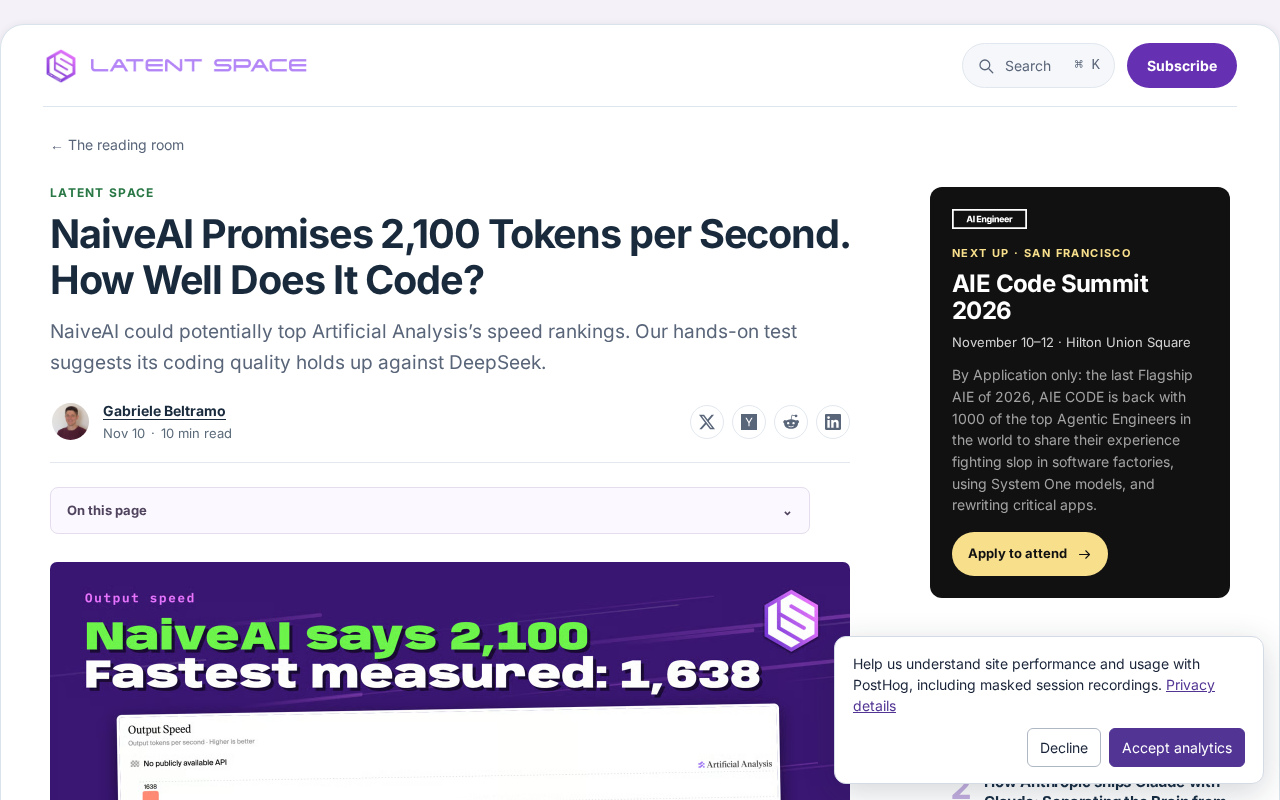
NaiveAI claims 2,100 tokens/sec with coding quality rivaling DeepSeek, suggesting speed and quality can coexist.
The article analyzes NaiveAI's claimed output speed of 2,100 tokens per second, far above mainstream models' tens to hundreds of tokens/sec. If sustained under real workloads, it would greatly improve code completion, multi-turn debugging, and batch generation. Tests say coding quality is comparable to DeepSeek, suggesting the traditional speed-quality trade-off may be broken. However, speed claims need to distinguish peak from sustained long-context generation, and the source didn't disclose test sets or scoring, so conclusions are directional. Developers should also consider API stability, rate limits, and output compliance, and await more independent, reproducible evaluations.
Title
NaiveAI Claims 2,100 Tokens per Second, Coding Ability Benchmarked Against DeepSeek
Meta Description
NaiveAI claims an output speed of 2,100 tokens per second, potentially challenging for the top spot on Artificial Analysis. Real-world tests show its coding quality is comparable to DeepSeekAd. This article analyzes the technical implications of the speed claim, the coding test conclusions, and what it means for developers.
Article Content
The race for AI inference speed is entering a new phase. A company called NaiveAI claims its model can achieve an output speed of 2,100 tokens per second—a figure that, if true, could top the Artificial Analysis speed leaderboard. But beyond speed, developers care more about: can it actually write code?
The Technical Implications Behind the Speed Claim
2,100 tokens per second is a number worth breaking down. For reference, mainstream large models typically output in the range of tens to hundreds of tokens per second in regular API calls. 2,100 tokens/second implies a potential order-of-magnitude improvement in output efficiency. If this speed can be sustained under real workloads, it would bring a noticeable change to coding scenarios that require frequent interaction—such as real-time code completion, multi-turn debugging conversations, and large-scale code generation.
However, speed claims themselves need to distinguish between test conditions. Peak speed, short-text burst speed, and sustained generation speed over long contexts are three different metrics. Whether NaiveAI can maintain this rate when generating long code files is key to judging its practical value.
Token is the basic unit of text processed by large language models, roughly a word fragment: an English word may be split into 1-3 tokens, and a Chinese character usually corresponds to 1-2 tokens. Thus "2,100 tokens per second" roughly equates to outputting 1,000-2,000 Chinese characters or about 1,500 English words per second—more than two orders of magnitude faster than normal human reading speed.
Artificial Analysis is an independent third-party model evaluation and tracking platform that maintains multiple leaderboards covering dimensions such as inference speed (output tokens/second), first-token latency, price, and a composite quality index. It is widely used by developers and researchers as a reference for model selection. Its speed data is typically measured based on standardized API calls; different vendors' deployment environments and sampling parameters can affect results, so leaderboard rankings should be interpreted in light of test conditions.
Coding Quality Test: Comparison with DeepSeek
According to the real-world test conclusions from the original source material, NaiveAI's coding quality "holds up to comparison with DeepSeek." DeepSeek is well-known in the developer community for its code generation capabilities and is regarded as one of the value-for-money benchmarks. That NaiveAI can match it in coding quality suggests it is not simply pursuing speed at the expense of output quality.
If this "speed + quality" combination holds, its significance lies in changing the traditional trade-off between speed and quality. In the past, ultra-fast models often compromised on complex reasoning and code correctness, while high-quality models struggled to achieve very low latency. NaiveAI's claim points to a different possibility: both can be satisfied simultaneously.
As an additional note, the specific test sets, task types, and scoring methods from the real-world tests were not disclosed in detail in the original source material, so this comparison conclusion should be understood as a directional judgment rather than a rigorous benchmark result.
DeepSeek is a series of large models launched by the Chinese AI company DeepSeek (深度求索). Its DeepSeek-Coder and subsequent general models perform prominently on code generation, repair, and completion tasks, and its API pricing is low, so it is widely used in the developer community as a value benchmark for coding capability. Using DeepSeek as a reference means comparing "practical-grade" coding quality rather than making an absolute comparison with top-tier closed-source models.
The rigor of benchmark evaluation depends on several elements: fixed test sets (such as HumanEval, MBPP, or SWE-bench, which is closer to real engineering), reproducible prompts and sampling parameters, and multi-person blind evaluation or automated unit test pass rates. Without these disclosures, "comparable to DeepSeek" can only be regarded as a preliminary impression, not yet sufficient to support strict performance conclusions.
Practical Implications for Developers
For developers who use AI coding assistants daily, the value of speed improvements shows up in several specific areas. Compressing code completion wait times from seconds to near-instant changes the rhythm of writing code; in multi-turn debugging conversations, model response speed directly affects troubleshooting efficiency; when batch-generating test code or refactoring suggestions, throughput determines whether workflows can be automated.
If NaiveAI can truly deliver on its promise of 2,100 tokens per second and keep coding quality stable near DeepSeek's level, then it will have clear appeal in these scenarios. But before adopting it, developers still need to pay attention to several practical issues: API stability and rate-limiting policies, speed degradation under long contexts, and code licensing and output compliance.
API rate-limiting policies typically include requests per minute (RPM), tokens per minute (TPM), and maximum concurrent connections. Even if a model's peak speed is very high, if an account's TPM quota is low, actual throughput will still be limited by the platform side, so developers need to distinguish between "model capability" and "available account quota" when evaluating.
Long-context speed degradation is a common phenomenon in inference services: as context length increases, attention computation and KV Cache memory usage rise, and output rate often declines. For coding tasks that require reading an entire code repository or long files, burst speed on short text is of limited reference value; sustained generation rate is the key metric.
The Next Step in the Speed Race
The Artificial Analysis speed leaderboard has always been one of the reference dimensions for comparing model capabilities. If NaiveAI makes the list and ranks near the top, it will further push the industry to focus on inference efficiency. From a trend perspective, model vendors are shifting from simply stacking parameters to optimizing inference architecture and deployment efficiency, and the importance of speed metrics is rising.
But speed is ultimately a means, not an end. For coding scenarios, whether the generated code compiles on the first try, whether it introduces hidden bugs, and whether it accurately understands complex requirements—these are the core factors that determine a tool's value. NaiveAI's claim opens a window worth watching; next, more independent, reproducible evaluation data will be needed to verify its true level.
One-line Summary
NaiveAI claims 2,100 tokens per second with coding quality comparable to DeepSeek, suggesting speed and quality may be achievable together.
Paragraph Summary
The article analyzes NaiveAI's claimed output speed of 2,100 tokens per second. This figure is far above the typical range of tens to hundreds of tokens/second for mainstream models. If it can be sustained under real workloads, it would significantly improve the experience of coding scenarios such as code completion, multi-turn debugging, and batch generation. Real-world test conclusions say its coding quality is comparable to DeepSeek, implying that the traditional trade-off between speed and quality may be broken. However, the article also notes that speed claims need to distinguish between peak speed and sustained generation speed over long contexts, and that the original source material did not disclose test sets or scoring methods, so the conclusion should be regarded as a directional judgment. Before adopting it, developers should also pay attention to API stability, rate-limiting policies, and output compliance, and look forward to more independent, reproducible evaluations.
Related articles
Anthropic Model Benchmarking: Fable 5 vs 5.1 vs 5.2 Comparison
Based on Reddit community comparison material, this analyzes benchmark differences among Anthropic models Fable 5, 5.1, and 5.2, and discusses the practical implications of version iterations for developers and model selection advice.

Jensen Huang Steps Down as Nvidia CEO, Asian Governments Scramble to Respond to Chip Supply Shifts
Jensen Huang's departure as Nvidia CEO triggers chain reactions across Asian governments: some confirm chip supply commitments, others monitor local AI project impacts and handle related investigations. This article analyzes supply chain stability, project risks, and compliance uncertainty.
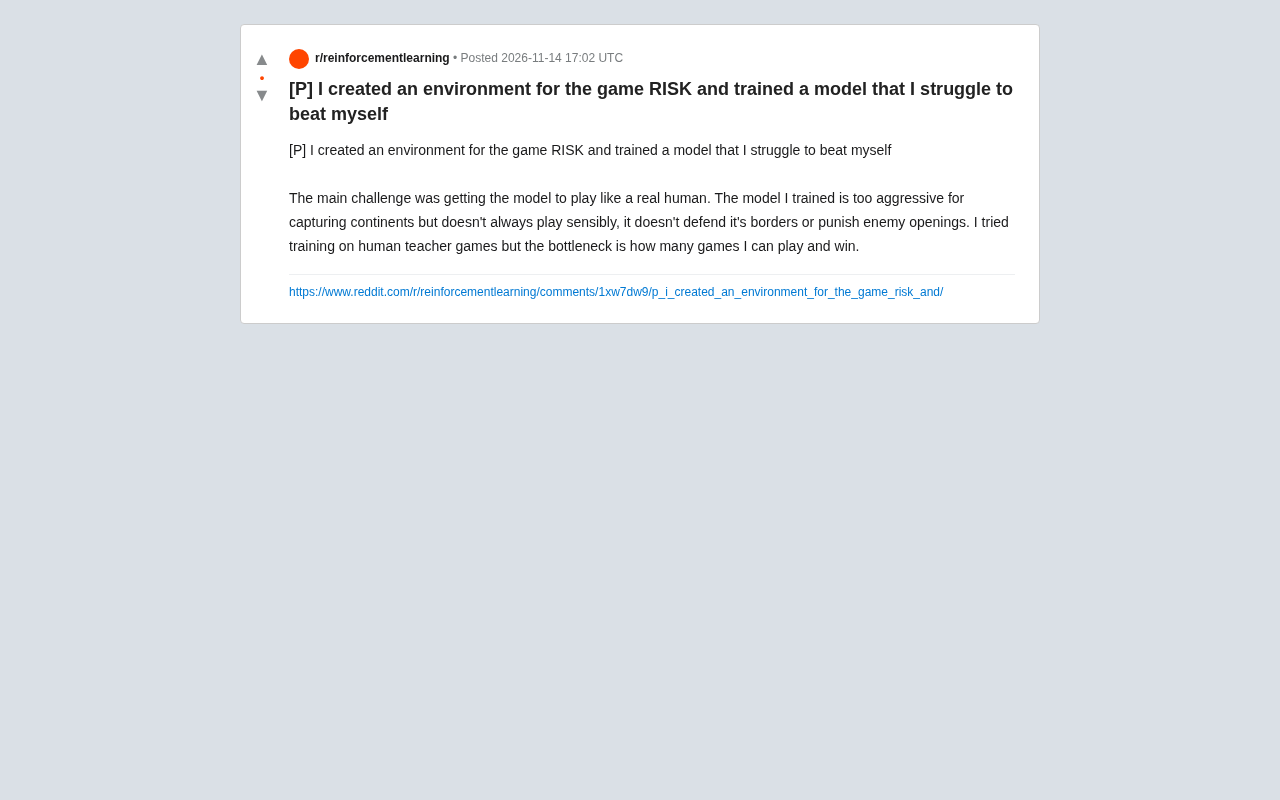
Reddit Player Builds RISK Game Environment and Trains an AI That's Nearly Impossible to Beat
Reddit player builds a RISK training environment and trains an aggressive AI model that's nearly unbeatable. Strong at expansion but weak at defense, the author hits a bottleneck trying human data training, revealing common game AI development challenges.