Nanbeige Open-Sources 33B Teacher Model: 512K Context, Agent Capabilities Surpass Qwen

Nanbeige4.3-33B is released under Apache 2.0 as a teacher for smaller models, with mixed agent benchmark results.
Nanbeige releases the 33B-parameter Nanbeige4.3-33B under the Apache 2.0 license with 512K context support, positioned as a teacher model for subsequent smaller agent models (including an upcoming 3B version). Self-test results show 80.9 on Terminal-Bench 2.1, higher than Qwen3.8-27B's 73.0, but slightly lower on SWE-Bench Pro at 60.3 versus 61.7. Reproducing agent results requires preserve_thinking=true, officially recommended only for multi-turn tool calling. As results are self-reported and not independently reproduced, the community is cautiously optimistic.
Introduction
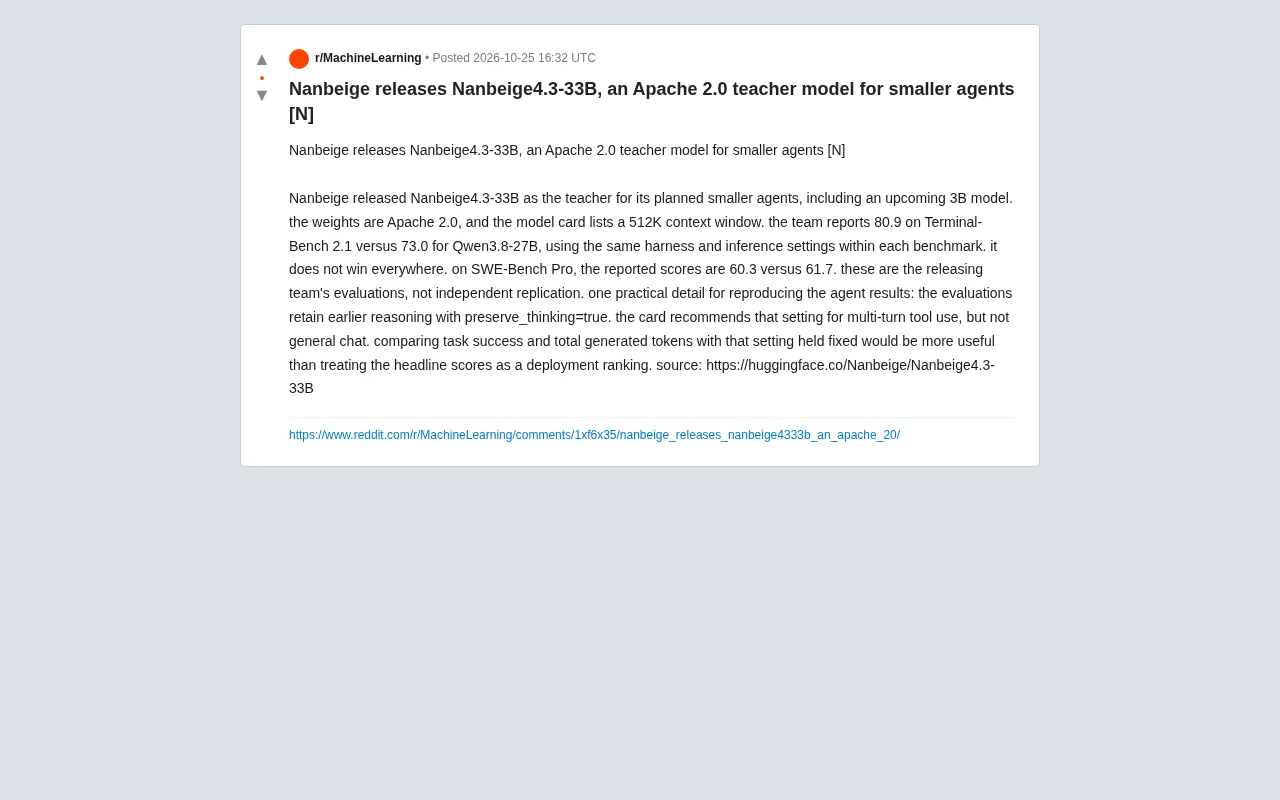
The open-source model community has welcomed a new member. Nanbeige recently released Nanbeige4.3-33B, a 33B-parameter model under the Apache 2.0 license, positioned as a "teacher model" for its subsequent smaller agent models (including an upcoming 3B version). According to Reddit community discussions and the Hugging Face model card, the model supports a 512K context window and demonstrates competitive performance against models of similar scale in agent evaluations.
Core Specs and Positioning
The most direct value of Nanbeige4.3-33B lies in its "teacher" identity. The team explicitly stated that the model will be used to guide smaller agent models, with a 3B version already planned. This "large model teaching small model" approach is gradually gaining popularity in the open-source community, aiming to bring lightweight models close to large-model performance on specific tasks while reducing deployment costs.
On the technical side, the 512K context window is a notable highlight, meaning the model can handle extremely long documents or complex multi-turn conversations. The weights are released under the Apache 2.0 license, allowing commercial use and modification—a friendly signal for developers and enterprises.
Knowledge Distillation and Teacher Models: Knowledge distillation is a model compression and capability transfer technique first proposed by Hinton et al. The basic idea is to have a stronger large model (teacher model) produce output distributions or reasoning traces on a large number of samples, then use these as supervision signals to train a smaller model (student model), enabling the student to approach the teacher's performance despite having far fewer parameters. In the era of large language models, distillation has expanded from early logits matching to imitating the teacher model's chain-of-thought, tool-calling traces, and other behaviors—especially critical in agent tasks, where an agent's core capability often lies in multi-step decision-making and tool use rather than pure text generation. Nanbeige4.3-33B as a teacher model follows this approach: the 33B model has sufficiently strong reasoning and tool-calling capabilities, but its deployment cost is too high for most applications. Distilling a 3B-level student model is expected to retain most agent capabilities while significantly reducing inference overhead.
Benchmark Performance: Wins and Losses
According to evaluation data published by the Nanbeige team, on Terminal-Bench 2.1, Nanbeige4.3-33B scores 80.9, compared to 73.0 for the comparison model Qwen3.8-27B. The team emphasized that both scores were obtained under the same test framework and inference settings.
However, the model does not lead across the board. On SWE-Bench Pro, Nanbeige4.3-33B scores 60.3, slightly below Qwen3.8-27B's 61.7. This mixed result reminds us that model capabilities are task-dependent and cannot be judged simply by a single overall score.
It is important to note that all the above data comes from the releasing team's own evaluation and has not yet been independently reproduced by a third party. In the open-source community, vendor self-reported results are typically viewed with caution, and actual performance still requires verification by more developers.
Terminal-Bench and SWE-Bench Pro: Both benchmarks evaluate agent capabilities but focus on different aspects. Terminal-Bench focuses on a model's ability to operate in a terminal environment; tasks typically require the model to complete real workflows such as file operations, system configuration, and debugging by executing shell commands, with scoring based on whether tasks are correctly completed—thus closer to operations and automation scenarios. SWE-Bench Pro is an extended version of the SWE-Bench series, which uses real GitHub issues as material and requires the model to locate and fix bugs in codebases; the Pro version strengthens task difficulty, repository scale, and evaluation rigor, focusing more on code understanding and patch generation in software engineering scenarios. What both share is that they require the model to engage in multi-turn interaction, read tool return results, and dynamically adjust strategies—so settings like preserve_thinking that affect multi-turn reasoning state directly influence final scores, which is why inference configurations must be fixed when comparing across benchmarks.
Key Details for Reproducing Agent Results
For developers wanting to reproduce the agent evaluation results, there is an easily overlooked but crucial setting in the model card: preserve_thinking=true. This setting retains the model's previous reasoning process; it is officially recommended for multi-turn tool-calling scenarios but not advised for regular chat.
This detail means that running the agent benchmark with default settings may produce results that differ from the officially published ones. A more reasonable comparison approach is to fix this setting and observe both task success rate and total generated tokens, rather than treating headline scores directly as a basis for deployment rankings.
preserve_thinking and Multi-Turn Tool Calling: In multi-turn tool-calling scenarios, the model needs to decide its next action each turn based on previous observations. By default, some inference frameworks discard the model's prior internal reasoning between turns, keeping only visible conversation and tool outputs to save context and computation. preserve_thinking=true keeps the model's previously generated thinking process in subsequent turns, maintaining cross-turn reasoning coherence and preventing the model from re-deriving at each step or missing earlier judgment basis. This is generally beneficial for agent tasks requiring long-chain decision-making, but at the cost of increased context usage and higher generated token counts. In regular chat scenarios, retaining thinking content yields almost no benefit and instead slows responses and increases costs, which is why it is not officially recommended there. This also explains why comparing agent scores should reference both task success rate and token consumption.
Community Reaction and Outlook
Discussions on Reddit are generally rational, with community users focusing more on the model's practical usability and reproduction details rather than mere scores. Some comments note that the 33B size occupies a delicate position in the open-source ecosystem: it is more capable than 7B/13B models but not as hardware-demanding as 70B. If it can effectively distill a high-quality 3B agent, it would complement lightweight application scenarios.
Currently, the model weights are available for download on Hugging Face. When the subsequent 3B model will be released and how effective the distillation will be are key to testing the success of Nanbeige's strategy.
Conclusion
The release of Nanbeige4.3-33B adds a new option to the open-source agent model ecosystem. Its Apache 2.0 license, 512K context, and optimizations for tool use all address real needs in current agent development. But the "self-reported" nature of the benchmarks reminds us that, until independent evaluations appear, cautious optimism is the more appropriate attitude.
One-line Summary
Nanbeige4.3-33B is released under Apache 2.0 as a teacher for smaller models, with mixed agent benchmark results.
Paragraph Summary
Nanbeige has released the 33B-parameter Nanbeige4.3-33B under the Apache 2.0 license with 512K context support, positioned as a teacher model for subsequent smaller agent models (including an upcoming 3B version). The team's self-test shows a score of 80.9 on Terminal-Bench 2.1, higher than Qwen3.8-27B's 73.0, but slightly lower on SWE-Bench Pro at 60.3 versus 61.7. Reproducing agent results requires preserve_thinking=true, officially recommended only for multi-turn tool calling. As all results are self-reported and not yet independently reproduced, the community is cautiously optimistic, and the distillation performance of the upcoming 3B model will be key to validating this strategy.
Related articles

Private Key Set to 4? CA's Elementary Mistake Leaves TLS Exposed
CA eMudra set private keys to tiny values like 4, making TLS certificates brute-forceable. A Computerphile video demonstrates the full process from extracting public keys to forging certificates, and explores the fragility of the PKI trust chain.

How Gen Turns Data into Decisions with ChatGPT Work
In an OpenAI user case, business leader Gen shares how ChatGPT Work turns data into decisions: within hours of launch, teams can judge whether integrations and onboarding flows work, shifting decision iteration from hundreds of trial-and-error attempts to a fast feedback loop.

ChatGPT vs. Claude In-Depth Comparison: Strong at Coding but Weak at Research — How to Bridge the Gap?
A user considers switching from ChatGPT to Claude, finding Claude stronger at coding but shallower at research. We analyze the differences and share tips to make Claude's research deeper.