NanoBananaEditor: An Open-Source AI Image Generation and Editing Powerhouse Built on Gemini

NanoBananaEditor: an open-source AI image generation and editing platform powered by Gemini
NanoBananaEditor is an open-source AI image generation and editing application powered by the Gemini 2.5 Flash API, built with TypeScript and already boasting 679 GitHub Stars. It integrates three core features—reference image-driven generation, mask-based inpainting, and version history rollback—combining image generation and editing in a unified interface. It fills the gap between ease of use and feature completeness in the open-source community, making it ideal for content creators, designers, and developers.
NanoBananaEditor Project Overview
In an era where AI image generation tools are emerging left and right, an open-source project called NanoBananaEditor is rapidly gaining traction on GitHub. Built by developer markfulton, this AI image generation and editing application offers creators a comprehensive platform that combines image generation, editing, and version management through an intuitive user interface and rich feature set.
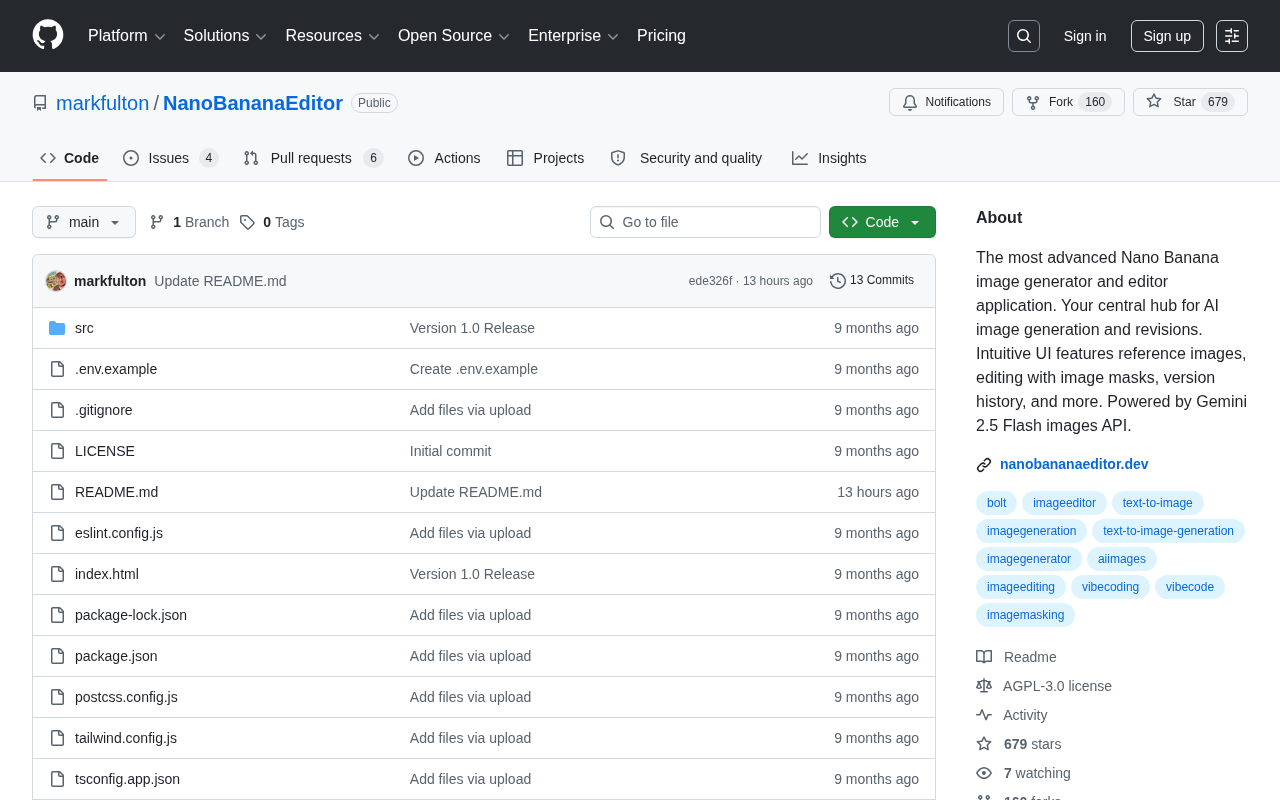
Since launch, the project has quickly amassed 679 Stars and 160 Forks. Developed in TypeScript, it's powered under the hood by Google's Gemini 2.5 Flash Image API. Gemini 2.5 Flash is the efficiency-focused version of Google DeepMind's multimodal model family released in 2025. Compared to the full Gemini 2.5 Pro, the Flash version maintains high generation quality while significantly reducing inference latency and computational costs. Its image generation capabilities are built on a native multimodal architecture, meaning the model learns text and image representations simultaneously during training, rather than stitching together separate language and image generation models as earlier approaches did. Google exposes the image generation endpoint to developers through the Gemini API—developers only need an API Key to make calls, with no need to deploy their own GPU servers. This is the key prerequisite that enables NanoBananaEditor to deliver powerful image generation capabilities as a lightweight frontend application.
These Star numbers are quite impressive among similar open-source projects, indicating strong community demand for integrated AI image tools.
Core Features Explained
Reference Image-Driven Generation
NanoBananaEditor supports reference images, allowing users to upload existing pictures as a foundation for generating new images. This feature is extremely practical in real-world creative scenarios—whether maintaining brand visual consistency or performing style transfer based on existing assets, reference images significantly improve the controllability of generated results.
From a technical perspective, image-conditioned generation is an important direction in the AI image generation field. The core principle involves encoding the user-provided reference image into visual feature vectors, which serve as conditional input to the generation model alongside the semantic vectors from text prompts. In the Diffusion Model framework, this is typically achieved through IP-Adapter, ControlNet, or the model's native image understanding module. Gemini's native multimodal architecture naturally supports images as input tokens, eliminating the need for additional adapter modules. Reference image technology addresses a fundamental limitation of pure text prompts: natural language inherently lacks precision when describing visual details (such as specific color palettes, texture qualities, and composition ratios), while a reference image can precisely convey visual information that's difficult to express in words.
Compared to purely text prompt-driven generation, reference images allow users to communicate creative intent more precisely, dramatically reducing the time spent iterating on prompts.
Mask-Based Inpainting
The project provides mask-based image editing capabilities. Users can draw masks to specify regions within an image that need modification, enabling inpainting. In other words, you don't need to regenerate the entire image—just mark the areas you're unsatisfied with and let the AI make targeted modifications.
Inpainting is a classic problem in computer vision that has gained entirely new implementation approaches in the AI generation era. Traditional inpainting relied on image interpolation and texture synthesis algorithms, while deep learning-based inpainting uses generative models to fill content in masked regions. The specific workflow is: the user draws a binary mask on the image, where white areas indicate regions to be regenerated and black areas indicate regions to be preserved. During generation, the model uses unmasked areas as contextual constraints, ensuring newly generated content maintains consistency with surrounding pixels in terms of color, lighting, and perspective. The key challenge in this technology is edge blending—making the transition between repainted and preserved regions appear natural and seamless. Modern multimodal models, trained on massive image datasets, handle this problem remarkably well, making local modifications virtually indistinguishable from the original.
This granular editing approach dramatically improves workflow efficiency, especially for professional scenarios requiring fine-tuning of AI-generated results.
Version History and Rollback Management
Version history is another standout feature of NanoBananaEditor. During AI image creation, users often go through multiple iterations, with each modification potentially producing unexpected results. Version history allows users to roll back to any previous version at any time, compare different iteration results, and select the most satisfying outcome.
This feature may seem simple, but it's absolutely critical in actual workflows. Many similar tools lack version management capabilities, meaning once users overwrite a previous version, there's no way to recover it, resulting in unnecessary rework. The version management design philosophy borrows from version control concepts in software development (like Git), treating each editing operation as a "commit." Users can freely navigate the version tree, which is particularly valuable for exploratory creative processes.
Technical Architecture Analysis
Gemini 2.5 Flash as the Generation Engine
NanoBananaEditor chose Gemini 2.5 Flash as its underlying image generation engine. Gemini 2.5 Flash is the speed and efficiency-focused version of Google's multimodal model lineup, and its image generation capabilities have attracted widespread attention recently. This native multimodal design gives Gemini stronger contextual understanding when handling complex tasks like "generating new images from reference photos" or "performing inpainting after understanding mask region semantics"—the model can not only "see" the visual content of reference images but also establish deep semantic associations with text instructions.
Choosing Gemini 2.5 Flash over alternatives like Stable Diffusion or DALL-E reflects the project's considerations in several areas:
- Response Speed: The Flash version is optimized for inference speed, suitable for editing scenarios requiring rapid iteration. Compared to Stable Diffusion's need for local GPU to perform dozens of denoising steps, the API-call approach offloads computation to the cloud, requiring virtually zero hardware on the user's end
- Multimodal Understanding: Gemini natively supports mixed image-text input, making it naturally suited for reference image and mask editing features. Unlike DALL-E 3, which primarily relies on text descriptions, Gemini can directly process images as part of the token sequence, enabling more nuanced image understanding
- Simple API Integration: Calling through Google AI's API lowers the hardware barrier for local deployment. Developers don't need to configure CUDA environments or download multi-GB model weights—just an API Key to start developing
TypeScript Full-Stack Development
The project is developed in TypeScript, a sensible technology choice for frontend-intensive image editing applications. As a superset of JavaScript, TypeScript provides static type checking, interface definitions, and better IDE support, offering clear advantages when building complex frontend applications.
For image editing applications, the TypeScript ecosystem offers several key libraries: Canvas API and WebGL provide low-level pixel manipulation and GPU-accelerated rendering; libraries like Fabric.js and Konva.js encapsulate canvas object operations (such as mask drawing and layer management); and frameworks like React or Vue handle complex UI state management (such as undo/redo stacks and version history trees). TypeScript's type system is particularly important when managing image editor state—a typical editor needs to track current canvas state, mask data, history version stacks, API request status, and many other dimensions of data. Type safety effectively prevents implicit bugs in state management, while the rich frontend ecosystem provides mature library support for features like mask drawing and canvas operations.
Use Cases and Practical Value
NanoBananaEditor is positioned as a user's "AI image generation and modification hub." This positioning precisely addresses a pain point with current AI image tools: most either focus on generation or editing, with very few offering seamless integration of both.
This pain point exists within a broader industry context. The trend toward integrated AI image tools reflects the AIGC (AI Generated Content) industry's transition from a technology validation phase to a productivity tool phase. Early AI image tools (such as Stable Diffusion WebUI and Midjourney from 2022) primarily solved the question of "can we generate at all," requiring users to switch between different tools to complete generation, editing, and post-processing steps. As underlying model capabilities have matured, user needs have shifted toward workflow efficiency—they need to complete the entire process from concept to finished product within a unified interface. Commercial solutions like Adobe Firefly and Canva AI are already moving in this direction, while in the open-source community, ComfyUI achieves similar integration through node-based workflows but has a steep learning curve. NanoBananaEditor's value lies in providing a closed-loop experience of generation-editing-version management with a lower barrier to entry, filling the gap between "ease of use" and "feature completeness."
Specific use cases include:
- Content Creators: Quickly generate and refine social media graphics and blog illustrations
- Designers: Leverage reference images and mask editing for rapid prototyping of concept designs
- Developers: Use as a reference project and code example for learning Gemini Image API integration
- AI Enthusiasts: Explore and experiment with different AI image generation and editing workflows
Summary and Future Outlook
NanoBananaEditor demonstrates a noteworthy trend: AI image tools are evolving from single-function utilities to integrated platforms. By combining generation, editing, and version management in a unified interface, powered by Gemini 2.5 Flash's multimodal capabilities, this open-source tool provides individual developers and small teams with a fully-featured AI image workstation.
As Gemini's model capabilities continue to improve and community contributors join in, NanoBananaEditor has the potential to evolve into a more mature AI image creation platform. Possible future directions include: supporting additional generation model backends (such as Stable Diffusion, Flux, etc.) to reduce dependence on a single API, introducing batch processing and automated workflow capabilities, and integrating more advanced editing features like image super-resolution and background removal. For developers following the AI image generation space, this project is worth bookmarking whether as a daily tool or a technical learning reference.
Related articles
 Product Reviews
The Programmer's Desk Setup Guide: Building a Workspace That Feels Like Home
Discover how programmers build productive, comfortable workspaces. From multi-monitor setups to ergonomic design, explore the desk philosophy that drives focus and flow.
 Product Reviews
Qoder vs Cursor Real-World Comparison: Which $20/Month AI IDE Is Better?
Hands-on comparison of Qoder vs Cursor AI IDEs: Agent autonomy, human interaction count, and architecture decisions. Qoder needed only 2 interactions vs Cursor's 8.
 Product Reviews
Cursor Cloud Agent Demo: Eliminating Bottlenecks Across the Entire Software Development Lifecycle
Deep analysis of Cursor's Cloud Agent demo showing how cloud VMs, automated test artifacts, and a full-chain control plane systematically eliminate human bottlenecks across the software development lifecycle.