Nanoleaf's Pivot: Betting on Robotics, Red Light Therapy, and AI to Reinvent Smart Lighting

Nanoleaf pivots from smart lighting into robotics, red light therapy, and AI.
After two years of relative silence, smart light panel maker Nanoleaf has announced a major strategic pivot, betting its future on robotics, red light therapy, and artificial intelligence. Leveraging its LED spectral control expertise, the company is entering the red light therapy health market, exploring mobile robotic lighting that breaks free from fixed installations, and integrating AI for smarter lighting experiences — expanding from decorative lighting into health tech and intelligent living.
A Smart Lighting Giant's Silence and Transformation
Nanoleaf, the company famous for its decorative smart light panels, has been unusually quiet for the past two years. While competitors like Govee and Philips Hue have continuously rolled out new products and innovative features, Nanoleaf has released only a handful of smart lighting products. However, this silence was far from stagnation — the company has been brewing a major strategic pivot.
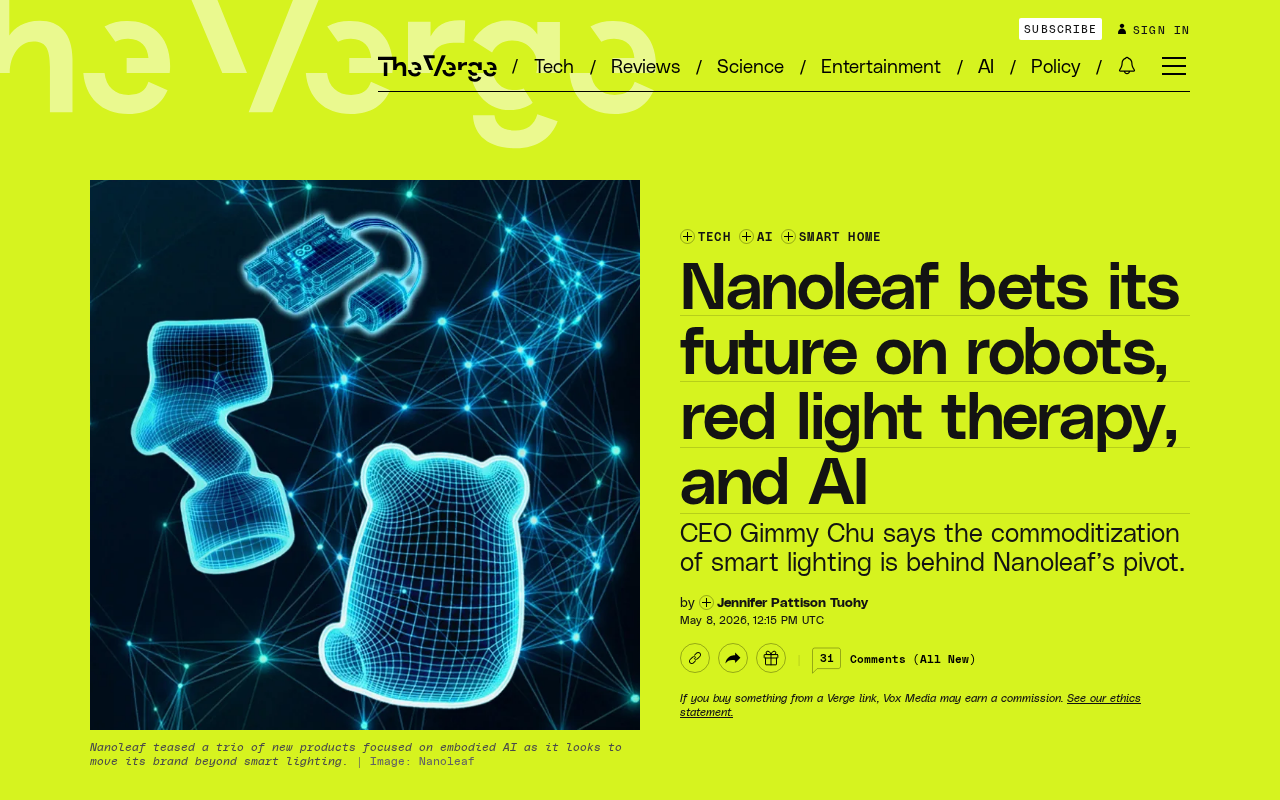
According to the latest reports, Nanoleaf is betting its future on three seemingly unrelated yet imaginative directions: robotics, red light therapy, and artificial intelligence. This strategic choice signals that the smart lighting company is expanding from purely decorative home lighting into the broader realms of health tech and smart living.
From Light Panels to Health Tech: Commercializing Red Light Therapy
Red Light Therapy (academically known as Photobiomodulation, or PBM) has attracted significant attention in the health and beauty space in recent years. Its scientific foundation dates back to NASA research in the 1960s — specific wavelengths of red light (630–700nm) and near-infrared light (700–850nm) can penetrate skin tissue and be absorbed by cytochrome c oxidase in cellular mitochondria, thereby promoting ATP (adenosine triphosphate) synthesis and accelerating cellular metabolism and repair. Multiple clinical studies have shown that red light therapy has measurable effects in improving skin elasticity, relieving muscle soreness, and aiding wound healing.
In terms of market size, the global red light therapy device market exceeded $1 billion in 2023 and is expected to continue expanding at a compound annual growth rate of over 15% through 2030, primarily driven by the proliferation of consumer-grade devices. This technology, which uses specific wavelengths of red light to promote cell repair and skin health, has been steadily transitioning from professional medical equipment to the consumer market. With its deep expertise in LED light source technology, Nanoleaf has a natural technological advantage for entering the red light therapy space.
Combining lighting products with health functionality means Nanoleaf's products would no longer be mere decorative pieces for setting the mood — they would become functional devices that deliver real health benefits. This shift from "looking good" to "being useful" could help the company carve out a differentiated position in the increasingly crowded smart lighting market.
Why Is Nanoleaf Choosing Red Light Therapy?
From a technology standpoint, Nanoleaf has accumulated years of experience in precisely controlling LED wavelengths and light spectra. The 630–850nm wavelength range required for red light therapy aligns perfectly with its existing technology stack. This means the company doesn't need to start from scratch — instead, it can extend functionality from an already solid foundation.
Robotics Integration: A New Form Factor for Mobile Smart Lighting
Introducing robotics into the lighting product line is a bold move. Achieving mobile smart lighting involves the convergence of several key technologies: SLAM (Simultaneous Localization and Mapping) is at the core — this algorithm, widely used in devices like robot vacuums, enables fixtures to build real-time maps and precisely locate themselves in unknown environments. Computer vision and human pose recognition allow lights to identify user positions, movements, and even emotional states, proactively adjusting lighting angles accordingly. Additionally, wireless charging and high-efficiency battery management are essential prerequisites for untethered mobile lighting. Some early movers already exist in the market — for example, Dyson's Solarcycle desk lamp automatically adjusts color temperature by tracking the sun's trajectory, offering a reference point for commercial viability in this direction.
While Nanoleaf's specific product forms haven't been fully disclosed, we can speculate that the company may be exploring the following directions:
- Smart fixtures that automatically adjust angle and brightness based on user location and activity
- Robotic lights that autonomously move within a room to provide optimal illumination
- Lighting devices with spatial awareness that dynamically adapt to different usage scenarios
The core value of robotic lighting lies in breaking the "fixed installation" limitation of traditional fixtures, allowing light sources to truly follow human needs. This has clear practical value in scenarios such as working from home, fitness training, and content creation. If Nanoleaf can combine its mature LED control technology with the robotics capabilities described above, it will establish a unique competitive advantage in this niche segment.
AI-Driven Smart Lighting: A New Paradigm
The introduction of artificial intelligence may be the most transformative element among Nanoleaf's three strategic directions. To understand this direction, it's important to first grasp the two primary deployment models for AI in smart homes: Edge AI deploys inference computations directly on the device's local chip, offering fast response times and strong privacy protection, with representative solutions including Qualcomm's QCS series chips; Cloud AI leverages large language models (LLMs) and cloud computing resources to handle more complex personalized learning tasks, but comes with latency and privacy risks.
The "smart" in current smart lighting products
Related articles
Meta Muse Hits 900K Downloads in Six D…
Meta Muse Hits 900K Downloads in Six Days: The AI Agent Era Has Officially Arrived
Meta's AI agent Muse hit 902K downloads in 6 days, topping US App Store and Google Play charts above ChatGPT and Claude. A deep dive into Muse's capabilities and the AI Agent race.
 Industry Insights
IRS Fully Embraces Claude AI, Accelerating Federal Government's AI Adoption
The IRS is recruiting staff with 24/7 Claude AI access, marking Anthropic's breakthrough into the federal government. Explore the strategic implications and tax use cases.
 Industry Insights
The IRS Mobile App Debate: A Trust Crisis in Government Digital Transformation
The IRS's proposed mobile app has sparked heated debate. This article analyzes the core arguments, exploring data security, privacy, and the trust crisis in government digital transformation.