Narrative Intelligence: The Human Advantage That AI Can't Replace

In an era where AI commoditizes execution skills, narrative intelligence and emotional intelligence become the key to human adaptability.
Based on an interview with Reed Frerichs on the Practical AI podcast, the article explores how AI is redefining work and individual roles. The core argument is that as AI rapidly commoditizes execution capabilities, simply upgrading skills is insufficient—understanding narrative logic and reexamining identity are key. Frerichs proposes the 'Own, Author, Act' framework to help individuals and teams reposition themselves, and emphasizes that as AI handles analytical work, leaders' differentiation shifts to emotional intelligence and human connection. The article advocates embracing uncertainty with a clear internal narrative as an anchor.
AI is redefining how we work, how we create, and how individuals position themselves within organizations. Facing this transformation, simply upgrading skills is no longer enough—understanding the narrative logic behind the technology and reexamining your own story and sense of identity may be the real key to staying adaptable.
In an episode of the Practical AI podcast, Reed Frerichs joined hosts Daniel Whitenack and Chris Benson for an in-depth discussion on "Narrative Intelligence."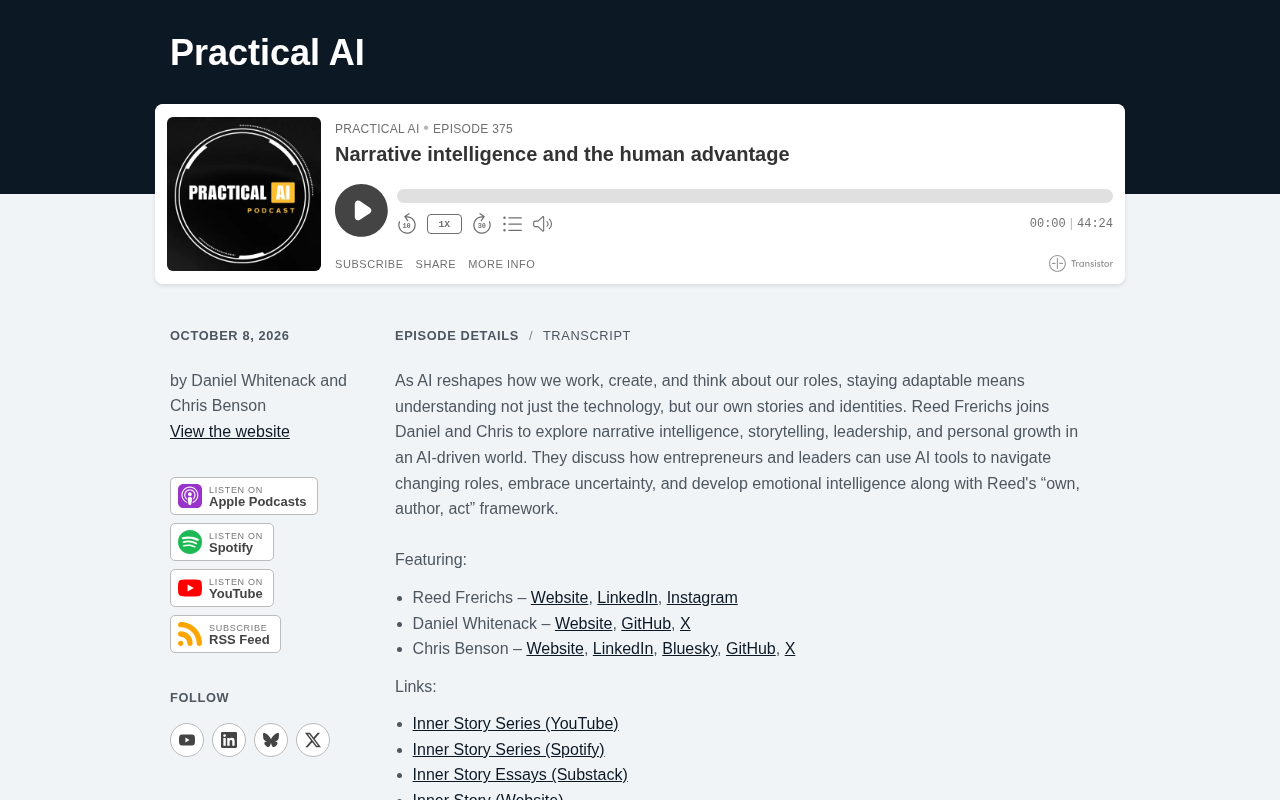
What Is Narrative Intelligence
Narrative intelligence isn't a newly invented concept, but its value in the AI era is being rediscovered. Reed Frerichs defines it as the ability to understand, construct, and apply stories—not just telling brand stories externally, but also the internal narrative you tell yourself.
When AI can generate copy, write code, and produce videos, pure execution capability is being rapidly commoditized. But deciding "what story to tell," "why tell this story," and "for whom this story matters"—these judgments remain deeply rooted in human experience, emotion, and values.
In the conversation, Frerichs pointed out that the real challenge facing entrepreneurs and managers isn't learning to use AI tools, but rather, once those tools are ubiquitous, re-answering fundamental questions like "Who am I?" and "Why does my team exist?"
Narrative Intelligence as a concept can be traced back to the fields of cognitive science and organizational research—it is not a product of the AI era. At the cognitive level, it refers to the fact that humans naturally rely on story structures to understand the world—we organize scattered experiences through plot, character, and causality, which psychologists like Jerome Bruner called "narrative thinking," standing alongside logical-scientific thinking. In organizational and leadership research, it is used to describe a leader's ability to unite teams and drive change by constructing shared stories. The AI era has reignited interest in this concept because generative models can mass-produce the "shells of stories" (copy, scripts, visual content) but cannot replace human judgment about whether a story is true or whether it resonates with the experiences of a specific group. Thus narrative intelligence has been upgraded from a soft skill to a key capability that distinguishes human from machine contributions.
The "Own, Author, Act" Framework
Frerichs proposed a three-step framework to help individuals and teams find direction in an AI-driven environment:
Own — Acknowledge and accept your current situation and identity. This sounds simple, but during periods of rapid role change, many people fall into denial or anxiety. Frerichs emphasizes that only by first "owning" your story can you make conscious choices on that foundation.
Author — Actively write your next chapter. This means not passively waiting for an organization or technology to define your role, but picking up the pen yourself to conceive it. With AI able to assist content production, the focus of "authoring" shifts from execution to intention and direction.
Act — Translate the narrative into concrete steps. Frerichs believes that a narrative without action is just wishful thinking, and AI tools can deliver their greatest value precisely at this stage—helping people bring ideas to life faster.
The core insight of this framework is that AI has changed the speed and cost of execution, but it hasn't changed the human ability to define direction and create meaning.
The "Own, Author, Act" framework structurally echoes core ideas from Narrative Therapy and adult development theory. Narrative Therapy, proposed by Michael White and David Epston, emphasizes that a person is not the problem itself but a subject who can "re-author" their life story. Adult development theory (such as Robert Kegan's constructive-developmental theory) also points out that when facing complex change, individuals must first accept their current way of meaning-making before they can transform to a higher stage. Frerichs transplants this psychological lineage into the AI and workplace context: "Own" corresponds to accepting one's current identity, "Author" corresponds to active reconstruction, and "Act" corresponds to grounding the new narrative in verifiable behavior. The three steps are not a linear process but closer to a cycle—the new experiences generated by each action become the raw material for the next round of "Owning."
Emotional Intelligence and Leadership in the AI Era
Another dimension worth noting in the conversation is emotional intelligence. When technical skills are no longer a scarce resource, the source of a leader's differentiation is shifting toward emotional intelligence—empathy, self-awareness, and the ability to remain stable amid uncertainty.
Frerichs's view is that AI tools can take on more and more analytical and repetitive work, which in turn frees up more space for leaders to focus on the human dimension. But the prerequisite is that leaders are willing to confront the problems that algorithms cannot solve: the team's fears, individual identity crises, and the cultural conflicts organizations face during transitions.
This resonates with "narrative intelligence"—understanding others' stories is as important as clarifying your own. In the process of AI reshaping the workplace, managers who can help teams reconstruct narratives and find new meaning will go further than those who simply pursue efficiency.
Emotional Intelligence (EI) was proposed by Peter Salovey and John Mayer in 1990 and later popularized by Daniel Goleman. It typically includes four dimensions: self-awareness, self-management, social awareness, and relationship management. Before AI entered the workplace, emotional intelligence was already regarded as an important predictor of leadership; after analytical and repetitive tasks were automated, its relative scarcity rose further. Goleman's later "attention" framework also echoes the discussion in this article: leaders need to simultaneously focus on the inner self, others, and the broader system. It's worth noting that emotional intelligence is not equivalent to "being nice to people"; it is closer to an ability to make effective judgments amid emotional information—which highly overlaps with the requirement in narrative intelligence to "understand others' stories."
Embracing Uncertainty
A recurring theme throughout the conversation is that uncertainty is not an obstacle to be eliminated but a condition to be embraced.
The pace of AI development means no one can accurately predict what work will look like three years from now. Frerichs's advice is that rather than trying to formulate a perfect plan, it's better to cultivate the ability to move forward amid ambiguity. Narrative intelligence plays a role here—when you have a clear internal story as an anchor, external changes won't cause you to lose your way.
For tech practitioners, this means that while chasing new tools and frameworks, you also need to spend time thinking: What role do these technologies play in my story? What kind of impact do I want to create with them?
These questions have no standard answers, but asking them itself is a way to maintain the human advantage in the AI era.
This article is based on an interview with Reed Frerichs on the Practical AI podcast. Reed Frerichs is the host of the Inner Story podcast, focusing on narrative, leadership, and personal growth.
VUCA is a concept proposed by the U.S. Army War College in the 1980s, referring to four environmental characteristics: Volatility, Uncertainty, Complexity, and Ambiguity. This framework was later widely introduced into business management to describe the decision-making environment under rapid technological iteration. Another concept related to VUCA is "Antifragile," proposed by Nassim Nicholas Taleb, which emphasizes that systems can not only withstand shocks but also benefit from volatility. What Frerichs calls "embracing uncertainty" is, at the practical level, close to treating uncertainty as a source of information rather than noise: when external predictions fail, a clear internal narrative can serve as a stabilizer, helping individuals continue to act and adjust even without a certain path.
One-line Summary
In an era where AI commoditizes execution skills, narrative intelligence and emotional intelligence become the key to human adaptability.
Paragraph Summary
Based on an interview with Reed Frerichs on the Practical AI podcast, the article explores how AI is redefining how we work and our individual roles. The core argument is that as AI rapidly commoditizes execution capabilities like copywriting and coding, simply upgrading skills is no longer enough—understanding the narrative logic behind technology and reexamining your own story and identity are the keys to staying adaptable. Frerichs proposes the three-step "Own, Author, Act" framework to help individuals and teams reposition themselves in an AI environment; he also emphasizes that as AI takes on analytical work, leaders' differentiation shifts toward emotional intelligence and attention to people. The article concludes by advocating embracing rather than eliminating uncertainty, using a clear internal narrative as an anchor to keep moving forward amid ambiguity, and thus proposes how to sustain the human advantage.
Related articles

DeepCell: One-Click AI Generation of Documents, Spreadsheets, and Slides
DeepCell tops Product Hunt with one-click generation of documents, spreadsheets, and slides, using the .deepcell format for linked updates, designed for System 2 tasks like modeling and sales reviews.

Doneas: 15-Minute Daily Accountability Calls That Keep Indie Developers From Procrastinating
Doneas is a daily accountability tool for indie developers: plan tasks on Monday, join a 15-minute call with five builders each day, and log deliveries on a public progress page. This article analyzes its core mechanics, effectiveness, and potential issues around retention and matching.

Fastlane 2.0: Fully Automated AI Ad Campaigns, From Creative to Optimization
Fastlane 2.0 is an AI ad automation tool: enter your website and it learns your brand, generates video and image ads, and runs and optimizes them on Meta, TikTok, Instagram, and YouTube.