NASA DART Mission: Humanity's First Successful Asteroid Orbit Deflection

NASA's DART spacecraft deflected moonlet Dimorphos, cutting its orbital period by 32 minutes and proving humanity can redirect asteroids.
DART (Double Asteroid Redirection Test) was NASA's landmark experiment to validate planetary defense technology. Targeting the binary asteroid system of Didymos and its moonlet Dimorphos, the mission used a kinetic impact strategy — crashing a spacecraft into Dimorphos using its own momentum. The pre-mission conservative estimate was a 73-second reduction in orbital period; the actual result was a stunning 32-minute shortening. This success provided real-world momentum transfer data and proved that asteroid deflection is not science fiction but an achievable engineering reality, laying the groundwork for future planetary defense systems.
The solar system has never been a quiet place. Astronomers often compare it to a "shooting range" filled with flying rocks, where asteroids and comets travel through in all directions. To understand just how real this risk is, you only need to look at the Moon's surface — cratered with dense, pockmarked scars, each one left behind by a cosmic collision. NASA decided to stop being a passive observer and instead set out to answer an active question: if a "big one" ever came hurtling toward Earth, would we have the ability to push it away?
Why Test Asteroid Deflection
Earth's history is full of evidence of catastrophic impacts. The extinction of the dinosaurs is commonly attributed to a large-scale asteroid strike. As one memorable line from this topic's science communication puts it: "If the dinosaurs had a space program, they might still be alive."
Behind that line lies a serious planetary defense proposition: humans are currently the only species on Earth with any chance of actively changing their own fate. But "having the ability" cannot remain a theoretical argument — it must be validated through real spaceflight experiments. That is precisely why NASA launched the pivotal mission in planetary defense: DART (Double Asteroid Redirection Test).
The Experimental Design of the DART Mission
To test deflection capability, you first need to choose the right target. NASA selected an asteroid called Didymos, which is orbited by a smaller companion body — Dimorphos (referred to as a "moonlet"). This binary system offered natural experimental conditions: by impacting the smaller Dimorphos, scientists could precisely measure changes in its orbital period around Didymos, without risking pushing the entire asteroid system in an unpredictable direction.
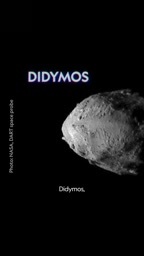
The experimental method itself was straightforward: NASA launched a spacecraft called DART and directed it to collide at high speed directly with Dimorphos. This is known as the "kinetic impact" strategy — relying not on explosions or nuclear weapons, but on the spacecraft's own momentum to alter the asteroid's trajectory. The core measurement was the change in Dimorphos's orbital period before and after the impact.
The kinetic impact strategy was prioritized because it is the most technically mature and lowest-risk approach. By comparison, other methods that have been discussed — such as nuclear deflection, the Gravity Tractor (using a spacecraft's own gravitational pull to slowly tug an asteroid), or solar sail reflectors — either involve politically sensitive nuclear weapons treaty issues, require extremely long lead times, or are far more difficult to engineer. The core logic of kinetic impact is "momentum transfer": the spacecraft strikes the target at extremely high speed (DART hit at approximately 6.1 kilometers per second), transferring its momentum to the asteroid. Combined with the recoil effect of ejected material from the impact point — quantified by the so-called "beta factor" (momentum enhancement ratio) — this amplifies the deflection effect. The reason the actual orbital period change far exceeded expectations is that rock fragments ejected from the impact site provided additional thrust. The measured beta factor fell between approximately 2.2 and 4.9, providing critical parameters for the design of future missions.
Results That Far Exceeded Expectations
Before the impact, NASA's conservative estimate was that Dimorphos's orbital period would shorten by about 73 seconds. Even a measurable change of that magnitude would be enough to demonstrate the viability of the kinetic impact approach.
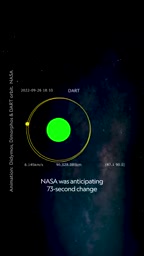
The actual results were remarkable: the impact shortened Dimorphos's orbital period by approximately 32 minutes. This figure vastly exceeded the original estimate, meaning that kinetic impact has a far more significant effect on an asteroid's orbit than previously thought. Beyond confirming the proposition that "we can change an asteroid's orbit," the mission also yielded invaluable real-world data for evaluating how large and how fast an impactor would need to be to handle threat objects of different sizes in the future.
What This Means for Human Civilization
This success gave humanity its first engineering-level proof that we are not helpless in the face of an impact threat from space.

Of course, one successful experiment does not mean the problem is fully solved. True planetary defense still requires more robust early warning systems, more precise orbital calculation capabilities, and sufficient lead time — because the earlier we can influence a threat object, the smaller the required orbital adjustment, and the higher the probability of success. But DART has taken a decisive step, transforming "asteroid deflection" from a science fiction concept into an engineering reality that has been empirically validated.
The closing line of this topic says it best: when the "big one" truly arrives, we don't want to share the fate of the dinosaurs. And now, humanity has at least grasped the first key to changing that destiny.
Early warning systems are the most critical first link in the planetary defense chain. Currently, NASA's Planetary Defense Coordination Office (PDCO) continuously tracks the orbits of Near-Earth Objects (NEOs) and has catalogued more than 35,000 near-Earth asteroids. However, a large number of objects smaller than 140 meters in diameter remain undiscovered — and an asteroid of that size striking a city would be enough to cause a regional catastrophe. The NEO Surveyor space telescope, which NASA plans to launch in the late 2020s, aims to identify more than 90% of potential threat objects 140 meters or larger within a decade. The earlier a threat is detected, the longer the window available for orbital intervention: applying a tiny velocity change decades in advance can cause an asteroid to pass harmlessly by Earth in the distant future, rather than colliding head-on.
Related articles

Chain of Thought Isn't Just for AI: How Humans Can Use CoT to Improve Thinking Quality
Chain of Thought isn't just a prompt trick for large models. Starting from a Hacker News discussion, this article analyzes why CoT works for human thinking too, breaks down actionable ways to transfer it, and highlights the key differences between human CoT and machine CoT.
Cloudflare Teams Up with OpenAI: Closi…
Cloudflare Teams Up with OpenAI: Closing the Loop from Vulnerability Discovery to Defense with AI
Cloudflare uses OpenAI Daybreak to investigate security vulnerabilities and generate reviewable remediation plans, while developers use Codex to boost coding efficiency and quality.

Orca Multi-Agent Orchestration in Practice: A Guide to Parallel Collaboration with Claude and Codex
Orca is Stable AI's free open-source agent workbench supporting 34 agents like Claude Code and Codex in parallel. Learn its Git worktree isolation, multi-model orchestration, and mobile management.