NASA Open-Sources the F´ Framework: A Space-Grade Toolkit for Flight Software and Embedded Systems Development
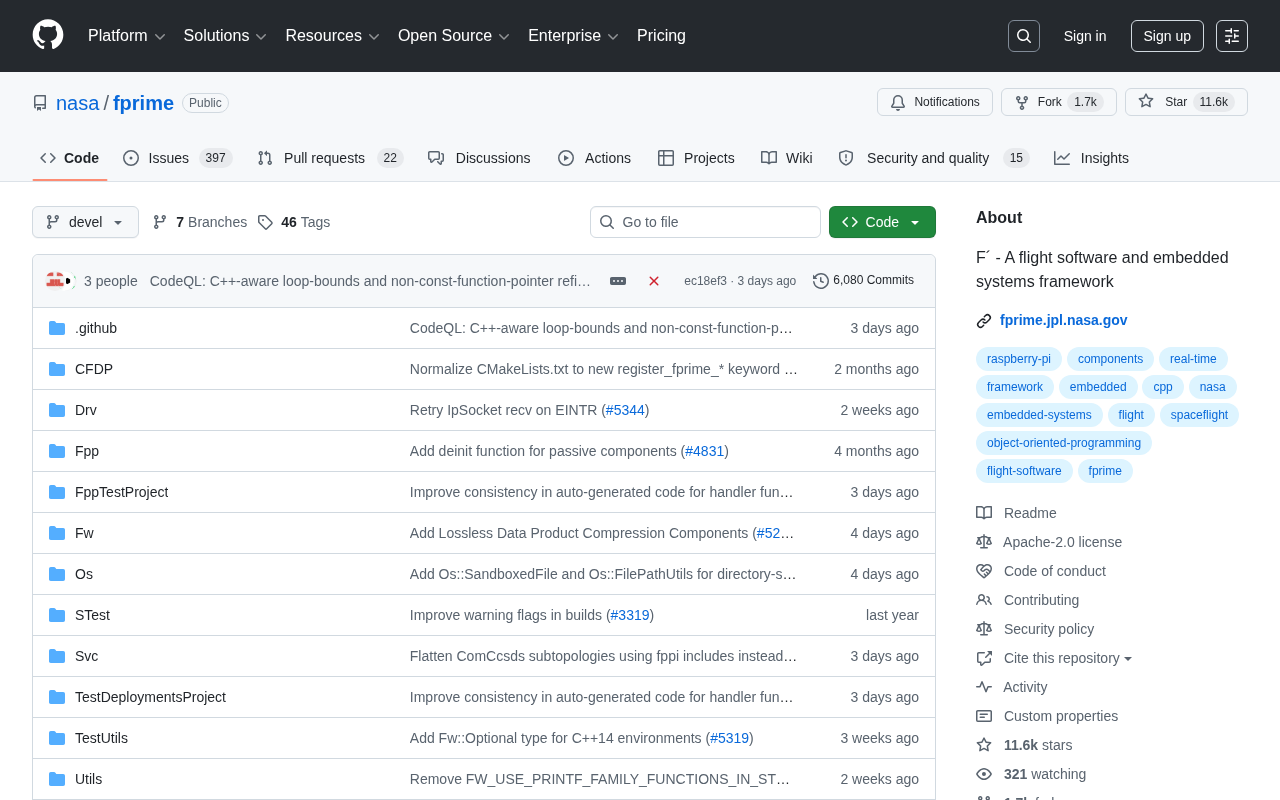
NASA JPL open-sources F´, a space-validated C++ flight software framework for CubeSats and embedded systems.
NASA's Jet Propulsion Laboratory has open-sourced F´ (F Prime), a component-based flight software framework written in C++. Validated on the Ingenuity Mars Helicopter and now with over 11,000 GitHub Stars, F´ targets CubeSats, drones, and embedded systems, dramatically lowering the barrier to space-grade software development.
Introduction: A Space-Grade Software Framework Goes Open Source
In the field of aerospace engineering, flight software is the "brain" of probes, satellites, and small spacecraft, responsible for critical tasks such as attitude control, sensor data acquisition, command execution, and fault handling. Flight software typically runs on radiation-hardened processors or commercial off-the-shelf (COTS) embedded processors, and must meet stringent software engineering standards such as DO-178C and NASA-STD-8739.8.
DO-178C is the international core standard for airworthiness certification of aviation software, jointly developed by RTCA and EUROCAE. It defines the complete lifecycle activities of airborne software from requirements analysis to verification, categorized into five DAL levels—A (catastrophic) through E (no effect)—based on the severity of software failure impact. NASA-STD-8739.8, on the other hand, is NASA's internal software engineering requirement standard, emphasizing independent verification and validation (IV&V), software safety analysis, and configuration management. It serves as the compliance baseline for flight software development at institutions like JPL. Together, these two standards form the institutional framework for quality assurance in aerospace flight software.
Unlike ground software, flight software is extremely difficult to repair once deployed—in deep space missions, a single command round-trip delay can reach tens of minutes, requiring the software to possess a high degree of autonomous Fault Detection, Isolation, and Recovery (FDIR) capability. FDIR refers to a spacecraft's ability to autonomously diagnose faults and execute recovery strategies through onboard software, without relying on real-time ground intervention. Typical mechanisms include watchdog timers, heartbeat detection, redundant sensor voting, and safe-mode switching—layered protection measures. Traditional flight software development has long cycles and high costs; software R&D for a medium-sized space mission often accounts for 30%–50% of the total budget. Such software has near-uncompromising requirements for reliability, real-time performance, and resource consumption.
Now, F´ (pronounced "F Prime"), developed under the leadership of NASA's Jet Propulsion Laboratory (JPL), has been open-sourced on GitHub and quickly won community attention—the project has already garnered over 11,474 Stars, with as many as 64 new stars in a single day, making it one of the most closely watched open-source projects in the embedded and aerospace software fields.
F´ is a flight software and embedded systems framework written in C++. It is not an experimental toy, but rather a "battle-tested" software infrastructure that has undergone the rigorous demands of real space missions—this is precisely the core value that distinguishes it from ordinary embedded frameworks.
What Is F´: A Component-Based Framework for Small Spacecraft
Component-Driven Architectural Design
The most distinctive feature of F´ is its adoption of a component-based architectural philosophy. This design draws on the mature ideas of Component-Based Software Engineering (CBSE) and Interface Definition Language (IDL). Developers break down complex flight software into functionally independent components, which communicate with each other through clearly defined ports.
Each component defines its input/output port types through the FPP (F Prime Prime) modeling language, and the framework's automatic code generator (Autocoder) converts these models into C++ skeleton code. FPP is a domain-specific language (DSL) designed specifically for F´, and its type system can check the type compatibility of port connections at compile time, eliminating a class of runtime errors at the root. When the Autocoder converts FPP models into C++ code, it simultaneously generates a Telemetry Dictionary and a Command Dictionary. These dictionaries can be directly imported by ground data systems (such as NASA's OpenMCT), enabling an end-to-end software-defined telemetry pipeline and greatly reducing the cost of manually maintaining data format consistency. Ports are divided into three call semantics—Synchronous, Asynchronous, and Guarded—corresponding to different thread-safety requirements, allowing developers to precisely control concurrency behavior. This is crucial for the timing determinism of real-time systems.
This design brings three key advantages:
- High cohesion, low coupling: Each component focuses on a single responsibility, facilitating independent development and testing;
- Strong reusability: Common components such as telemetry, command dispatch, and time management can be reused across different missions;
- Easy verification: Clear interface boundaries make unit testing and formal verification more actionable.
For resource-constrained spacecraft, this modular design not only improves engineering efficiency but also effectively reduces the mission risks posed by software defects.
Built for Resource-Constrained Environments
F´ has been specially optimized for CubeSats, drones, and various embedded systems. The CubeSat is a small-satellite standard jointly proposed in 1999 by California Polytechnic State University, San Luis Obispo, and Stanford University, using a 10cm×10cm×10cm module as the basic 1U unit. A typical 1U to 3U CubeSat has only a few hundred MB of memory, a processor clocked at tens to hundreds of MHz, and a power budget on the order of a few watts.
This aligns closely with F´'s design philosophy—the framework's core library occupies only a few hundred KB after compilation, its runtime memory footprint can be kept within a few MB, and it supports multiple real-time operating systems such as VxWorks, FreeRTOS, and Linux, covering the hardware platforms commonly used in CubeSats. The framework emphasizes lightweight design and execution determinism, fundamentally avoiding the bloat commonly seen in general-purpose frameworks.
Why It Deserves Attention: Endorsement from Real Space Missions
The Engineering Lineage of NASA JPL
F´ is developed under the leadership of NASA's Jet Propulsion Laboratory. JPL is the world's premier deep-space exploration institution, responsible for landmark missions such as the Mars rovers and the Mars helicopter. F´ was directly applied to the flight control software of NASA's Ingenuity Mars Helicopter—the first aircraft in human history to achieve powered flight on another planet, which made its first flight on Mars successfully on April 19, 2021.
Ingenuity faced multiple extreme engineering constraints: the Martian atmospheric density is only about 1% of Earth's, equivalent to the thin air at an altitude of about 35 kilometers on Earth, so the rotors had to spin at high speeds of 2,400 to 2,900 RPM to generate sufficient lift; the Martian day-night temperature difference reaches ±100°C, posing a severe test for batteries and electronic components; meanwhile, the communication delay between Mars and Earth meant that each flight had to be executed fully autonomously based on a pre-uploaded flight script. The flight control system adopts a dual-layer architecture of a Qualcomm Snapdragon 801 (running Linux) and an independent microcontroller (running VxWorks), where an F´-derived version handles upper-level mission planning and state management, while the underlying attitude control loop runs at a frequency of 500Hz. This architectural design has become an important engineering reference example in the fields of commercial drones and autonomous robotics.
Ingenuity's success completely upgraded F´ from a "laboratory achievement" to "interplanetary-validated" engineering infrastructure, representing a mature paradigm of modern aerospace flight software engineering. Open-sourcing such a battle-tested framework means that developers, university research teams, and even commercial aerospace startups can all build their own systems on the foundation of NASA's years of engineering experience, without reinventing the wheel.
Dramatically Lowering the Barrier to Aerospace Software Development
Traditionally, flight software development has been a highly specialized, nearly closed field, with only large aerospace agencies and top-tier contractors possessing the development capability. F´'s open-sourcing is an important part of NASA's Open Government Initiative—NASA has already open-sourced over 500 software projects through code.nasa.gov. At the same time, in the commercial aerospace sector, the rise of companies like SpaceX and RocketLab has driven an explosion in the global small-satellite market. According to industry forecasts, more than 15,000 small satellites will be in orbit before 2030, and this scale effect creates an urgent need for reusable software infrastructure to reduce R&D costs.
F´'s open-sourcing is breaking down traditional barriers:
- Educational value: Universities can directly use it for aerospace software teaching and research practice;
- Startup-friendly: Commercial aerospace companies don't need to build a complete software stack from scratch;
- Community collaboration: Developers worldwide can contribute components, fix defects, and jointly expand the ecosystem.
This openness is driving aerospace software from "closed-door development" into a new era of "open-source co-building." It's worth noting that F´ does not exist in isolation, but is an important part of an increasingly thriving aerospace open-source software ecosystem: the cFS (core Flight System) framework, led by NASA's Goddard Space Flight Center, adopts a service-oriented architecture and has been applied to dozens of NASA missions, with a positioning more oriented toward medium-to-large satellite platforms; ESA's TASTE toolchain integrates the AADL architecture description language and formal methods, emphasizing safety certification. F´'s differentiating advantages lie in its deep-space mission validation endorsement, lightweight design, and active official NASA maintenance support, giving it a unique competitive position in the CubeSat and small-spacecraft niche market.
Technology Ecosystem and Applicable Scenarios
A Complete Development Toolchain
F´ not only provides the framework itself but also comes with modeling tools, automatic code generation, a testing framework, and ground data system integration capabilities. Developers use FPP (F Prime Prime), a domain-specific language (DSL), to describe component interfaces, topology connections, and data dictionaries, after which the Autocoder toolchain automatically generates C++ base classes, serialization code, ground test stubs, and telemetry dictionaries.
This model-driven development (MDD) approach separates architectural decisions from implementation details, reducing the likelihood of introducing defects through manually written boilerplate code, while the generated code is thoroughly validated to meet NASA's software reliability requirements. For team collaboration, FPP model files also become "living documentation" for communicating architecture across teams, significantly improving development efficiency and code consistency.
Typical Application Domains
Beyond its core use in spacecraft flight software, F´'s scope of applicability continues to expand:
- CubeSats and small satellites: Its lightweight design naturally fits resource-constrained scenarios;
- Drones and robotics: Meets the core requirements of real-time control and fault tolerance;
- Embedded scientific instruments: Supports payload data acquisition and processing;
- Teaching and rapid prototyping: Helps teams quickly build runnable embedded systems.
Conclusion: Open Source Is Reshaping the Aerospace Software Landscape
F´'s popularity is no accident, reflecting two important trends behind it: first, the explosive growth of commercial aerospace and small satellites, which has generated enormous demand for reliable, out-of-the-box flight software frameworks; and second, the open-sourcing of technology by top-tier research institutions, which brings once-unattainable engineering capabilities to a much broader developer community.
For embedded engineers, aerospace enthusiasts, and researchers in related fields, F´ offers a rare learning and practice platform—you can directly study NASA-grade software architecture, gain a deep understanding of core engineering concepts such as component-based design, real-time scheduling, telemetry data management, and autonomous FDIR recovery, and even apply them to your own projects. As the community continues to grow, this framework—born from deep-space exploration and validated by interplanetary flight—may continue to shine in even more terrestrial and space scenarios.
Key Takeaways
Key Takeaways
Related articles

The Truth Behind Codex 'Build a Website in 5 Minutes': AI Isn't Creating Sites—It's Helping You Copy Them
Exposing the truth behind viral Codex 5-minute website videos: creators aren't building original sites with AI—they're copying shared prompts or scraping others' work. Learn AI coding tools' real limits.

Getting Started with AI Agent Development: A Complete Guide from Concept to Practice
A comprehensive guide to AI Agent architecture and development, covering automated marketing, intelligent customer service, and investment analysis scenarios with single and multi-agent collaboration.

The Truth Behind Codex 'Build a Website in 5 Minutes': AI Isn't Creating Sites — It's Helping You Copy Them
Exposing the truth behind viral Codex 5-minute website videos: creators aren't building original sites with AI — they're copying shared prompts or scraping others' work.