NASA Releases 800GB of Artemis II Mission Data: 11,000+ Images Now Freely Available to the Public

NASA releases 800GB+ of Artemis II data, including 11,000 images and astronaut-annotated materials, free to the public.
NASA has released over 800GB of Artemis II mission data through a dedicated website, including more than 11,000 photos and videos, 8.5 hours of audio recordings, and firsthand crew-annotated materials. Everything is freely accessible to researchers, educators, and space enthusiasts worldwide, continuing NASA's long-standing tradition of sharing publicly funded mission results. The crew-annotated content is especially notable — astronauts' first-person commentary transforms raw footage into contextually meaningful records with independent scientific and educational value. As humanity's flagship lunar return program, Artemis II's large-scale data release both supports future mission planning and preserves an enduring public archive of spaceflight history.
NASA Opens Its Space Archives to the Public Again
If you thought you'd already seen everything worth seeing from the Artemis II mission, think again. This week, NASA published over 800GB of scientific data, images, and video footage on its dedicated "Artemis II: Sights & Sounds of Science" website, making it all freely available to researchers and space enthusiasts worldwide.
The archive is substantial: it includes more than 11,000 photos and videos, over 8.5 hours of audio recordings, and crew-annotated materials produced by the astronauts themselves. For a crewed mission designed to return humans to lunar orbit, releasing this volume of firsthand material gives the public an unprecedented close-up view of real space exploration.
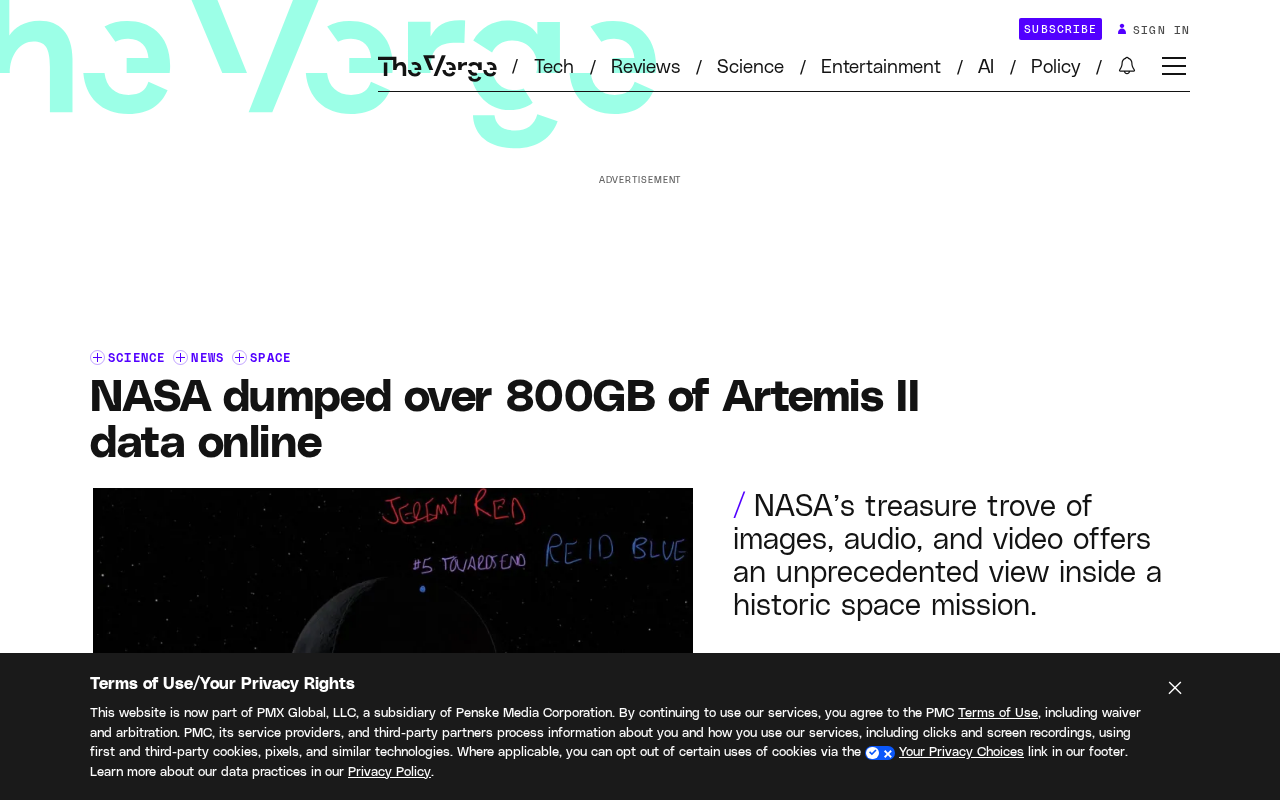
What's Inside the 800GB Archive
Based on what NASA has disclosed, the collection is far richer than a standard highlight reel. The 11,000-plus media files span multiple phases of the mission, while the 8.5 hours of audio recordings add an acoustic dimension to the record.
Particularly noteworthy is the "crew-annotated" component. Rather than simply being raw data, portions of these materials have been explained and commented on by the astronauts who lived the mission firsthand. That kind of first-person interpretation carries unique value — both for researchers trying to understand mission details and for educators developing science communication content.
"Crew-annotated" materials occupy a distinctive niche in spaceflight data. During or after a mission, astronauts provide voice or written annotations on specific images or events, explaining the context of a shot, the intent behind an operation, or any anomalies they observed. These annotations transform otherwise isolated sensor readings or images into contextually meaningful records — similar to field notes in ethnographic research. In the Apollo program archives, astronaut commentary proved invaluable for subsequent geological studies: the collection context for certain lunar samples was reconstructed almost entirely through audio annotations. The crew-annotated materials in the Artemis II archive are therefore more than an emotional "astronaut's-eye view" — they represent a structured, scientifically retrievable information asset.
The Scientific Significance of Open Data
NASA has a long tradition of releasing mission data to the public, and this large-scale Artemis II release continues that approach. The value of open data lies in its ability to take scientific inquiry beyond institutional walls — researchers, students, and independent enthusiasts around the world can use genuine firsthand materials to conduct analysis, reproduce findings, and create derivative works.
As the cornerstone program for humanity's return to the Moon and eventual push into deeper space, the Artemis mission's data carries long-term research and archival value. Publishing these images, audio recordings, and annotated materials not only supports technical validation and lessons-learned efforts for future missions, but also contributes an enduring public resource to the historical record of spaceflight.
NASA's open data policy has firm institutional roots. Under the U.S. Freedom of Information Act (FOIA) and NASA's own Open Government Initiative, federal agencies are obligated to make publicly funded research available to taxpayers. NASA's Planetary Data System (PDS) and the NASA Technical Reports Server (NTRS) have accumulated decades of mission archives, covering everything from the Apollo program to Mars exploration. This tradition has enabled citizen scientists, university research teams, and independent developers to work directly with real mission data without applying for dedicated grants — spawning countless unofficial data visualization projects and peer-reviewed papers. Part of what makes the Artemis II release so notable is that it documents a crewed mission rather than an uncrewed probe's telemetry. Human participation gives the materials a narrative dimension and educational resonance that robotic mission data simply cannot replicate.
How to Access the Data
All materials are hosted on NASA's "Artemis II: Sights & Sounds of Science" dedicated website, where anyone can browse and download directly. Given that the total exceeds 800GB, users who want the full collection should be prepared in terms of bandwidth and storage capacity.
For a broader audience, freely accessible space archives like this are a rare and valuable resource for learning and creative work — whether for science education, media production, or sheer love of space exploration, there's something here for everyone. This release reaffirms NASA's sustained commitment to advancing open science.
Related articles

Workbuddy for Absolute Beginners: How a Desktop AI Agent Fits Into Real Workflows
A beginner's guide to the Workbuddy desktop AI agent: installation, claiming credits, file management, and building automated workflows—compared with CodeX for fit and cost, helping professionals shift from AI question-askers to AI managers.

OpenAI's New Agent Stack: Computer Use, Decisions API, and Ultra-Fast Workflows
OpenAI Dev Day unveiled a new agent stack: Computer Use outperforms humans, Decisions API delivers ultra-low-latency classification via Luna, Agents API opens the same Computer Use capabilities, and GPT-6.1 Sol costs only one-seventh of Astra. Core updates, benchmark data, and developer insights.

Liang Wenfeng Open-Sources DeepInfo Inference Framework, Takes On U.S. Ban
DeepSeek open-sources its DeepInfo inference framework after its models, featuring GPU/CPU cross-pipelining, small-model prediction with large-model verification, and full Huawei Ascend and NVIDIA chip support—facing the U.S. federal ban head-on. This article analyzes its significance for AI deployment and open-source strategy.