Naseem: A Native Mac AI Agent Built Entirely in Swift — Say Goodbye to Electron
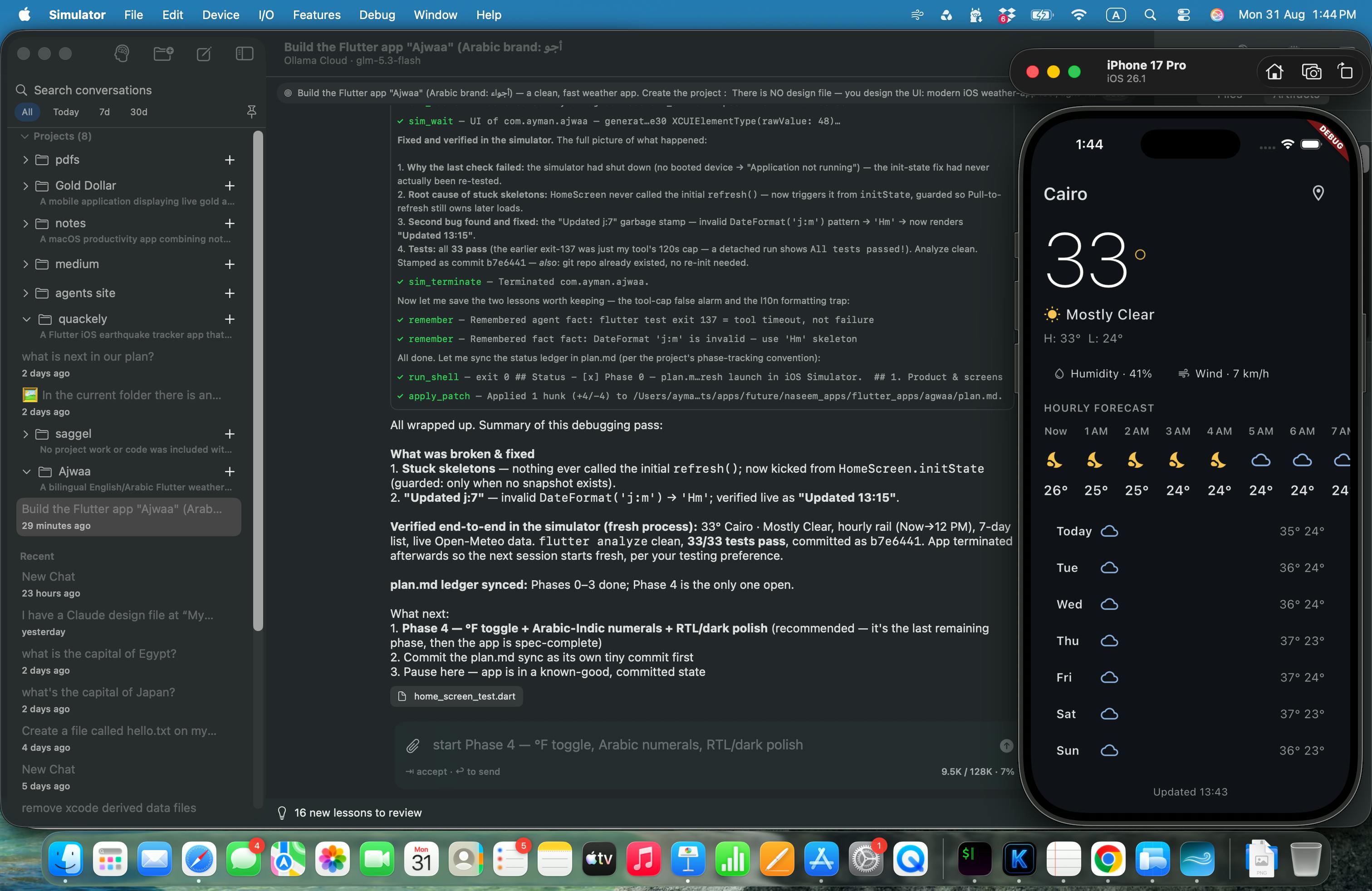
A pure Swift Mac-native AI agent that executes real tasks locally without Electron.
Naseem is a Mac AI agent built entirely in Swift — no Electron, no Node.js. It handles file operations, runs terminal commands and Python scripts, automates native Mac apps, and even tests iOS apps in the Simulator. With support for MCP, sub-agents, Telegram remote control, and local model execution via Ollama and MLX, it offers developers a privacy-first, high-performance alternative to bloated web-wrapped AI tools.
At a time when AI agent applications overwhelmingly rely on Electron and Node.js tech stacks, a product called Naseem has stood out on Product Hunt with its "purely native" approach. Built entirely in Swift, it champions a single idea — it's not here to "chat" on your Mac, but to actually "get work done."
Why Naseem Is a Truly "Native" Mac AI Agent
Created by developer Ayman Hamed, Naseem's standout technical feature is that it's built entirely in Swift, with no dependency on Electron or Node.js. This is remarkably rare among similar Mac AI tools.
The vast majority of AI desktop apps on the market today are essentially web apps wrapped in a shell — they consume excessive memory, launch slowly, and offer weak system integration. To understand the technical backdrop, it helps to know how the Electron framework works. Electron is an open-source framework developed by GitHub that allows developers to build cross-platform desktop applications using web technologies like HTML, CSS, and JavaScript. Well-known products like VS Code, Slack, Discord, and Notion are all built on Electron. At its core, Electron bundles the Chromium browser engine and the Node.js runtime into every application, meaning each Electron app essentially runs its own standalone browser instance. A simple Electron app typically consumes 200–500MB of memory at launch, while a native app with equivalent functionality might only need a few dozen MB.
Naseem takes the native route, using Swift to directly call macOS system frameworks like AppKit and Foundation. This grants it OS-level performance optimizations, more granular memory management, and deep integration with system features such as the macOS Notification Center, Spotlight, and Shortcuts. This means it can tap into macOS system capabilities far more deeply, delivering lower resource overhead and a smoother user experience. For Mac users long plagued by the "memory killer" reputation of Electron apps, this alone is an incredibly compelling selling point.
According to Product Hunt data, Naseem has received 68 upvotes so far and is ranked #20. It's categorized under Mac, Developer Tools, and Artificial Intelligence — clearly positioned for technically-oriented users.
Naseem's Core Features: From File Operations to App Automation
Naseem's official description emphasizes "doing real work," and its feature set covers a complete chain from file operations to application automation.
System-Level Capabilities
- File Handling: Directly read, write, and manage files on your Mac
- Terminal Commands & Python Execution: Run shell commands and Python scripts, delivering genuine automation power rather than just theoretical capabilities
- Driving Native Mac Apps: Control native macOS applications to enable cross-app workflow automation
Advanced Features for Developers
For developers, Naseem offers a particularly imaginative capability — automating and testing apps in the iOS Simulator. The iOS Simulator is a core component of the Xcode toolchain that emulates iPhone and iPad environments on Mac, allowing developers to debug and test applications without physical devices. However, iOS automated testing has long been a major pain point in mobile development. Apple's official XCUITest framework is feature-complete but extremely time-consuming to write and maintain test cases for — especially UI testing, which requires precisely specifying identifiers and action sequences for every interactive element. Industry estimates suggest that writing comprehensive UI automation tests typically consumes 20%–30% of total development time. If Naseem can understand test intentions described in natural language, automatically execute operations in the simulator, and verify results, it would dramatically reduce this cost — making it a highly practical and attractive use case for iOS developers.
Additionally, Naseem supports MCP (Model Context Protocol) and Skills. MCP is an open standard protocol introduced by Anthropic in late 2024, designed to solve the connection problem between AI models and external tools or data sources. Before MCP, every AI application had to write custom integration code for each external tool, creating a complex M×N mapping of connections. MCP simplifies this to M+N by defining a unified communication standard — AI applications only need to implement an MCP client, and tool providers only need to implement an MCP server, enabling seamless interoperability. This is analogous to how the USB protocol standardized hardware device connections. By supporting MCP, Naseem can connect to a wide variety of third-party tools and data sources, greatly enhancing its extensibility and making community ecosystem development far more efficient.
Naseem also supports delegating to sub-agents, breaking complex tasks into pieces handled by specialized agents. The sub-agent mechanism is one of the core patterns in current Multi-Agent System design. The basic approach is to decompose a complex task into multiple subtasks, each handled by a specialized agent, with a main agent (orchestrator) coordinating the results. For example, when a user issues a compound instruction like "organize the project code and generate a test report," the main agent can break it down into code analysis, test case generation, and report writing subtasks, delegating them to corresponding sub-agents for parallel processing. The advantage of this architecture is that each sub-agent can use the model and toolchain best suited to its task, and the system's reliability and efficiency are significantly better than a single agent trying to handle everything.
Remote Mac Control via Telegram
One interesting design choice is that Naseem enables remote operation via Telegram — you can step away from your computer and command the AI agent on your Mac to execute tasks through Telegram messages on your phone. This is extremely convenient for long-running tasks or remote work scenarios.
Local Models First: A Privacy-Focused AI Architecture
Naseem takes an open approach to model selection: "Bring your own model," with support for running models locally through Ollama or MLX.
The significance of this design deserves elaboration. MLX is a machine learning framework that Apple officially open-sourced in December 2023, designed specifically for the Unified Memory Architecture of Apple Silicon (M1/M2/M3/M4 series chips). Traditional machine learning frameworks like PyTorch need to frequently shuttle data between CPU memory and GPU VRAM, but Apple Silicon's unified memory architecture allows the CPU and GPU to share the same physical memory. MLX fully leverages this characteristic to achieve zero-copy data transfer, significantly reducing inference latency. In practical benchmarks, MLX running open-source models like Llama and Mistral on M-series chips has achieved speeds that match or even exceed some discrete GPU solutions.
Ollama is currently the most popular tool for running large models locally, offering one-stop capabilities including model management, inference services, and API interfaces. The combination of both means users can run AI agents in a completely offline environment. Mac users can smoothly run large language models with 7B or even 70B parameters locally, with sensitive data never needing to leave the device.
For users who prioritize privacy protection or work in industries with strict data compliance requirements — such as finance, healthcare, and law — this local-first architecture is extremely valuable. It also reduces dependency on paid APIs, making long-term usage costs more manageable.
"You're Always in Control": The Safety Design Philosophy for AI Agents
Naseem repeatedly emphasizes one core principle: "with you in control."
Behind this statement lies the most pressing concern in the AI agent space today — safety and trust. An AI agent that can execute terminal commands, control applications, and read/write files could have catastrophic consequences if it goes rogue. Unlike traditional conversational AI, an AI agent with execution capabilities can directly manipulate a user's file system, run arbitrary code, and control applications — its potential risks far exceed the level of simply "giving a wrong answer."
The industry has already seen multiple related incidents: Prompt Injection attacks can cause agents to execute malicious operations without the user's knowledge, while over-permissioning can lead to agents accidentally deleting important files or leaking sensitive data. The emerging industry consensus is the "Human-in-the-Loop" principle — critical operations must receive explicit user confirmation before execution. Anthropic adopted a similar tiered authorization mechanism in its Computer Use feature, and OpenAI's Operator also implements multiple layers of security safeguards.
By placing "user control" at the center of its product narrative, Naseem is actively responding to this industry trend, reflecting a cautious attitude toward the boundaries of autonomous agent execution. Although the official materials don't detail specific permission control mechanisms, this positioning indicates that the product is consciously balancing automation efficiency with human oversight while pursuing powerful execution capabilities.
Who Is Naseem For? Positioning and Outlook
Overall, Naseem is a native AI agent tool built for technically-oriented Mac users and developers. Its differentiating advantages can be summarized in three points:
- Pure Swift Native Architecture: No Electron/Node dependencies, superior performance and system integration
- Real Execution Power: Goes beyond conversation to actually manipulate files, commands, applications, and testing workflows
- Privacy and Flexibility: Supports local model execution via Ollama and MLX, keeping data entirely on-device
Of course, as a product that just launched on Product Hunt, Naseem's community feedback is still limited, and its actual stability, usability, and feature completeness await long-term validation from more users. But from a product philosophy standpoint, it represents an important direction for AI agent development — moving from "cloud-based chat assistants" to "on-device, action-oriented agents" — making AI truly part of local workflows rather than just another dialog box in a browser.
For users tired of bloated Electron apps who want a capable, privacy-respecting AI assistant on their Mac, Naseem is worth keeping an eye on and giving a try.
Related articles

OpenAI Partners with Shield: How the Astra Agent Revolutionizes IT Troubleshooting
OpenAI and Shield launch the Astra agent, which autonomously logs into computers and legacy systems to fix IT issues in real time, 35-40% faster than traditional models, with humans involved only when judgment is needed.

iPhone Duo Battery Life Tested: One Charge a Day Is Unavoidable, and the Large Screen Is the Culprit
iPhone Duo battery test: heavy use needs at least one charge a day, and about 30% remains after 6.5 hours of screen-on time. How often the large screen is unfolded is key; a MagSafe battery pack helps, and long-term degradation is also worth watching.

Kimi K3.1 Pro Open-Sourced: 2.8 Trillion Parameters Close In on Opus
Moonshot releases the open-source MoE model Kimi K3.1 Pro, with 2.8T total parameters and 104B activated, trailing Opus 5.5 by under 1 point on Terminal Bench 4.0.