Naverny Borshchu: The Open-Source Community Map That Rates Ukrainian Borscht
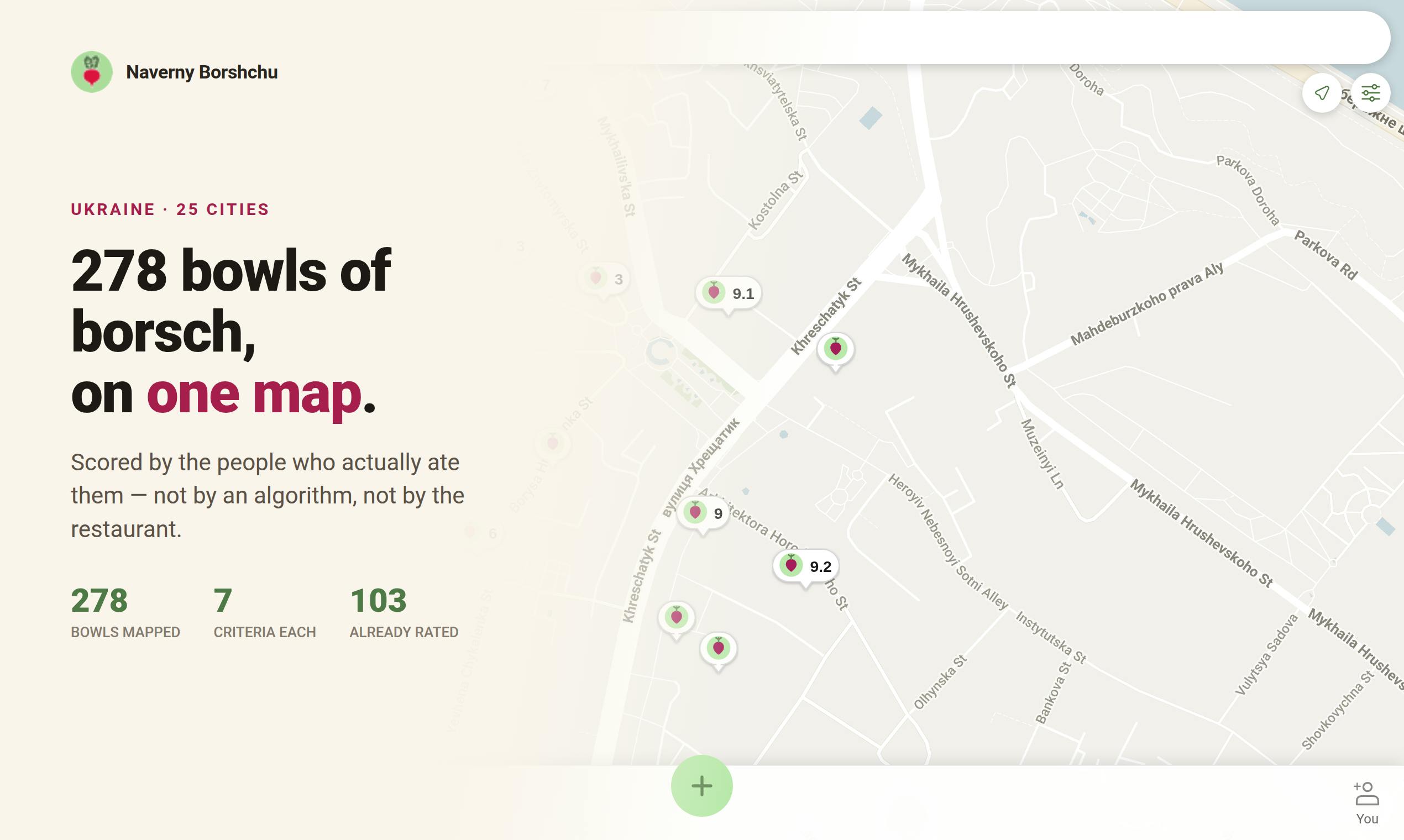
An open-source community map rating Ukrainian borscht across 7 dimensions with a clever "discoverer" mechanic.
Naverny Borshchu is a niche food map built by indie developer Andrew Kolp, dedicated to cataloging and rating Ukraine's national dish. It lists 278 bowls of borscht across 31 cities, scored on 7 dimensions — meatiness, beetiness, thickness, saltiness, aftertaste, presentation, and overall. Its "discoverer" mechanic cleverly tackles the UGC cold start problem by permanently crediting the first person to rate each bowl. Free, open-source, and ad-free, it serves as both a practical dining guide and a cultural documentation project tied to borscht's UNESCO heritage status.
In a world saturated with food review apps, a map product laser-focused on a single dish stands out. Naverny Borshchu turns its attention to Ukraine's national dish — borscht — using a community-crowdsourced map to answer a question that sounds simple but has never been seriously tackled: where can you find the best bowl?
A Map Built for Borscht and Nothing Else
Naverny Borshchu currently lists 278 bowls of borscht across 31 cities, each rated by someone who actually ate it across 7 criteria: meatiness, beetiness, thickness, saltiness, aftertaste, presentation, and overall impression.
This granular rating system is far more specific than the generic five-star reviews you'd find on most food apps. Rather than rating a restaurant, it zeroes in on a single bowl of soup. For a dish like borscht — with its wildly diverse regional variations and preparation styles — that kind of vertical, in-depth evaluation framework is genuinely more useful.
The "Discoverer" Mechanic: Turning Cold Start Into a Game
Of the 278 bowls currently listed, 103 have been rated while 175 remain blank. Naverny Borshchu addresses this with a clever incentive: whoever is the first to taste and rate an unreviewed bowl of borscht earns permanent recognition as that bowl's "discoverer."
At its core, this mechanic tackles one of the hardest problems in UGC (user-generated content) products: the cold start problem. A blank map holds no appeal for early users — but the identity of being the first discoverer of a specific bowl, with its built-in scarcity and sense of honor, transforms the tedious task of filling in content into an exploration game. Users aren't just rating soup; they're "claiming" uncharted territory. This approach echoes the growth logic seen in early mapping and check-in products.
The cold start dilemma in UGC products is well-documented: no content means no users; no users means no content. This vicious cycle has killed countless community products in their infancy. Classic solutions include founders seeding initial content themselves (as Reddit did early on), rewarding early contributors with points or badges (like Stack Overflow's badge system), and the check-in + "Mayor" mechanic pioneered by Foursquare — where whoever checked in most at a location became its Mayor. Naverny Borshchu's "discoverer" mechanic closely mirrors Foursquare's Mayor logic, but dials down competition while amplifying scarcity and permanence. A mayoral title can be stolen by the next frequent visitor; discoverer status is permanently bound to that bowl, deepening the ritual significance of the contribution.
Free, Open Source, and Ad-Free by Principle
In an era of aggressive monetization, Naverny Borshchu explicitly positions itself as free, open source, ad-free, and without affiliate links. Its category tags include a direct link to GitHub, meaning the code is fully open for inspection.
This stance signals something closer to a community-driven, culturally motivated indie project than a business. For Ukraine, borscht is more than everyday food — it's a UNESCO-recognized cultural heritage, carrying deep national identity. Building an open, non-commercial community map around it is, in a sense, using product design as a form of cultural documentation and preservation.
Borscht was added to UNESCO's list of Intangible Cultural Heritage in Need of Urgent Safeguarding in 2022 — a designation with unmistakable historical context, coming at the outbreak of the Russia-Ukraine conflict. Ukraine's push to have borscht recognized as its own cultural heritage was also a way of asserting national identity and historical ownership at the cultural level. Borscht has a long history across multiple Eastern European countries, with significant regional variation: the Ukrainian version typically centers on beetroot slow-cooked with pork or beef, yielding a deep red, rich soup, while Russian, Polish, and other regional versions differ in ingredient ratios and seasoning. It's no coincidence, then, that Naverny Borshchu lists "beetiness" as a standalone rating dimension — it's essentially quantifying the most distinctive flavor characteristic of Ukrainian borscht.
The Value and Limits of a Small-but-Beautiful Product
Naverny Borshchu was built by indie developer Andrew Kolp. On Product Hunt, it garnered modest votes and comments, landing at #17. By the numbers, it's a classic niche product with a highly vertical audience — primarily Ukrainian locals and travelers interested in the country's food culture.
Its value lies in doing one seemingly small thing with genuine care: 7 rating dimensions, a discoverer mechanic, open-source transparency — every design choice reflects the creator's thoughtfulness. But its ceiling is equally apparent. Single category, single region, reliance on voluntary community contributions — it's hard to scale like a general-purpose review platform.
Then again, that may not be the point. Products like this remind us that chasing exponential growth isn't the only path for internet products. Building a careful map around a real, culturally meaningful need — rating every bowl with genuine attention — is its own form of worthwhile creation. For anyone planning to visit Ukraine or wanting to explore its food culture in depth, this map is a practical and delightful place to start.
Related articles

Can 'Your Mother' Make Us Forget Marvel's Blade Disaster?
Marvel's Blade reboot starring Mahershala Ali collapsed due to mismanagement. We explore why its failure may not be the worst outcome — and what 'Your Mother' has to do with it.
SHIUI: A Minimalist Ink-Wash UI Kit Inspired by Japanese Hinomaru Aesthetics
SHIUI is a flat ink-wash Web UI kit inspired by Japanese Hinomaru poster aesthetics, built around paper, sumi ink, and vermilion with zero shadows. A design breakdown.

Kirokune: An iPhone Work Incident Logger That Requires No Account
Kirokune is an iPhone app for logging workplace incidents — no account required. Combines text, audio, and photos in a timeline. Ranked #9 on Product Hunt with 86 votes.