Neckbeard: A DevOps/SRE Plugin Built for Agents

Neckbeard trending on HN shows Agents shifting from general assistants to vertical plugins like DevOps/SRE.
The article uses the Neckbeard project, which sparked discussion on Hacker News, as an entry point to show that the Agent ecosystem is shifting from general capabilities to specialized plugins in vertical domains. Neckbeard is positioned as a DevOps/Platform/SRE plugin for Agents, and these three areas share traits of high information density, long troubleshooting chains, and repetitive work. The article argues that pluginization is a pragmatic path for Agent deployment: clear boundaries, easy integration, and scenario-specific optimization. Meanwhile, community discussion focuses not on feature count but on reliability, permission boundaries, and auditability in critical operations. The article concludes that the next stage of Agent competition will happen in deep integration within vertical scenarios.
Starting from the HN Hot Post: The Agent Ecosystem Begins to "Verticalize"
Recently on Hacker News, a project called Neckbeard sparked discussion. Its positioning is very direct — a DevOps / Platform / SRE plugin built for Agents.
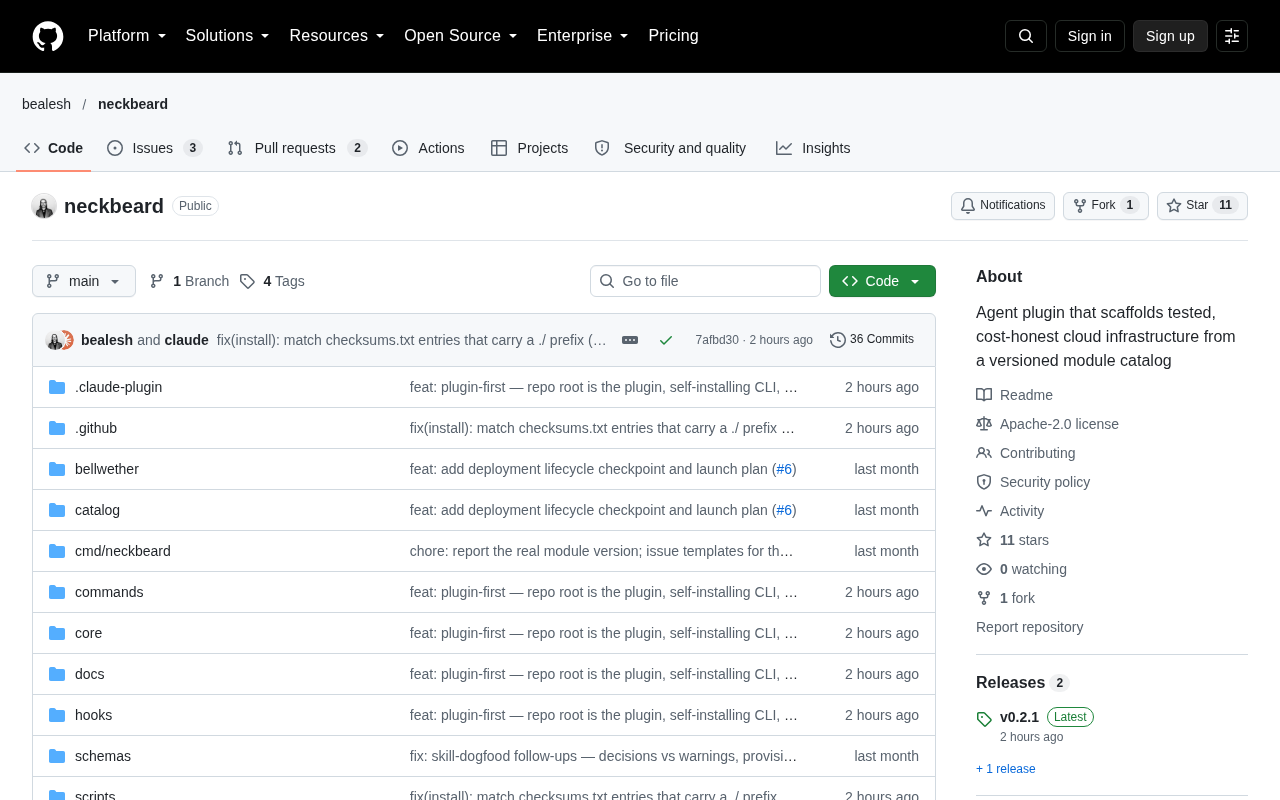
Over the past year, discussions around Agents have mostly centered on "general capabilities": Can it write code? Can it call tools? Can it autonomously plan multi-step tasks? But the emergence of Neckbeard points to a more practical trend — Agents are moving from general-purpose assistants toward specialized plugins in vertical domains.
Why DevOps, Platform, and SRE?
These three areas share a common trait: high information density, long troubleshooting chains, and lots of repetitive work.
- DevOps: CI/CD pipelines, environment configuration, deployment rollbacks
- Platform: Internal developer platforms, resource orchestration, permission management
- SRE: Alert response, root cause analysis, capacity planning
The daily reality of this work often involves operations engineers switching back and forth between multiple dashboards, log systems, and command lines. An Agent plugin that can understand context, proactively pull data, and offer judgments naturally hits this pain point.
The name Neckbeard carries a self-deprecating engineering culture flavor, but its functional positioning is quite pragmatic.
SRE (Site Reliability Engineering) was first systematically proposed by Google around 2003. The core idea is to bring software engineering methods into operations: using quantitative metrics like SLOs (Service Level Objectives) and Error Budgets to define "how reliable is reliable enough," rather than chasing 100% availability. Its biggest difference from traditional operations is that SRE treats "operations" as a software problem that can be solved with code and automation.
Platform Engineering is a concept that has emerged in recent years, and can be understood as a further division of labor within DevOps: rather than having every business team build their own CI/CD, monitoring, and permission systems, a dedicated platform team provides an "Internal Developer Platform" (IDP) that encapsulates infrastructure capabilities as self-service offerings.
These two directions share the same characteristic as DevOps: a large amount of context is scattered across documents, dashboards, logs, and chat records, and operations are often irreversible — this is precisely where Agent plugins can deliver value, and also where they most need constraints.
Pluginization: A Pragmatic Path for Agent Deployment
Rather than training a general-purpose Agent that knows everything but masters nothing, it is better to let the Agent connect to professional toolchains through plugins. This is the path Neckbeard takes.
The benefits of this model are obvious:
- Clear boundaries: Plugins only handle tool invocation and knowledge encapsulation for specific domains, keeping the error scope controllable
- Easy integration: No changes to the Agent core; mounted through plugin protocols
- Specialization: Prompts and tool sets optimized for DevOps/SRE scenarios
For teams already using Agents for operations tasks, such plugins can significantly reduce the cost of "building from scratch."
The "plugin protocol" mentioned here typically refers to two categories of standards in current mainstream practice: one is tool/context access protocols represented by MCP (Model Context Protocol), which defines how Agents discover, describe, and invoke external tools and data sources; the other is the Function Calling/Tool Schema mechanism built into various Agent frameworks.
The essence of pluginization is decoupling "capability" from "reasoning": the Agent handles understanding intent and orchestrating steps, while plugins handle encapsulating specific APIs, authentication, parameter validation, and error handling. This way, operations teams don't need to expose all the details of internal systems to the model — they only need to expose a limited, reviewed set of operations through plugins.
The cost is that plugins themselves require long-term maintenance — when upstream APIs change, plugins may break. Therefore, the sustainability and version management of the plugin ecosystem often test engineering capabilities more than a one-time integration.
Multi-Source Perspectives: Where the Community's Attention Lies
Judging from the热度 of the HN discussion (the post received considerable comment engagement), the core concerns among developers are: the reliability and permission boundaries of Agents in critical operations tasks.
DevOps and SRE scenarios differ from writing code — a wrong deletion operation, a misjudged alert response, could result in a production incident. Therefore, the industry generally believes that the value of such plugins lies not just in "what they can do," but more in "under what constraints they do it."
The significance of projects like Neckbeard may not lie in how long the feature list is, but in the fact that it represents the Agent toolchain evolving toward controlled, professional, and auditable directions.
Auditability is repeatedly mentioned in such discussions, and specifically includes several layers of meaning: who (which Agent, which user) initiated the operation, what data it was based on, which command was executed, and what the result was — all must leave tamper-proof records.
A common industry practice is to introduce Human-in-the-loop: allow Agents to automatically execute read-only operations (querying logs, pulling metrics), while requiring human confirmation or an approval workflow for write operations (restarting services, rolling back deployments, modifying permissions). Another layer is the principle of least privilege, meaning plugins only request the permissions necessary to complete the current task, rather than directly reusing all of the operations staff's credentials.
These constraints may seem to reduce the Agent's "autonomy," but in fact they are precisely the prerequisite for it to be trusted and used long-term in production environments.
A Signal, Not an Endpoint
Neckbeard itself may just be an early-stage project — small in scale, with features still iterating. But the signal it sends is worth paying attention to: the next stage of Agent competition will happen in deep integration within vertical scenarios.
Whoever can best encapsulate a professional domain's toolchain, best practices, and security constraints will be more likely to become the de facto standard for Agents in that domain. DevOps/SRE is just one of the first entry points.
One-line Summary
Neckbeard trending on HN shows Agents shifting from general assistants to vertical plugins like DevOps/SRE.
Paragraph Summary
The article uses the Neckbeard project, which sparked discussion on Hacker News, as an entry point to point out that the Agent ecosystem is shifting from pursuing general capabilities to specialized plugins in vertical domains. Neckbeard positions itself as a DevOps/Platform/SRE plugin built for Agents, and these three areas share the common traits of high information density, long troubleshooting chains, and lots of repetitive work — precisely hitting the pain point of operations engineers switching back and forth between multiple dashboards and command lines. The article argues that pluginization is a pragmatic path for Agent deployment: clear boundaries, easy integration, scenario-specific optimization, and lower costs for teams building from scratch. Meanwhile, the community's focus is not on the number of features, but on the reliability, permission boundaries, and auditability of Agents in critical operations tasks. The article concludes that the next stage of Agent competition will happen in deep integration within vertical scenarios.
Related articles

Build a Price-Reduction Negotiation Guide with ChatGPT in 10 Minutes: 10 Talk Tracks + 5 Objection Handlers
Learn how to use ChatGPT to generate a property price-reduction conversation guide in 10 minutes: a six-element market brief, 10 talk tracks, and 5 objection handlers.

REA Goes Viral on GitHub: Letting AI Reverse-Engineer Any App Feature
REA, a viral open-source MCP server on GitHub, gives Cloud Code, Codex, Cursor and other AI coding agents reverse-engineering powers—dissecting any app feature in ten minutes. This article covers how it works, the five-step install, an Excalidraw hands-on test, and security and compliance risks.

Give Your AI Agent a Shelf: MCP + x402 Lets Agents Shop Autonomously
A real experiment: give an AI Agent a secondhand shelf, expose search, lookup, and purchase-intent tools via MCP, and return payment challenges with x402—but eBay still closes the deal. Exploring agent-readable e-commerce.