#DevOps
40 related articles
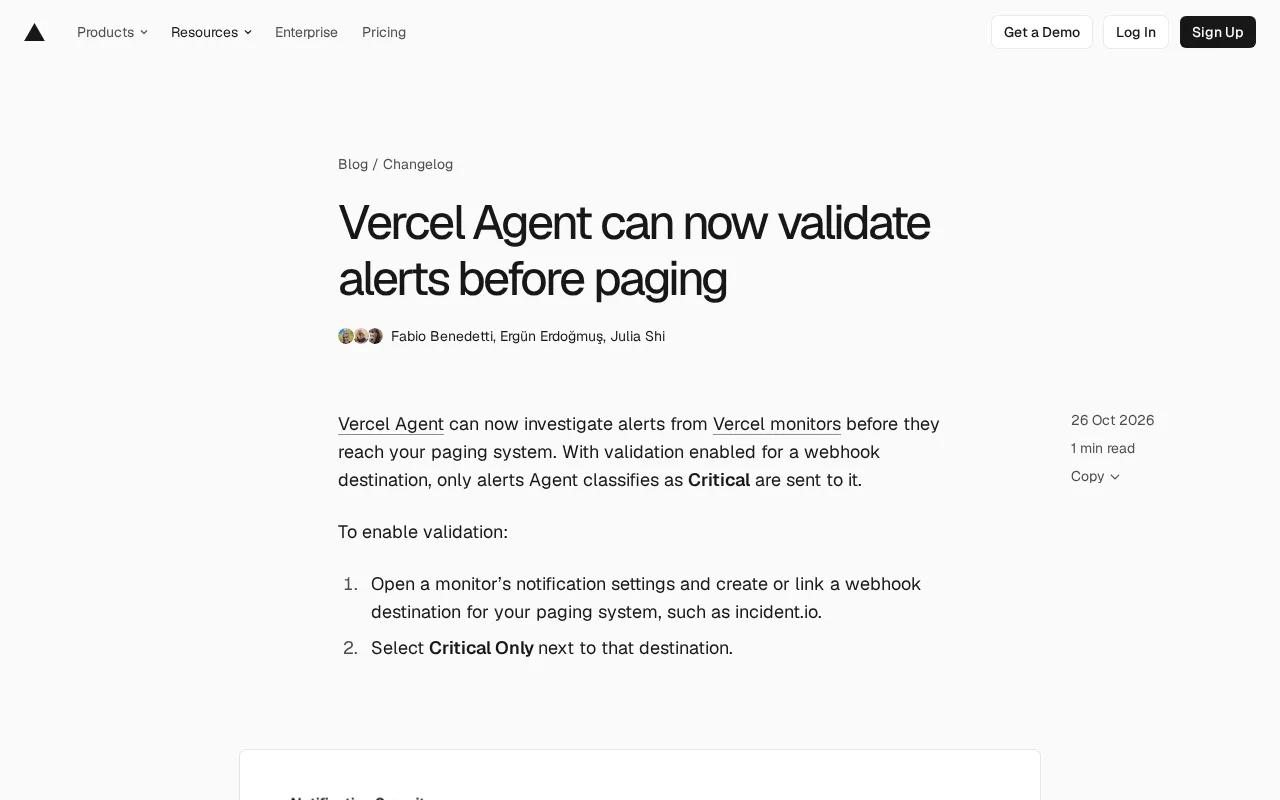
Vercel Agent Upgrade: Alerts Verified by AI Before Triggering Pages
Vercel Agent adds alert verification, investigating logs and metrics before alerts reach paging systems, sending only Critical alerts to incident.io and similar services to reduce alert noise for operations teams.
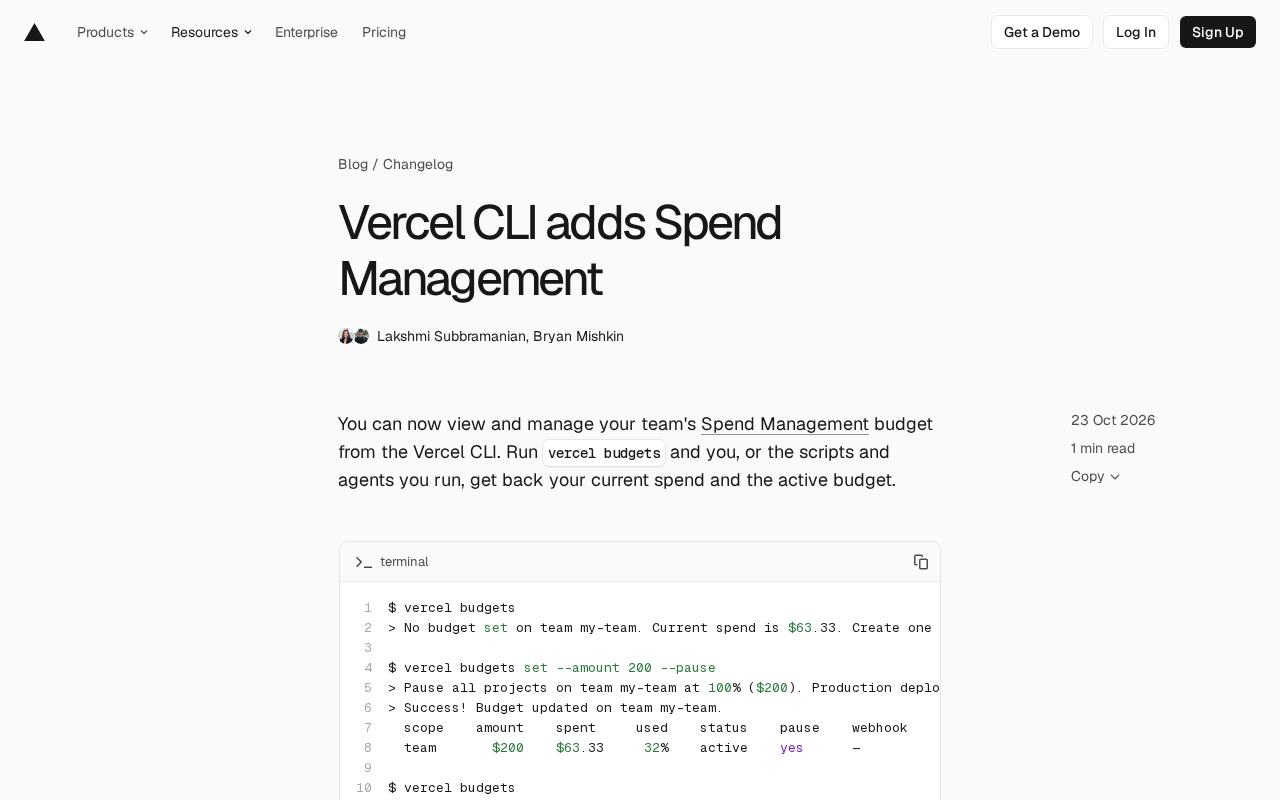
Vercel CLI Adds Budget Management: Control Team Spending from the Terminal
Vercel CLI adds Spend Management budget features: view, set, and delete team budgets with `vercel budgets`, query alert history, and use `--pause` to suspend production deployments on overspend.

GitLab Emergency Patch Release: Analysis of Critical Security Fixes
GitLab releases critical patch 19.5.1, sparking 355 points of discussion on Hacker News. This article analyzes the background, upgrade steps for self-hosted instances, and verification points to help DevOps teams respond quickly to security updates.

Model Drafts On-Call Commands, Read-Only Validation Keeps It Safe
The first commands in a runbook carry the highest risk. Learn to define command blocks in YAML, validate read-only behavior with Python, and replay with fixtures for safety.

Database Migrations That Can Roll Back at 2 AM
Starting from a real incident where dropping a column at 2 AM couldn't be rolled back, this distills four actionable database migration principles: every change has a down step, the four-step expand-contract method, ordering rules for migrations and deployments, and idempotent retries with statement timeouts. Make rollbacks boring.

How AI Agents Are Automating DevOps: Boosting Both Efficiency and Reliability
AI agents are transforming DevOps: from automating repetitive tasks to predicting failures and accelerating release cycles. This article analyzes core capabilities, solutions from Red Hat and Google Cloud, and the real challenges and future trends of AIOps adoption.

GitHub Shared Org Automation: Outside Collaborator Access Reviews and Repository Archiving
GitHub's engineering team shares how to use native features to automate outside collaborator access reviews and archive stale repositories in shared organizations, reducing security risk and management complexity.

Neckbeard: A DevOps/SRE Plugin Built for Agents
Neckbeard, a DevOps/Platform/SRE plugin for Agents discussed on Hacker News, signals the Agent ecosystem's verticalization trend. This analysis explores the value and security boundaries of pluginization in operations.

AI Agent Orchestration Arms Race: Building Blast-Radius-Aware Code Review on Kubernetes
Multi-agent orchestration is becoming the mainstream architecture for AI code review, but blast-radius risks like runaway loops and dependency hijacking follow. This article breaks down a Kubernetes-based blast-radius-aware architecture: a three-layer orchestration model, ResourceQuota and SecurityContext sandboxes, a custom Operator in practice, and multi-agent collaboration with human-in-the-loop guardrails.

From Amazon to Zoom: An SRE Engineer's Career Transformation Journey
GeeksforGeeks mentor Manish shares his real journey from self-taught DevOps at Cognizant to Amazon and then Zoom as an SRE, covering self-study strategies, interview failure lessons, self-built project methods, and AI's impact on DevOps.

Stop Automating Everything: Modern Software Testing Requires Balanced Quality Engineering
More automated tests don't mean higher software quality. Learn how to balance API testing, UI automation, exploratory testing, UX accessibility, and AI-assisted quality engineering to build truly reliable software.

How Multi-Agent AI Is Reshaping Incident Debugging: From Logs to Root Cause
An open-source project shows how three AI agents — log parser, hypothesis generator, evidence validator — build a multi-agent RCA system that investigates incidents like an engineer, not just explains errors.

MCP Server Deep Dive: Transforming AI from Assistant to Autonomous DevOps Agent
MCP (Model Context Protocol) is Anthropic's open standard dubbed the 'USB-C port for AI.' This deep dive covers its 3-layer architecture, Resource/Tools/Prompts primitives, real-world DevOps incident response, and security best practices.

Inside OpenAI's Software Factory: AI Agents Across the Entire Development Pipeline
How OpenAI's Software Factory embeds AI Agents across coding, multi-agent review, risk-based auto-merging, and production monitoring — plus three hands-on demos.

A Complete Proxmox Home Lab Architecture Breakdown: 50+ Self-Hosted Services in Practice
A deep dive into a real Proxmox home lab running 50+ self-hosted services, covering GitOps pipelines, AI tools, security monitoring with CrowdSec and Wazuh, and IaC-driven DR practice.

After an Emergency Production Fix, Who's Responsible for Syncing the Changes Back to Git?
After a production incident, who syncs manual config changes back to Git? Explore configuration drift governance, incident documentation best practices, and PR ownership handoffs for DevOps and SRE teams.

Rollouts Launches: Automated Deployment Monitoring That Catches Regressions Before Users Do
Rollouts is a new deployment monitoring tool that auto-generates monitoring plans and watches rollouts in real time, catching regressions before users are affected.

The Parasite Round Theorem: Why AI Self-Healing Pipelines Can Never Fix Their Own Startup
Why does an AI pipeline that fixes itself never come back up? This article unpacks the Parasite Round Theorem — startup self-lock, ESM cache freeze, and validation delay — with three actionable fixes you can apply today.

GitLab.com Throttles Anonymous Requests to 60 Per Hour: How to Prepare Your Automation Scripts
GitLab.com caps anonymous API requests at 60/hour from Oct 19, with brownout drills on Oct 7 & 14. Learn how to audit scripts and add authentication before the deadline.

Is AI Coding Making CI Your New Bottleneck? A Practical Guide to Reworking Your Pipeline
AI coding tools are flooding CI pipelines with commits. Learn how to rework your CI with parallelism, Test Impact Analysis, and incremental builds to keep up.