Needle: How a 14MB Foundation Model Is Unlocking Edge AI Deployment
Needle compresses a foundation model to 14MB, enabling AI deployment on resource-constrained edge devices.
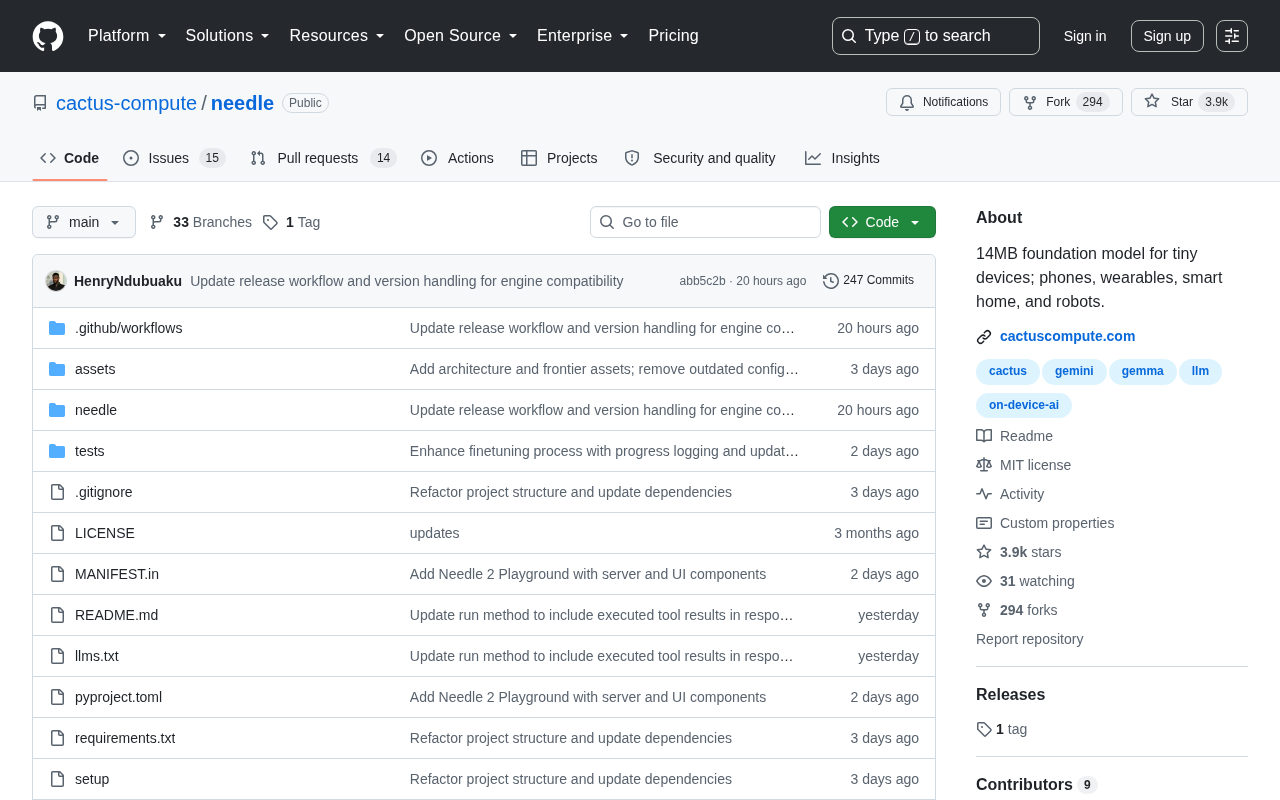
Needle, an open-source project from cactus-compute, delivers a 14MB foundation model targeting edge devices like phones, wearables, smart home gadgets, and robots. Unlike single-task TinyML models, Needle aims to provide general-purpose capabilities that can be fine-tuned for diverse downstream tasks. With 3,835 GitHub stars and growing, the project reflects the industry's accelerating shift toward on-device AI inference driven by latency, privacy, and cost concerns.
When a Foundation Model Shrinks to 14MB
In an era where the AI arms race proudly boasts models with tens of billions of parameters and tens of gigabytes in size, an open-source project from the cactus-compute team is taking a radically different path. The project, called Needle, compresses a usable foundation model down to just 14MB—a size smaller than many mobile app installation packages.
It's worth explaining the concept of a "foundation model" here. The term was formally introduced by Stanford's Human-Centered AI Institute in 2021, referring to general-purpose models trained on large-scale data through self-supervised learning that can be fine-tuned for various downstream tasks. GPT series, BERT, LLaMA, and others all qualify as foundation models. Unlike traditional task-specific models, the core value of foundation models lies in their emergent capabilities and transfer learning potential—one model trained once can serve text generation, classification, question answering, code writing, and many other scenarios. Needle positioning itself as a foundation model rather than a specialized model means it attempts to preserve this generality and transferability under the extreme constraint of 14MB—a technically ambitious goal.
Since its release, the project has quickly gained traction on GitHub, accumulating 3,835 stars and 292 forks, with a growth momentum of 248 new stars per day. For a project focused on "extreme lightweight," this community response clearly demonstrates the market's strong demand for edge-side AI.
Needle's positioning is crystal clear: a foundation model built for micro devices. The target hardware listed in the project description includes phones, wearables, smart home devices, and robots. These devices share common characteristics—limited compute, tight memory, and power sensitivity—precisely the "deep waters" where traditional large models struggle to deploy.
Why Edge Devices Need a 14MB Model
The Hidden Costs of Cloud Inference
Currently, mainstream AI applications almost entirely rely on cloud inference: devices send data to servers, which complete the computation and return results. While this model is mature, it comes with several inescapable pain points.
First is latency. For scenarios demanding real-time responsiveness like robot control and voice interaction, the tens or even hundreds of milliseconds of network round-trips can be the dividing line between "usable" and "unusable." Second is privacy—health data collected by wearables and home footage captured by smart home devices face leakage risks once uploaded to the cloud. Finally, there's cost and availability: continuous cloud calls mean ongoing server expenses, while offline environments (basements, wilderness, areas with poor connectivity) render cloud solutions completely non-functional.
Market data shows these pain points are rapidly amplifying. According to market research firms, the global edge AI market is projected to grow from approximately $15 billion in 2023 to over $60 billion by 2028, with a compound annual growth rate exceeding 30%. Factors driving this growth include: IoT device counts expected to surpass 75 billion by 2025, 5G networks improving bandwidth without fundamentally solving latency and coverage blind spots, and increasingly strict data privacy regulations worldwide (such as GDPR and China's Personal Information Protection Law) making local data processing a compliance necessity. Against this backdrop, AI models that can run directly on end devices are no longer "nice to have"—they're critical components of industrial infrastructure.
The Resource Barrier of On-Device Inference
Running models locally on devices (on-device inference) solves the above problems, but the tradeoff is confronting extremely limited device resources. A smartwatch might have only a few hundred MB of memory, and a smart home chip's compute power is even more constrained. Traditional quantized LLMs, even compressed to a few hundred MB, remain a "luxury" for such devices.
Here it's useful to understand the background of NPUs (Neural Processing Units). NPUs are hardware accelerators specifically designed for AI inference computation. Compared to general-purpose CPUs and GPUs, NPUs offer orders-of-magnitude better energy efficiency for core AI computations like matrix multiplication and convolution operations. Currently, Qualcomm's Snapdragon 8 series Hexagon NPU, Apple's Neural Engine, and MediaTek's APU are all integrated into mobile chips. However, a vast number of micro devices—such as low-cost MCUs (microcontrollers) and sensor nodes—don't have NPUs and rely solely on low-power CPU cores like the Cortex-M series.
Needle's 14MB size targets precisely this barrier. It means the model can be embedded directly in firmware, reside permanently in memory, and potentially run on pure CPU even on devices without dedicated NPUs. This provides a realistic path toward "giving every micro device basic intelligence."
Needle's Technical Orientation and Ecosystem Position
Built with Python, Targeting Embedded Deployment
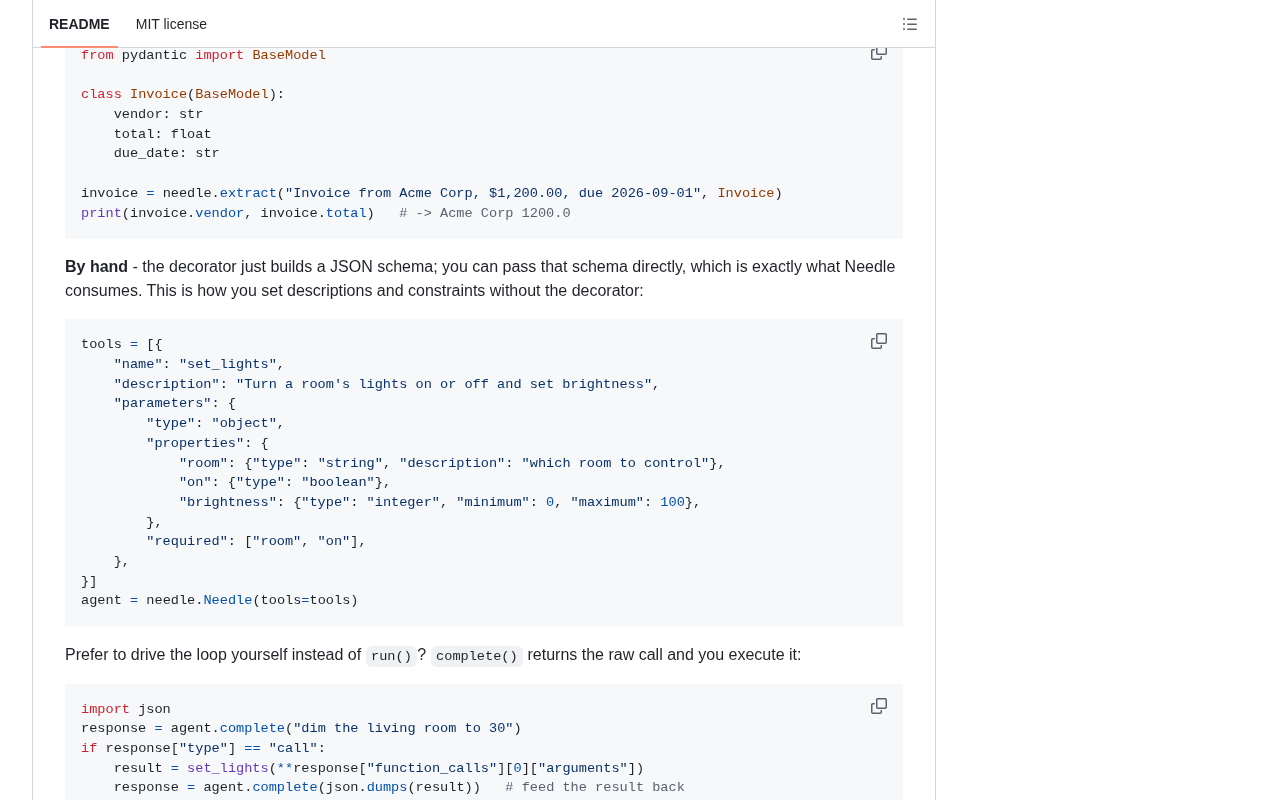
Based on project information, Needle uses Python as its primary language, lowering the barrier for developers and facilitating community participation in training, fine-tuning, and experimentation. Since its ultimate goal is deployment in embedded environments, the project will predictably include a lightweight inference runtime adapted for ARM architectures, microcontrollers, and other edge hardware.
A notable detail: Needle comes from the Cactus Compute team. This company specializes in developing on-device AI inference frameworks, and Needle can be seen as the "model layer" in their technology stack—combining an extremely small foundation model with an efficient inference engine creates a complete edge AI solution.
How 14MB Is Achieved: Model Compression Techniques
Compressing a model from several GB to 14MB typically requires combining multiple compression techniques. Quantization is the most common approach, reducing model parameters from FP32 (32-bit floating point) to INT8 or even INT4 (4-bit integer), achieving 4-8x storage reduction. Knowledge Distillation has a small model (student model) learn the output distribution of a large model (teacher model), preserving as much of the large model's reasoning capability as possible with minimal parameters. Pruning removes redundant connections and neurons from neural networks. Additional techniques include weight sharing and low-rank decomposition.
More aggressive approaches innovate at the model architecture level, designing network structures natively suited for small sizes rather than simply shrinking existing architectures. Examples include using more efficient attention mechanism variants and reducing redundant layer designs. The specific combination of techniques Needle employs hasn't been fully disclosed, but the 14MB target inevitably means deep customization in architecture design and training strategy—this isn't simply "shrinking" a large model but more likely a model purpose-built from scratch for this size target.
A "Foundation Model," Not a "Toy Model"
The project emphasizes that Needle is a foundation model, not a specialized small model trained for a single task. There's clear intent behind this wording: a foundation model implies it possesses general capabilities and can serve as a starting point for downstream task fine-tuning, rather than being a fixed-function module that can only do one thing.
This is also the fundamental difference between Needle and traditional embedded ML models (like keyword wake-up and gesture recognition models in the TinyML space). TinyML refers to the technical field of running machine learning models on microcontrollers operating at milliwatt-level power consumption. Typical applications include keyword wake-up (like local detection of "Hey Siri"), accelerometer gesture recognition, and anomaly vibration detection. These models are usually only tens of KB to a few MB in size, deployed using lightweight inference frameworks like TensorFlow Lite Micro or ONNX Runtime. But TinyML models are almost always single-task and fixed-function—a keyword wake-up model can't do sentiment analysis, and a gesture recognition model can't understand natural language.
Needle attempts to break this paradigm by providing foundation-model-level general capabilities within TinyML-acceptable size ranges. This essentially creates an entirely new technical tier between traditional TinyML and large language models. Developers can build diverse on-device intelligent applications on top of it—from simple intent recognition to basic text understanding—without needing to separately train and deploy a model for each task.
Trend Signals in Edge AI
Needle's popularity isn't an isolated event but a microcosm of the entire industry's tilt toward "on-device intelligence." As the efficiency optimization wave arrives following the plateau of large model capabilities, "doing more with smaller models" is becoming the new focal point of technical competition.
From Apple deploying compressed models on devices (like iPhone's Apple Intelligence local inference capabilities), to Qualcomm and MediaTek integrating NPUs in mobile chips (Qualcomm's latest Snapdragon 8 Gen 3 supports models with over 10 billion parameters running on-device), to various open-source communities producing small model projects (like Microsoft's Phi series, Google's Gemma, and other small but efficient models), the direction is highly consistent: AI is migrating from data centers to end devices.
Needle's aggressive target of compressing to 14MB is, in a sense, pioneering the vision of "AI in everything"—when a model is small enough and power-efficient enough, it can appear in places that previously couldn't host AI, like a button-sized sensor, an offline home robot, or smart glasses with only a basic chip. This extreme lightweight approach opens an entirely new application space: the question shifts from "can this device run AI" to "what can AI do on this device."
Of course, a 14MB size inevitably comes with capability tradeoffs. For developers, the rational expectation is: Needle won't replace cloud-based large models for complex reasoning, but it has the potential to become a "good enough and efficient" choice in niche scenarios requiring low power, offline operation, and real-time response. Its more likely role is as a "sentinel" in an edge-cloud collaborative architecture—completing rapid preliminary judgments locally and only uploading complex tasks to the cloud when necessary.
Final Thoughts
Needle represents a pragmatic approach to edge AI—not pursuing the ultimate in parameter scale, but pursuing the ultimate in deployment scenarios. For developers focused on on-device deployment, hardware manufacturers, and robotics practitioners, this project is worth following closely.
The project is still in its early stages, and key metrics like actual performance, supported task range, and quantization precision loss still await further verification through official documentation and community testing. But one thing is certain: the act of fitting a foundation model into 14MB is already toppling an important domino toward the goal of "making intelligence ubiquitous." When the industry's attention shifts from "how big can a model be" to "how small can a model be while remaining useful," a new technical race has only just begun.
Related articles

Chain of Thought Isn't Just for AI: How Humans Can Use CoT to Improve Thinking Quality
Chain of Thought isn't just a prompt trick for large models. Starting from a Hacker News discussion, this article analyzes why CoT works for human thinking too, breaks down actionable ways to transfer it, and highlights the key differences between human CoT and machine CoT.
Cloudflare Teams Up with OpenAI: Closi…
Cloudflare Teams Up with OpenAI: Closing the Loop from Vulnerability Discovery to Defense with AI
Cloudflare uses OpenAI Daybreak to investigate security vulnerabilities and generate reviewable remediation plans, while developers use Codex to boost coding efficiency and quality.

Orca Multi-Agent Orchestration in Practice: A Guide to Parallel Collaboration with Claude and Codex
Orca is Stable AI's free open-source agent workbench supporting 34 agents like Claude Code and Codex in parallel. Learn its Git worktree isolation, multi-model orchestration, and mobile management.