Neko Health Enters the US: The Business Case for Full-Body Scan Health Tech

Spotify co-founder Daniel Ek's health tech startup Neko Health brings full-body scanning to the US preventive care market.
Neko Health, co-founded by Spotify billionaire Daniel Ek, offers non-invasive full-body scanning as a preventive health screening service. The company has officially entered the US market, with investor Farooq Abbasi discussing its trajectory on the Equity podcast. While the US presents the world's largest private healthcare consumer market, Neko faces significant hurdles including high hardware costs, FDA compliance, and proving clinical value to consumers. The company exemplifies the broader trend of tech capital entering healthcare — and tests whether a star founder's credibility can translate into a scalable, sustainable business.
Why Neko Health Is Turning Heads
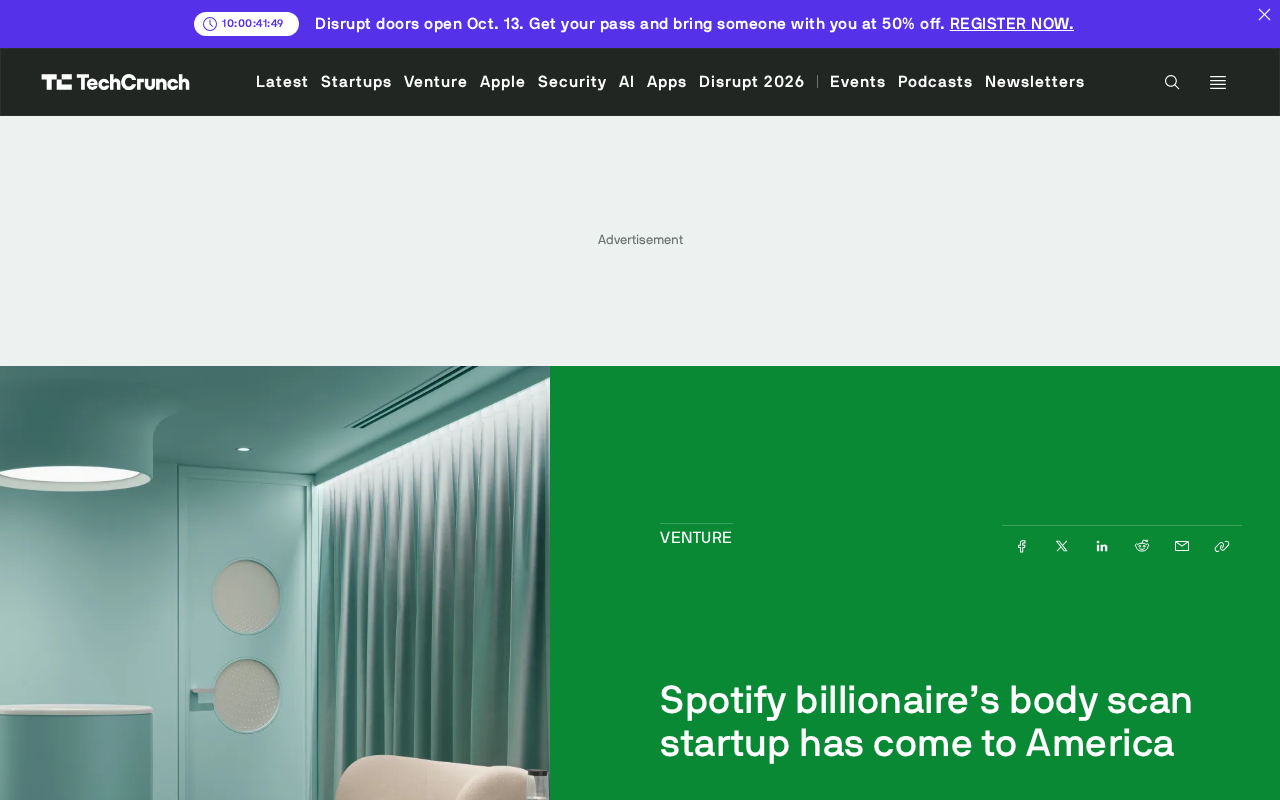
Neko Health, the health tech company co-founded by Spotify billionaire Daniel Ek, has officially entered the US market. This startup, whose core product is a full-body scan, recently returned to the spotlight following an interview with investor Farooq Abbasi on the Equity podcast.
Neko Health positions itself as a provider of preventive health screening through non-invasive full-body scan technology. Rather than the traditional healthcare model of "see a doctor only when symptoms appear," Neko aims to move health monitoring upstream — detecting problems before they arise. This is the key selling point that has attracted both capital and consumers.
The Business Logic Behind the Founding Story
Having Spotify's founder behind Neko Health brings enormous visibility and resource advantages in its own right. A tech founder crossing into the health sector isn't purely a personal passion project — it reflects a calculated bet on preventive care as a long-undervalued market.
Investor Farooq Abbasi discussed the status of this "hot health tech company" and its next steps during the podcast interview. From an investment perspective, the consumer-grade health scanning service that Neko Health represents sits at the convergence of three factors: maturing technology, growing consumer health awareness, and strong capital interest.
Market Opportunity in Preventive Health Screening
For full-body scan services to gain a foothold in the US market, the core challenges include high hardware costs, regulatory compliance requirements, and convincing consumers of the real-world value of scan results. The complexity of the American healthcare system and its high willingness to pay represent both opportunity and barrier.
Full-body scan technology typically integrates multiple imaging and sensing modalities — commonly MRI, low-dose CT, ultrasound, and dermatological photography — enabling systematic screening of the heart, vasculature, organs, and skin in a single visit. Neko Health's scanning approach reportedly relies primarily on MRI and ultrasound, avoiding ionizing radiation risks, which forms the technical foundation of its "non-invasive" positioning. However, preventive full-body scanning remains a subject of ongoing debate in the medical community: critics point out that broad screening can generate large numbers of false positives, triggering unnecessary follow-up procedures and even overtreatment, while also amplifying individual anxiety and wasting systemic medical resources. The American College of Radiology (ACR) currently does not recommend routine full-body CT scans for asymptomatic individuals. Striking the right balance between clinical value and commercial promotion is a fundamental question the entire sector must answer.
What Entering the US Really Means
Expanding from European markets into the United States is a critical step for Neko Health in proving its business model can scale. The US has the world's largest private healthcare consumer market, with a substantial population willing to pay for premium health services — fertile ground for Neko's expansion.
That said, the source material offers limited detail on specific US market entry plans, pricing strategy, or expansion timeline. Abbasi's podcast discussion was largely high-level, addressing the company's broader prospects rather than providing granular operational data.
Industry Observations
The Neko Health story reflects a broader trend of tech capital flowing into the health sector. When tech founders bring their resources and product thinking into traditional healthcare, they often reshape service experiences and delivery models. But health tech differs from mainstream consumer tech — the regulatory hurdles, clinical validation requirements, and ethical considerations are considerably more complex.
For practitioners working at the intersection of AI and health tech, Neko Health is worth watching closely. It serves as both a testing ground for the consumerization of preventive medicine and a case study in whether a founder's halo can translate into a sustainable business model.
The "consumer health tech" space that Neko Health occupies has already seen several pioneers emerge in the US market, including Prenuvo (focused on whole-body MRI) and Cleerly (specializing in cardiac CT screening). The shared business logic across this sector is to bypass traditional insurance reimbursement systems and charge health-conscious, high-spending consumers directly — anywhere from hundreds to thousands of dollars per out-of-pocket scan — sidestepping the complexity of insurance negotiations. The tradeoff, however, is that this model naturally limits its audience to high-income individuals, making it difficult to achieve scalable, equitable health benefits. Additionally, US FDA approval requirements for medical imaging devices and diagnostic software, along with varying telehealth regulations across states, represent compliance barriers that European companies must prioritize when entering the American market.
Related articles

Workbuddy for Absolute Beginners: How a Desktop AI Agent Fits Into Real Workflows
A beginner's guide to the Workbuddy desktop AI agent: installation, claiming credits, file management, and building automated workflows—compared with CodeX for fit and cost, helping professionals shift from AI question-askers to AI managers.

OpenAI's New Agent Stack: Computer Use, Decisions API, and Ultra-Fast Workflows
OpenAI Dev Day unveiled a new agent stack: Computer Use outperforms humans, Decisions API delivers ultra-low-latency classification via Luna, Agents API opens the same Computer Use capabilities, and GPT-6.1 Sol costs only one-seventh of Astra. Core updates, benchmark data, and developer insights.

Liang Wenfeng Open-Sources DeepInfo Inference Framework, Takes On U.S. Ban
DeepSeek open-sources its DeepInfo inference framework after its models, featuring GPU/CPU cross-pipelining, small-model prediction with large-model verification, and full Huawei Ascend and NVIDIA chip support—facing the U.S. federal ban head-on. This article analyzes its significance for AI deployment and open-source strategy.