NekroAgent Open-Source Framework: AI Agent Solution Supporting QQ, Discord, and Multiple Platforms

NekroAgent is a cross-platform open-source AI Agent framework designed for multi-user interaction scenarios.
NekroAgent is an open-source cross-platform Agent framework designed for multi-user concurrent interaction scenarios, integrating sandbox code execution, long-term memory, MCP management, and a visual console. It supports 8+ platforms including QQ, Discord, Telegram, Minecraft, and BilibiliLive. Unlike AutoGPT and MetaGPT which focus on single-user task automation, NekroAgent is architecturally designed from the ground up for real-time interaction between Agents and multiple real users, offering natural advantages in community management, game NPCs, and live stream interaction.
Project Overview: What is NekroAgent
AI Agent frameworks are emerging left and right, but few are truly designed for multi-user interaction scenarios. NekroAgent is an open-source cross-platform Agent framework built by developer KroMiose, focused on solving the challenge of multi-user concurrent interaction. It integrates sandbox code execution, long-term memory, MCP management, and a visual console into a unified system, and has already earned 837 Stars on GitHub.
NekroAgent isn't just another simple chatbot—it's a complete solution that can scale into a general-purpose Agent system. It supports integration with QQ, Discord, Telegram, Minecraft, BilibiliLive, WeChat, Email, and more, covering virtually all mainstream interaction scenarios including instant messaging, gaming, live streaming, and email.
Core Architecture and Technical Highlights
Sandbox Code Execution
NekroAgent integrates a Claude Code sandbox execution environment, enabling the Agent to not only converse but actually write and run code. Computational tasks are processed within a securely isolated sandbox without posing any risk to the host system. This capability elevates NekroAgent from a purely conversational AI to an intelligent agent with real execution power.
A sandbox is a critical security isolation technology that creates a restricted execution environment on top of the host operating system, preventing code running within it from accessing the external file system, network, or processes. Common sandbox implementations include containers (such as Docker), virtual machines, WebAssembly, and OS-level namespace isolation (such as Linux's seccomp and cgroups). Introducing sandbox execution in AI Agent scenarios is particularly crucial: code generated by large language models may contain unpredictable system calls or resource consumption, and sandboxes confine potential risks to a controllable scope. The Claude Code sandbox is a code execution environment provided by Anthropic around its Claude model, supporting instant execution and result return for multiple programming languages. NekroAgent integrates it to give Agents a complete closed-loop capability of "think-code-execute-feedback."
Workspace Orchestration Mechanism
The framework introduces a Workspace concept that supports orchestration and management of multiple task flows. In multi-user interaction scenarios, requests and task contexts from different users need effective isolation and coordination—workspace orchestration is the core mechanism addressing this pain point. Developers can flexibly define workflows to achieve parallel processing and orderly scheduling of tasks.
The workspace concept draws from modern DevOps and orchestration system design philosophies. In traditional Agent frameworks, all tasks share a single execution context, which easily leads to context pollution, resource contention, and state confusion when multiple users initiate requests simultaneously. The workspace mechanism creates independent isolated spaces for each task flow or user session, containing independent variable environments, file system views, and execution queues. This is similar to the isolation concept of Pods in Kubernetes—each workspace has its own lifecycle and resource quota. In multi-user interaction scenarios, workspace orchestration also needs to handle cross-workspace collaboration requirements. For example, requests from multiple users in a group chat may need to share partial context while maintaining independence of their respective task states.
Long-Term Memory System
Most Agent frameworks rely solely on context windows to maintain conversation coherence. NekroAgent, however, has built-in long-term memory capabilities. The Agent can remember user preferences, interaction history, and key information across sessions, providing a more personalized experience in group chat and other multi-user scenarios. For building intelligent assistants with persistent "personality," long-term memory is indispensable infrastructure.
To understand the value of long-term memory, one must first understand the Context Window limitation of large language models. The context window is the maximum number of tokens a model can process in a single inference, ranging from 4K to 200K for current mainstream models. However, no matter how large the window, it cannot cover interaction history spanning days or even months. Long-term memory systems typically use vector databases (such as Chroma, Milvus, Pinecone) to encode historical conversations and key information as high-dimensional vectors, retrieving relevant fragments through semantic retrieval and injecting them into the current context when needed. More advanced implementations also introduce memory compression, forgetting curve simulation, and importance scoring mechanisms to simulate the selective retention characteristics of human memory. In multi-user group chat scenarios, long-term memory also needs to solve the "memory attribution" problem—distinguishing different users' preferences and histories to avoid information cross-contamination.
Structured MCP Management
MCP (Model Context Protocol) is an increasingly important protocol standard in the AI Agent ecosystem. NekroAgent provides structured MCP management functionality, allowing developers to conveniently integrate and manage various external tools and services. This standardized management approach lowers the barrier to tool integration and makes Agent capability expansion more controllable.
MCP was proposed and open-sourced by Anthropic in late 2024, aiming to establish a unified communication interface between AI models and external tools and data sources. Before MCP, each Agent framework needed to write dedicated adapter code for different tools (such as search engines, databases, file systems, API services), resulting in massive duplication and compatibility issues. MCP defines a standardized request-response format comprising three core components: Tool Description, Parameter Schema, and Execution Result. Developers only need to wrap tools according to the MCP specification, and any MCP-supporting Agent framework can call them directly. This is similar to how the USB protocol unified peripheral interfaces—MCP is becoming the "universal socket" of the AI Agent ecosystem. Currently, hundreds of MCP Servers cover common services like GitHub, Slack, and database queries. NekroAgent's structured MCP management means developers can complete tool registration, configuration, permission control, and status monitoring in a one-stop visual interface.
Multi-Platform Integration: Covering Mainstream Interaction Channels
NekroAgent's breadth of platform support is quite remarkable among similar open-source projects:
- Instant Messaging: QQ, WeChat, Discord, Telegram
- Gaming Platforms: Minecraft
- Live Streaming Platforms: BilibiliLive
- General Protocols: Email, SSE (SDK)
Developers only need to write Agent logic once and can deploy it across multiple platforms, significantly reducing development costs for multi-channel operations. SSE (SDK) interface support also provides a standardized extension channel for custom platform integration.
It's worth elaborating on the role of SSE (Server-Sent Events) protocol here. SSE is a unidirectional real-time communication protocol based on HTTP, where the server can continuously push event streams to the client through persistent connections. Unlike WebSocket's bidirectional communication, SSE is more lightweight, natively compatible with HTTP infrastructure (such as proxies, load balancers, CDN), and supports automatic reconnection when connections drop. In AI Agent scenarios, SSE is commonly used for streaming model-generated text output (i.e., pushing token by token), as well as real-time pushing of Agent state changes and execution progress. NekroAgent adopts SSE as an SDK-level general integration protocol, meaning developers can connect any custom frontend or third-party platform to the Agent system through standard HTTP SSE connections without relying on specific message queues or proprietary protocols, greatly lowering the technical barrier for custom integration.
Visual Console and Operations Monitoring
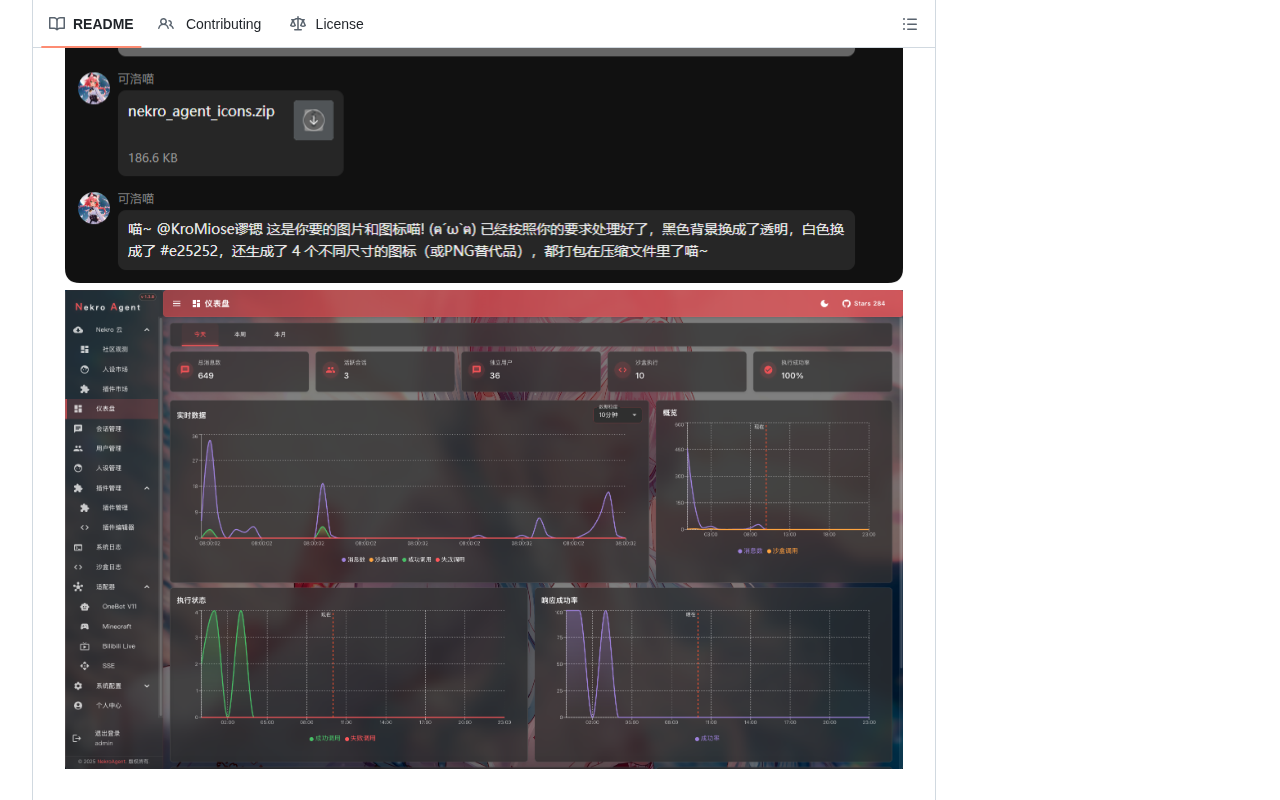
When running multi-user interactive Agents in production environments, operations and debugging capabilities are crucial. NekroAgent's visual console supports the following functions:
- Real-time monitoring of Agent running status
- Viewing task execution details and logs
- Managing plugin and tool configurations
- Receiving real-time status updates and exception alerts
These capabilities ensure operations personnel can discover and address issues immediately, which is especially critical for high-concurrency multi-user interaction scenarios.
Tech Stack and Plugin Extension Mechanism
NekroAgent is developed in Python, enabling direct leverage of Python's rich AI and machine learning ecosystem for capability extension. The framework emphasizes high extensibility in its design, supporting a plugin collaboration mechanism—developers can add new capabilities by writing plugins without modifying core code.
Key extension directions include:
- Code Execution: Running user-submitted code tasks in sandbox environments
- Tool Invocation: Interfacing with third-party tools and APIs via MCP protocol
- Plugin Collaboration: Multiple plugins working together to handle complex task chains
- Multi-modal Interaction: Supporting input and output across multiple modalities including text and images
Typical Application Scenarios for NekroAgent
NekroAgent's most direct use case is building intelligent chatbots, but its capability boundaries extend far beyond that:
- Community Management: Deploy intelligent administrators in Discord or QQ groups with memory capabilities and code execution ability to automatically handle common issues and violations
- Game NPCs: Create intelligent NPCs with long-term memory and complex behavioral logic in Minecraft to enhance gaming experiences
- Live Stream Interaction: Enable intelligent bullet-screen interaction and automated content generation on Bilibili Live, deepening streamer-audience engagement
- Automated Workflows: Build enterprise-level automated processing flows through email and SDK interfaces
- Multi-Platform Customer Service: A single Agent logic simultaneously serving user inquiries across multiple platforms with unified management and maintenance
Comparison with AutoGPT, MetaGPT, and Other Frameworks
Compared to well-known Agent frameworks like AutoGPT and MetaGPT, NekroAgent's differentiated positioning is reflected in two aspects: deep support for multi-user interaction scenarios and broad coverage of multi-platform integration.
Most Agent frameworks focus more on single-user task automation, while NekroAgent has considered multi-user concurrency, cross-platform deployment, and real-time interaction needs from the very beginning of its architectural design. This gives it natural advantages in areas like community operations, game interaction, and live streaming scenarios.
To better understand this positioning difference, it's helpful to review the design philosophies of several representative frameworks. AutoGPT was the viral autonomous Agent project from early 2023, with its core concept being to let GPT-4 autonomously set sub-goals, execute tasks, and iteratively optimize—pioneering the "autonomous Agent" paradigm. However, its design primarily targets single-user task automation and lacks consideration for multi-user concurrency and real-time interaction. MetaGPT introduces the concept of role division from software engineering (such as product manager, architect, engineer), enabling multiple Agents to collaborate on complex software development tasks, but similarly focuses on offline task generation rather than real-time multi-user interaction. Other noteworthy frameworks include LangChain (focused on LLM application development toolchains), CrewAI (multi-Agent collaboration), and Microsoft AutoGen (multi-Agent conversation framework). NekroAgent's uniqueness lies in the fact that it's not designed for "collaboration between Agents" but for "real-time interaction between an Agent and multiple real users"—this positioning difference determines its distinct emphasis on concurrency handling, platform adaptation, and state management at the architectural level.
Of course, with 837 Stars, the project is still in its growth phase, and there's room for improvement in community ecosystem and documentation completeness. For developers with customization needs, early participation presents both challenges and opportunities—meaning greater influence and contribution potential.
Conclusion: A Multi-User Interaction Agent Framework Worth Watching
NekroAgent demonstrates the complete form that a mature Agent framework should have: not only conversational ability but also code execution power, cross-session memory, and broad cross-platform capabilities. Its focus on multi-user interaction scenarios helps it carve out a differentiated position among numerous Agent frameworks.
If you're looking for an AI Agent solution that can simultaneously deploy to QQ, Discord, Telegram, and other platforms, or need to build intelligent interactive experiences in gaming, live streaming, and similar scenarios, NekroAgent is an open-source project worth exploring in depth.
Related articles
 Product Reviews
The Programmer's Desk Setup Guide: Building a Workspace That Feels Like Home
Discover how programmers build productive, comfortable workspaces. From multi-monitor setups to ergonomic design, explore the desk philosophy that drives focus and flow.
 Product Reviews
Qoder vs Cursor Real-World Comparison: Which $20/Month AI IDE Is Better?
Hands-on comparison of Qoder vs Cursor AI IDEs: Agent autonomy, human interaction count, and architecture decisions. Qoder needed only 2 interactions vs Cursor's 8.
 Product Reviews
Cursor Cloud Agent Demo: Eliminating Bottlenecks Across the Entire Software Development Lifecycle
Deep analysis of Cursor's Cloud Agent demo showing how cloud VMs, automated test artifacts, and a full-chain control plane systematically eliminate human bottlenecks across the software development lifecycle.