Nemotron 3.5 Lightning: A High-Efficiency Open-Source Model Designed for Long-Running Agents

NVIDIA's Nemotron 3.5 Lightning is an open-source model optimized for fast, efficient long-running AI Agents.
NVIDIA's Nemotron 3.5 Lightning is a new open-source model designed specifically for continuous, long-running AI Agent workloads. Emphasizing speed, intelligence, efficiency, and openness, it addresses key challenges in Agent deployment—inference latency, computational cost, and context management. Its open-source approach enables self-deployment, deep customization, and significant cost savings for high-frequency Agent tasks.
A New Option for the Era of Long-Running Agents
As AI applications evolve from simple Q&A to complex task chains, agents capable of sustained, long-running task execution are becoming an industry focal point. NVIDIA's Nemotron 3.5 Lightning is an open-source model designed precisely for this trend. The official positioning is summarized in four keywords: smart, fast, efficient, and open.
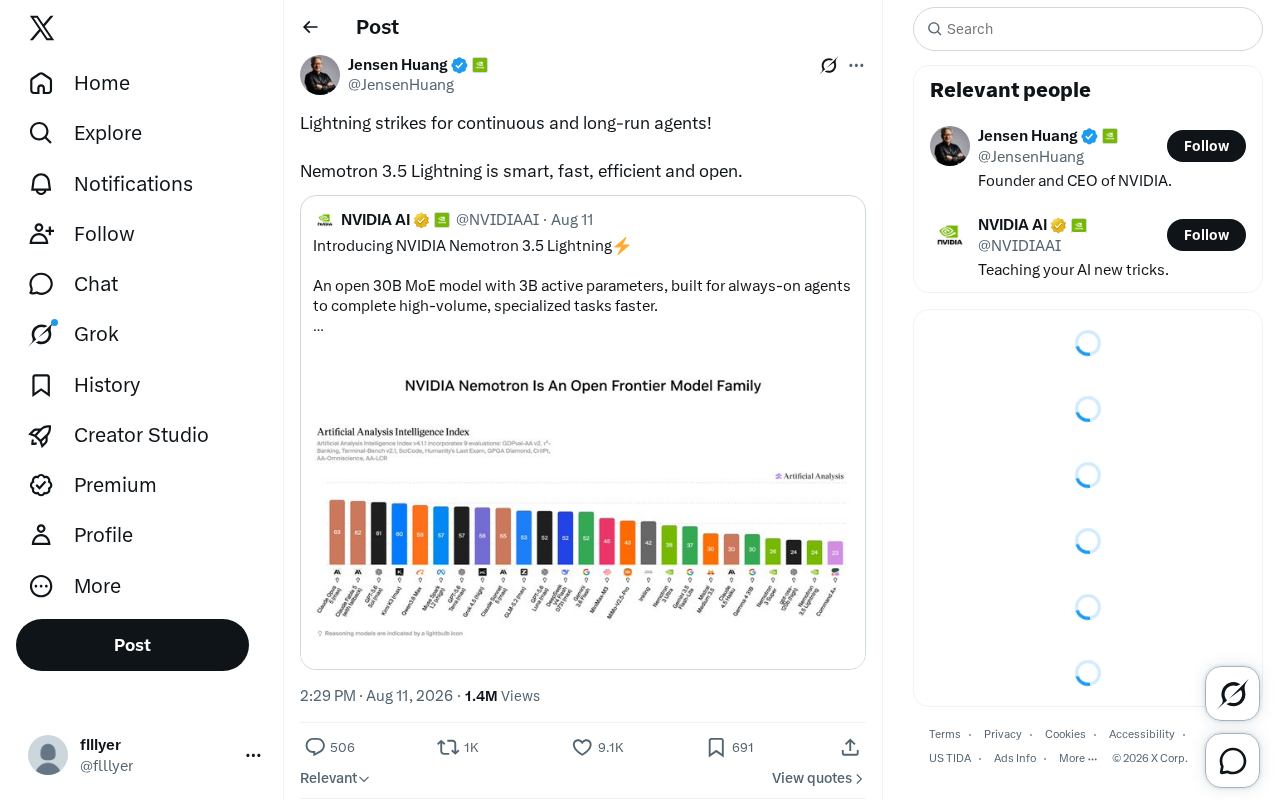
This release is no coincidence. Current mainstream large models often face challenges when handling long-running continuous tasks—declining inference speed, high computational costs, and difficult context management. The name Nemotron 3.5 Lightning itself conveys its core proposition: responding as fast as lightning while maintaining stable long-running capabilities.
Why Long-Running Agents Need a Lightning-Class Model
Core Technical Challenges of Continuous and Long-Running Execution
Continuous and long-run agents refer to AI systems that need to execute persistently over minutes or even hours, continuously invoking tools and maintaining state. Typical scenarios include automated coding assistants, complex workflow orchestration, and multi-step data analysis.
From a technical architecture perspective, current mainstream Agent execution paradigms include ReAct (Reasoning + Acting) and Plan-and-Execute. In the ReAct pattern, the model performs a "think—act—observe" loop at each step: first reasoning about the current state, then deciding which tool to call, observing the tool's returned results, and entering the next round of reasoning. Plan-and-Execute instead has the model generate a complete plan first, then execute each subtask step by step. Regardless of the paradigm, a complete Agent task often involves dozens or even hundreds of model calls, each needing to process an ever-growing context window—including conversation history, tool call records, intermediate results, and more. This places extremely high demands on inference infrastructure, especially KV Cache (key-value cache) management: as context length grows, KV Cache GPU memory consumption increases linearly, becoming one of the primary bottlenecks for long-running execution.
In these scenarios, every bit of inference latency gets amplified. If an Agent task requires 100 model calls and each inference is 1 second slower, the cumulative efficiency loss becomes significant. Therefore, inference speed and computational efficiency become critical metrics for whether long-running Agents can be deployed in production—their importance rivals or even exceeds the intelligence level of individual responses.
To address inference latency, the industry has developed multiple optimization techniques. Speculative Decoding uses a small model to rapidly generate candidate token sequences, which are then verified in parallel by the large model, boosting inference speed 2-3x without quality loss. Continuous Batching and Paged Attention (the technique employed by the vLLM framework) optimize throughput at the serving and scheduling layer. The "fast" characteristic emphasized by Nemotron 3.5 Lightning likely reflects architectural design decisions that accommodate these inference optimization techniques.
The Balancing Act Between Efficiency and Intelligence
Historically, the industry has often traded off between "smarter large models" and "faster small models." Behind this tradeoff lies a widely observed pattern—Scaling Laws indicate that model performance typically improves predictably with increases in parameter count, data volume, and compute. But larger models mean higher inference costs and slower response times, which is particularly fatal in Agent scenarios requiring high-frequency calls.
Nemotron 3.5 Lightning attempts to break this tradeoff, with officials emphasizing that it achieves both intelligence and efficiency simultaneously. Technical paths to achieve this typically include several directions: Knowledge Distillation, using outputs from a large teacher model to train a smaller student model so it can approach the large model's capabilities with fewer parameters; Quantization techniques (such as INT4/INT8 quantization, GPTQ, AWQ, etc.), reducing computation and memory usage by lowering weight precision; Architecture optimization, such as adopting Grouped Query Attention (GQA) to replace standard Multi-Head Attention to reduce KV Cache overhead, or using Mixture-of-Experts (MoE) architecture to activate only a subset of parameters per inference.
Notably, Nemotron 3.5 Lightning is not the only model attempting to solve the efficiency-intelligence balance. The Mistral series achieves near GPT-3.5 performance with compact parameter counts; Microsoft's Phi series has demonstrated small model potential through high-quality training data; Meta's Llama series holds an important position in the open-source ecosystem. NVIDIA's differentiated competitive advantage likely lies in deep optimization for its own GPU hardware stack—end-to-end synergy from CUDA cores to the TensorRT-LLM inference framework, an advantage that pure model companies cannot easily replicate.
For Agent developers, this means achieving lower operational costs and faster response speeds without sacrificing task quality.
Nemotron 3.5 Lightning's Open-Source Strategy and Its Value
Notably, Nemotron 3.5 Lightning adopts an open-source release model, continuing NVIDIA's open approach with the Nemotron series.
NVIDIA's Nemotron series has followed a clear evolutionary trajectory. Early Nemotron models primarily served NVIDIA's internal research and NeMo framework integration needs. The Nemotron-4 series released in 2024 (including the 340B parameter version) marked NVIDIA's serious entry into open-source large model competition, released under permissive licenses allowing commercial use. The "3.5" version number of Nemotron 3.5 Lightning suggests it may represent significant improvements on the Nemotron-3 architecture without a full generational leap to the fourth generation, while the "Lightning" suffix clearly signals its specialized optimization for speed.
From a broader industry perspective, the 2024-2025 open-source LLM ecosystem has formed a multi-polar landscape: Meta's Llama series holds foundational community status, Mistral has influence in the European market, and Alibaba's Qwen and DeepSeekAd excel in Chinese-language scenarios. NVIDIA's participation in model open-sourcing as the "pick-and-shovel seller" carries different strategic intent than pure model companies—by providing high-quality open-source models deeply optimized for its own hardware, it reinforces the ecosystem lock-in effect of its GPU+software stack while lowering the barrier for developers to embrace the NVIDIA technology stack.
For enterprises and developers, open-source models deliver several direct benefits:
- Self-deployment: No dependence on closed-source APIs; sensitive data can remain on-premises or in private cloud environments
- Deep customization: Ability to fine-tune and optimize for specific Agent scenarios
- Cost control: Avoiding long-term per-call billing expenses, which is especially important for high-frequency long-running Agents
In call-intensive applications like long-running Agents, the combination of open-source + efficiency directly addresses the core pain point of cost-sensitive scenarios. Consider a typical automated coding Agent: completing a moderately complex development task might require 200-500 model calls. Using a GPT-4-level closed-source API, the cost per task could reach several dollars; a self-deployed efficient open-source model can reduce marginal costs by one to two orders of magnitude.
Potential Impact on the AI Agent Industry
The launch of Nemotron 3.5 Lightning reflects a new direction in foundational model competition: shifting from pursuing pure parameter scale and benchmark scores toward optimizing for real-world Agent workloads in production environments.
Future Agent systems will likely adopt layered architectures—using efficient, fast models to handle the bulk of routine steps, invoking stronger models only at critical decision points. This architecture already has multiple implementation patterns in engineering practice: Router model approaches use a lightweight classifier to judge the difficulty of current requests, routing simple tasks to fast models and complex tasks to powerful models; Cascading inference lets the fast model attempt an answer first, escalating to a stronger model only when confidence is insufficient; Speculative Planning has the fast model generate candidate execution plans for review and correction by the strong model.
The economic logic of this layered design is crystal clear. In a typical long-running Agent execution, roughly 80% of steps are relatively routine operations (such as formatting output, simple tool calls, state updates), while only 20% involve critical reasoning decisions. If the strongest (and most expensive, slowest) model is used for all steps, enormous resource waste results. Open-source models like Nemotron 3.5 Lightning that combine speed with intelligence are ideal candidates for the "workhorse engine" in this architecture—they need to be smart enough to independently handle most task steps while being fast and economical enough to support high-frequency invocation.
Of course, publicly available information remains relatively limited, and specific benchmark data, parameter scale, context length, and other details await further official disclosure. When making actual selection decisions, developers still need to conduct validation tests based on their own scenarios, paying particular attention to model performance on core Agent capability dimensions such as multi-turn tool calling, long-context retention, and instruction-following consistency.
Summary
With its core selling points of "smart, fast, efficient, and open," Nemotron 3.5 Lightning targets the rapidly emerging long-running Agent market. It represents model vendors' response to the real demands of the Agent era—an era where a model's value lies not only in how difficult a question it can answer correctly, but in whether it can stably, quickly, and economically support long-running intelligent agent systems. As more technical details are revealed, its performance in real-world Agent applications deserves continued attention.
Related articles

Python 3.15 New Feature: Is the sentinel Type Better Than None?
Python 3.15 adds the sentinel type, using named unique sentinel objects to replace None and bare object(), resolving confusion among missing values, explicit emptiness, and invalid input while avoiding type hint failures.

Deep Learning's Three Architectures and the Universal Approximation Theorem: A Complete Guide to MLPs, CNNs, and Transformers
Explaining the inductive bias differences among MLP, CNN, and Transformer, the existence meaning of the Universal Approximation Theorem (UAT), and the role of Taylor expansion in approximation analysis, while clearing up common misconceptions.

GitLab Emergency Patch Release: Analysis of Critical Security Fixes
GitLab releases critical patch 19.5.1, sparking 355 points of discussion on Hacker News. This article analyzes the background, upgrade steps for self-hosted instances, and verification points to help DevOps teams respond quickly to security updates.