Nemotron 3.5 Lightning Lands on Perplexity API: Ultra-Low-Cost Inference Model Analysis

Nemotron 3.5 Lightning offers ultra-cheap inference on Perplexity's Agent API, ideal for input-heavy agent workflows.
NVIDIA's Nemotron 3.5 Lightning is now available on Perplexity's Agent API at just $0.0115 per million input tokens—over 200x cheaper than GPT-4o. With a 15x gap between input and output pricing, it's optimized for input-intensive workflows like RAG and multi-step agent tasks. While the aggressive pricing makes complex agent architectures economically viable, developers should carefully evaluate model quality, rate limits, and output costs in production scenarios.
An Ultra-Low-Cost Inference Model Enters Developers' Radar
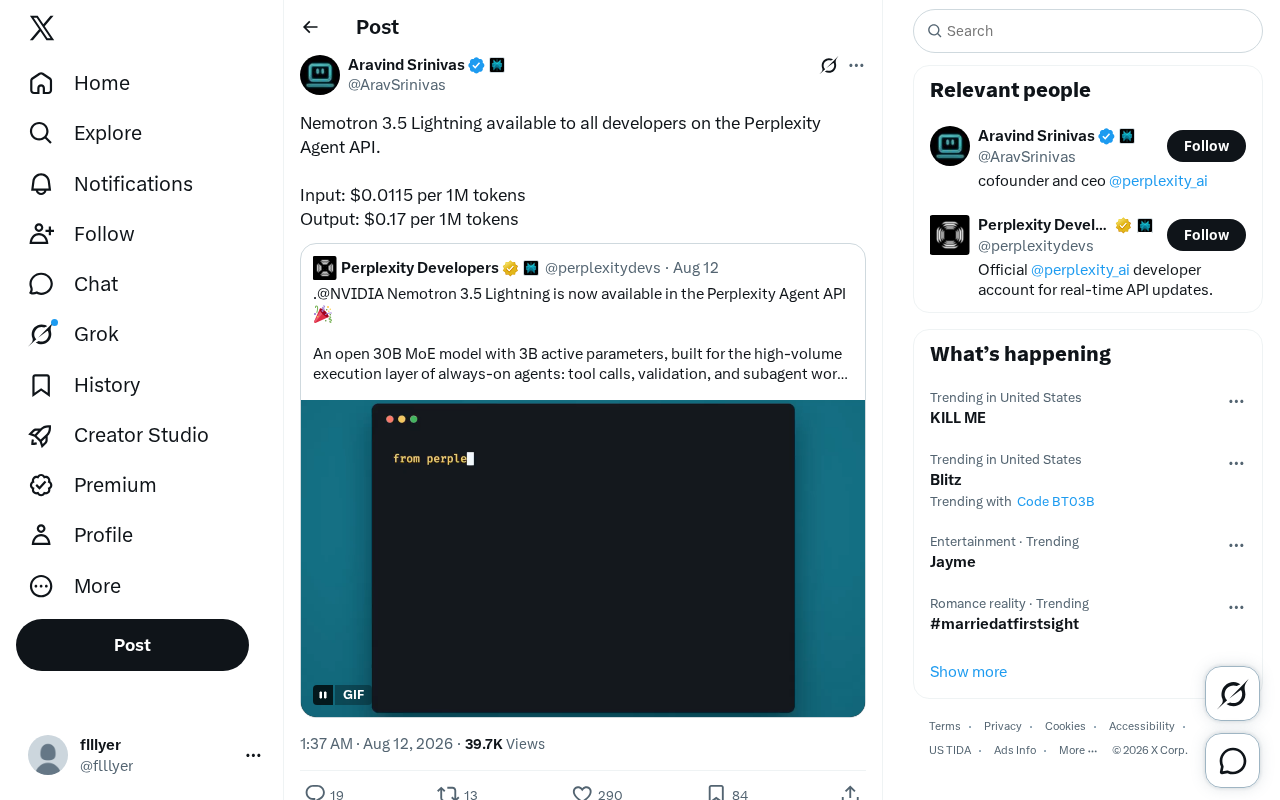
Perplexity recently announced that the Nemotron 3.5 Lightning model is now available to all developers on its Agent API. What makes this noteworthy isn't the model's feature set per se, but its pricing—an extremely aggressive cost structure that could redefine the economics of large-scale AI applications.
According to the officially published pricing:
- Input: Only $0.0115 per million tokens
- Output: $0.17 per million tokens
In the current LLM API market, these numbers sit at the very bottom of the pricing spectrum. For comparison, OpenAI's GPT-4o input pricing is approximately $2.5 per million tokens, Anthropic's Claude 3.5 Sonnet is around $3, Google's Gemini 1.5 Flash is approximately $0.075, and even the budget-positioned DeepSeekAd V3 comes in at around $0.27. Nemotron 3.5 Lightning's input pricing is over 200x cheaper than GPT-4o and a full order of magnitude lower than even the cheapest mainstream models, pushing the threshold below two cents.
Product Positioning Analysis of Nemotron 3.5 Lightning
The model's positioning is clearly signaled by its naming and pricing. The "Lightning" suffix typically indicates a lightweight version optimized for speed and cost, rather than a flagship model pursuing maximum reasoning capability.
Nemotron itself is a large language model series launched by NVIDIA in 2024, with its core differentiator being performance improvement through Synthetic Data Generation. NVIDIA leverages its advantages in GPU hardware and the CUDA ecosystem, combined with its proprietary NeMo framework for model training and optimization. What makes the Nemotron series unique is its extensive use of high-quality synthetic data generated by the model itself for iterative training—a method known as the "Data Flywheel" that reduces dependence on human-annotated data while improving model performance on specific tasks. Version 3.5 represents the latest iteration of the series, and the Lightning suffix indicates this is a high-efficiency inference version that has undergone distillation or architectural streamlining, emphasizing efficient deployment in enterprise scenarios and synthetic data generation capabilities.
What the Input-Output Price Gap Reveals
Here's a telling detail: the gap between input pricing ($0.0115) and output pricing ($0.17) is nearly 15x. Such asymmetric pricing isn't unusual in the industry, but such a dramatic ratio reveals a clear application bias:
- Well-suited for input-intensive tasks: Such as long document summarization, large-scale text classification, and context processing in Retrieval-Augmented Generation (RAG). RAG is one of the most prevalent architectural patterns in enterprise AI applications today. Its core approach is to retrieve relevant document fragments from external knowledge bases before the model generates a response, then inject those fragments as context into the model's prompt. A typical RAG query might inject 5,000-20,000 tokens of retrieved results, while the final output might only be 200-500 tokens. This is precisely why ultra-low input pricing is so advantageous for RAG scenarios—when each query consumes massive amounts of input tokens, even tiny differences in per-token input cost create enormous cost disparities at scale.
- Not ideal for long-form text generation: If an application requires the model to produce lengthy content, output costs accumulate rapidly and the cost advantage diminishes.
In other words, this model is naturally aligned with the "Agent" workflows that Perplexity emphasizes—scenarios where the model needs to frequently read tool call results, retrieve documents, and process intermediate states, with each step's final output typically being structured, concise decision instructions.
Synergies with the Perplexity Agent API
Perplexity's decision to integrate this model into its Agent API, rather than a standard chat completion interface, sends a clear signal.
Perplexity's Agent API is fundamentally different from traditional Chat Completion APIs. Traditional APIs typically handle single-turn or simple multi-turn conversations, while the Agent API supports building AI agents with autonomous decision-making capabilities—agents that can plan task steps, call external tools (such as search engines, code interpreters, database queries), and dynamically adjust behavioral strategies based on intermediate results. Technically, Agent APIs typically integrate Function Calling, Tool Use, and the ReAct (Reasoning-Action) paradigm, enabling the model to iteratively think, execute actions, and observe results in a loop until complex tasks are completed. Perplexity itself started with search-augmented generation, so its Agent API naturally possesses web retrieval capabilities.
The defining characteristic of Agent workflows is multi-turn, high-frequency model calls: a complex task might trigger dozens or even hundreds of inference calls, each accompanied by substantial context input.
To illustrate the cost impact more concretely, consider a specific scenario: suppose a research Agent needs to complete the task "analyze a company's competitive landscape." It might need to execute 15-30 independent model calls, including task decomposition, search query generation, document summarization, and information synthesis steps. Each call averages 8,000 input tokens (including system prompts, conversation history, and tool return results) and 500 output tokens. With 30 calls, that's 240,000 total input tokens and 15,000 total output tokens. Using Nemotron 3.5 Lightning, the total cost would be approximately: input 0.24×$0.0115≈$0.003 + output 0.015×$0.17≈$0.003, totaling less than $0.006. Using a GPT-4o-level model, the same task could cost over $1. This magnitude of difference makes complex Agent workflows that were previously economically unfeasible suddenly viable.
In this architecture, the per-token input price becomes the critical variable determining overall operational costs. At just $0.0115 per million input tokens, developers can dramatically reduce both experimentation costs and scaling costs when building complex agents. This is particularly friendly for products such as:
- Enterprise knowledge base agents that process large volumes of documents
- High-concurrency automated customer service or ticket processing systems
- Research Agents that rely on frequent tool calls
The Far-Reaching Impact of Low-Price Strategies on the AI Industry
From a broader perspective, the arrival of Nemotron 3.5 Lightning is yet another footnote in the ongoing trend of declining AI inference costs. Over the past two years, per-unit inference costs for large models have dropped at a stunning pace, driven by the combined effects of model architecture optimization, maturation of quantization techniques, and hardware economies of scale.
On the technical front, the dramatic decline in inference costs can primarily be attributed to three key advances. First is model quantization—compressing model weights from FP32 (32-bit floating point) to FP16, INT8, or even INT4 formats, reducing memory footprint and computational requirements by several times with almost no performance loss. Second is inference engine optimization—frameworks like NVIDIA's TensorRT-LLM and vLLM dramatically improve GPU utilization through techniques such as PagedAttention, Continuous Batching, and Speculative Decoding. Third is model Distillation—using large model outputs to train smaller models, enabling the smaller models to approach large model performance on specific tasks. The Lightning version likely employs a combination of these techniques to achieve its extreme cost-performance ratio.
Cost Is No Longer the Primary Bottleneck for AI Applications
When input costs are compressed to near-negligible levels, the competitive focus of AI applications shifts from "can we afford it" to "can we design sufficiently intelligent workflows." Developers no longer need to be constrained by token-saving concerns and can more boldly introduce redundant retrieval, multiple verification passes, self-reflection, and other reliability-enhancing mechanisms into their agents.
Aspects Developers Should Carefully Evaluate
Of course, ultra-low pricing should be viewed rationally. Price does not equal value, and several key questions still require validation through actual testing:
- Model Quality: How does the Lightning version perform on complex reasoning and instruction following? Can it meet production environment requirements? Lightweight models that have undergone distillation and quantization typically experience some degree of performance degradation on multi-step logical reasoning, nuanced semantic understanding, and similar tasks. This degradation may be imperceptible for simple tasks but could cause significant quality drops in edge cases.
- Stability and Rate Limiting: Low-cost models are often accompanied by stricter rate limits or lower service priority. In high-concurrency scenarios, latency fluctuations and request queuing may impact user experience.
- Actual Output Costs: As noted earlier, if an application generates substantial output, the $0.17/million tokens output price becomes the real cost driver.
Conclusion
The availability of Nemotron 3.5 Lightning on the Perplexity Agent API marks another step toward the democratization of cost-effective inference models. For developers building agent-based applications, it offers an extremely attractive cost option, particularly well-suited for input-intensive, output-lean workflows.
However, as with all tooling decisions, the final judgment should be built on real-world scenario testing—low price is the door opener, but model quality and workflow design are what truly determine whether an application succeeds or fails.
Related articles

Chain of Thought Isn't Just for AI: How Humans Can Use CoT to Improve Thinking Quality
Chain of Thought isn't just a prompt trick for large models. Starting from a Hacker News discussion, this article analyzes why CoT works for human thinking too, breaks down actionable ways to transfer it, and highlights the key differences between human CoT and machine CoT.
Cloudflare Teams Up with OpenAI: Closi…
Cloudflare Teams Up with OpenAI: Closing the Loop from Vulnerability Discovery to Defense with AI
Cloudflare uses OpenAI Daybreak to investigate security vulnerabilities and generate reviewable remediation plans, while developers use Codex to boost coding efficiency and quality.

Orca Multi-Agent Orchestration in Practice: A Guide to Parallel Collaboration with Claude and Codex
Orca is Stable AI's free open-source agent workbench supporting 34 agents like Claude Code and Codex in parallel. Learn its Git worktree isolation, multi-model orchestration, and mobile management.