Neura HQ: Reshaping the B2C Shopping Journey with Conversational AI Agents
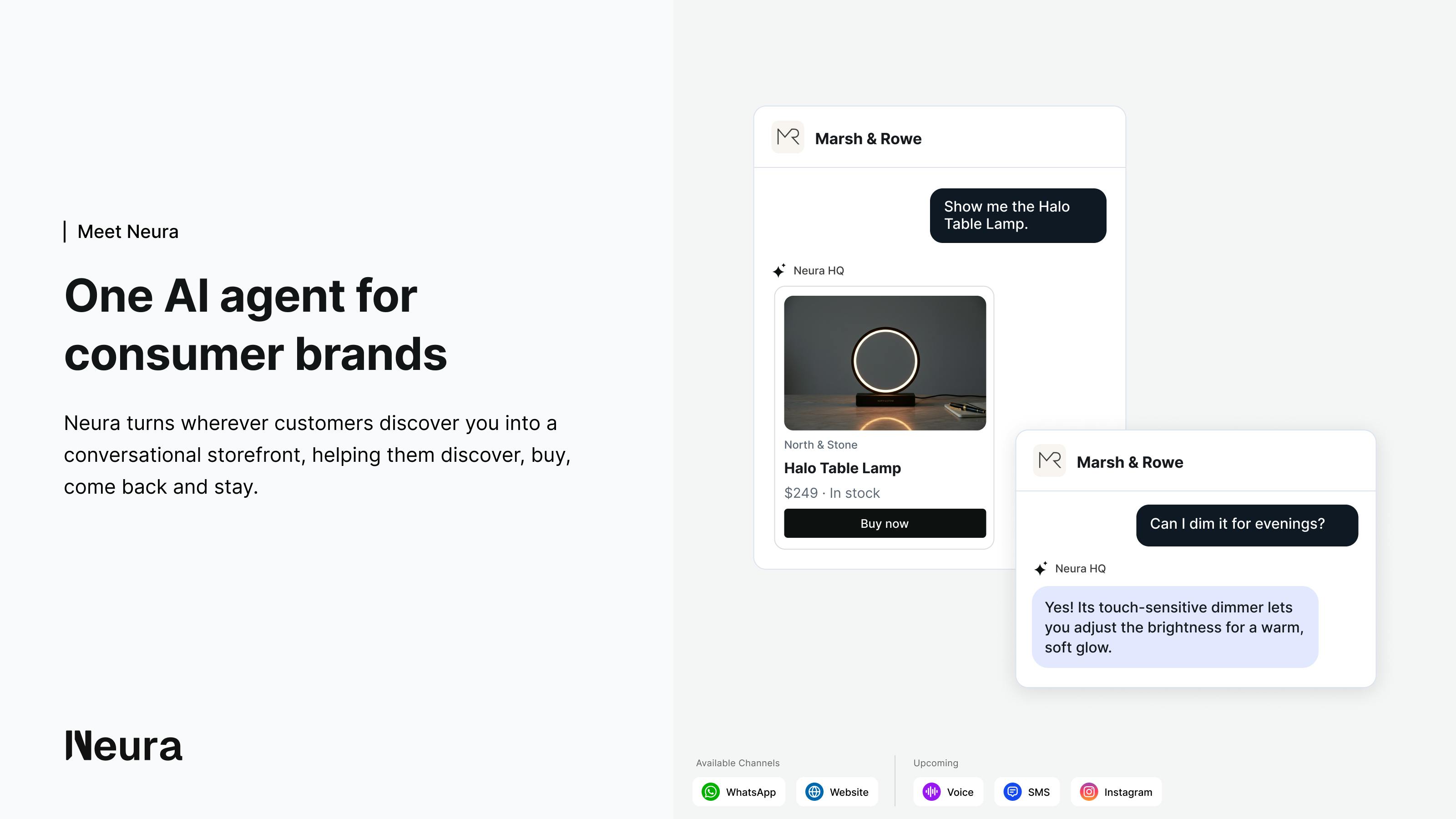
Neura HQ launches an agentic conversational storefront with AI shopping guides covering the full journey and minute-level deployment.
Neura HQ is an agentic conversational storefront for B2C brands, ranked #13 on Product Hunt. It uses action-capable AI agents to intervene at moments of customer need, offering personalized recommendations, promotions, inventory checks, store guidance, and order tracking. Deployment takes minutes via conversation, lowering adoption barriers. Its differentiation is combining conversational AI with conversion and retention goals. Key details like inventory real-time accuracy and integration depth remain undisclosed.
In B2C retail, every touchpoint is a "stay or leave" decision. Customers discover brands through ads, social media, or physical stores—and the moment their needs aren't immediately met, they turn away. Neura HQ, a new product ranked #13 on Product Hunt, is targeting exactly this pain point with an "agentic conversational storefront" for consumer brands, aiming to intervene with AI agents at the moment customers need them—accompanying them throughout the journey like the most capable sales associate.
From "Self-Service Browsing" to "Conversational Companionship": A Paradigm Shift in Retail Experience
Traditional e-commerce interactions are static: users search, filter, click—with most of the decision-making burden falling on the consumer. Neura HQ's core proposition is to change this one-way model. It's described as an "agentic" conversational storefront—one that not only answers questions but proactively recommends products, shares promotions, checks online and in-store inventory, directs customers to the nearest physical location, tracks orders, and follows up throughout the entire shopping journey.
This "agentic" quality means the AI is no longer a simple customer service bot but an action-capable shopping assistant. It attempts to replicate the role of a top-tier in-store sales associate: understanding customer intent, mobilizing inventory and promotional information, and removing decision barriers. For brands, this is equivalent to deploying a tireless "best sales associate" at every digital touchpoint.
Agentic AI is fundamentally different from traditional generative AI or chatbots. Ordinary chatbots are typically passive and reactive: the user asks, it answers, and the interaction ends after a single exchange. "Agentic" means the system possesses goal-oriented autonomous action capability—it can proactively plan steps, invoke external tools (such as inventory databases, order systems, and promotion engines), maintain context across multiple turns, and adjust strategy based on user feedback. In retail scenarios, agentic AI needs to autonomously decide when to recommend alternatives, when to check nearby store inventory, and when to proactively push coupons—without requiring step-by-step user instructions. This capability relies on large models as the "reasoning hub," paired with API integration layers to execute specific operations. By embedding agentic capabilities into the storefront, Neura HQ essentially upgrades AI from an "information provider" to a "transaction facilitator"—and this is the core dividing line between it and general-purpose customer service bots.
Minute-Level Deployment: Configuring Conversations Through Conversation
Neura HQ claims its setup process "takes just minutes, completed by talking to it." This suggests the product may employ natural language-driven configuration, lowering the technical barrier for brands to adopt an AI storefront. For small and mid-sized consumer brands lacking dedicated AI teams, this "talk to the product to complete deployment" experience could be more appealing than traditional rule engines or complex backends.
However, the original information doesn't disclose specific integration methods, supported data sources, or backend capabilities. Based on its product positioning, it needs to connect product catalogs, inventory systems, order management, and store locations to truly deliver the promised full-journey companionship. The depth of these underlying integrations will determine whether "minute-level deployment" is marketing rhetoric or a replicable reality.
Natural Language-based Configuration (NL-based Configuration) is a design paradigm that AI products have increasingly adopted in recent years to lower the onboarding barrier. Traditional e-commerce tool deployment typically requires technical staff to write rules, configure field mappings, and integrate API documentation—taking anywhere from days to weeks. "Completing setup through conversation" means the product has a built-in configuration agent: brands describe their requirements in natural language (e.g., "when a customer asks about sizing, check inventory first, then recommend similar styles"), and the system translates this into executable conversation flows or integration configurations. The advantage is a significant reduction in reliance on specialized AI teams, enabling smaller brands to launch quickly. But its limitations are also clear: the reliability of natural language configuration depends on the underlying intent parsing accuracy, and complex business logic (such as multi-warehouse inventory prioritization and promotion stacking rules) may still require human fallback. Therefore, whether "minute-level deployment" can be delivered hinges on whether the product has pre-built sufficiently rich retail domain templates and robust integration middleware.
Full Shopping Journey Coverage: From Recommendations to After-Sales
According to the Product Hunt page description, Neura HQ covers: personalized recommendations, promotion sharing, online and offline inventory checks, nearest store guidance, and order tracking. This connects nearly the entire pre-purchase, purchase, and post-purchase chain. Its value lies in reducing the friction of customers jumping between different pages, apps, and channels—when a customer becomes interested through a social media ad, the conversational interface can directly capture that intent rather than pushing the user to an official website where they'd have to search again.
This "serve them where you meet them" approach aligns with the current conversational commerce trend. Brands are increasingly realizing that cart abandonment often stems from missing information or cumbersome processes, and a conversational agent that can instantly pull inventory, explain delivery, and offer alternatives has the potential to recover moments that would otherwise be lost.
Conversational Commerce was coined by former Uber executive Chris Messina in 2015, referring to a business model where discovery, consultation, purchase, and after-sales are completed through chat interfaces (such as WeChat, WhatsApp, or brand-owned chat windows). Its core logic is to shorten the "interest—decision—transaction" path: customers don't need to navigate multiple pages or apps—they can complete the loop from question to order within a conversation. In recent years, as large models gained multi-turn dialogue and tool-calling capabilities, conversational commerce has evolved from early menu-based bots to forms that can understand ambiguous needs, proactively ask follow-up questions, and dynamically recommend. Neura HQ's "conversational storefront" is an extension of this trend—it's not just placing a customer service window next to product pages, but attempting to make the conversational interface itself the storefront, carrying the full transaction chain of recommendations, inventory checks, store guidance, and order tracking. This complements the traditional e-commerce "search-filter-add to cart" shelf logic and is particularly suited for impulse purchases and social ad-driven traffic scenarios.
Market Opportunity and Unverified Aspects
Neura HQ received 77 upvotes and 7 comments on its launch day, ranking #13—showing some early attention, though the sample is too small to judge product maturity. Demand from B2C brands for AI storefronts is real, but competition is intensifying: built-in AI assistants from e-commerce platforms, standalone conversational commerce tools, and general-purpose LLM-driven customer service solutions are all competing for the same space.
Neura HQ's differentiation lies in combining "agentic" with "storefront"—not just answering questions, but orienting toward conversion and retention. However, actual results depend on recommendation accuracy, real-time inventory data, multilingual and multi-channel support, and brands' control over conversational style. These details aren't elaborated in the original material and require hands-on product experience to verify.
For readers interested in AI applications and e-commerce tooling, Neura HQ represents a product direction worth tracking: packaging large models' conversational capabilities into retail infrastructure that can directly produce business outcomes. Whether it can grow from a standout Product Hunt launch into a standard配置 for consumer brands depends not on how smooth the demo is, but on whether it can operate reliably within real inventory, order, and promotion systems.
One-line Summary
Neura HQ launches an agentic conversational storefront, using AI shopping guides to cover the entire shopping journey with minute-level deployment that lowers the barrier for brand adoption.
Paragraph Summary
Neura HQ is an agentic conversational storefront product for B2C consumer brands, ranking #13 on Product Hunt on its launch day. It aims to replace static e-commerce browsing with action-capable AI agents that intervene at the moment customers express needs, providing personalized recommendations, promotion sharing, online and offline inventory checks, nearest store guidance, and order tracking across the full journey. The product emphasizes deployment through conversation in just minutes, lowering the technical barrier for brands to adopt an AI storefront. Its differentiation lies in combining conversational capabilities with conversion and retention goals rather than being a mere customer service bot. However, the original information doesn't disclose key details such as real-time inventory accuracy, recommendation precision, and multi-channel integration depth—product maturity still requires hands-on verification.
Related articles

Michael Nielsen Takes Down His Classic Neural Network Textbook, Sparking Community Discussion
Michael Nielsen's classic free textbook Neural Networks and Deep Learning has been taken offline, sparking discussion on Hacker News about the reasons and impact.

Inside the AI Training Data Market: The Trade-off Between Exclusivity and Discounts
G2i founder Gabe Greenberg reveals the dual-track pricing of the AI training data market: labs pay a premium for exclusive data or accept discounts that allow others to buy it.

SessionGraph: Unifying All Coding Agent Sessions in One Interactive Graph
SessionGraph aggregates coding agent sessions into an interactive graph, helping developers review, debug, and manage AI coding workflows across sessions. This article examines its positioning, value, and open questions.