Neuralink Co-founder Max Hodak: The Era of Screens Is Coming to an End
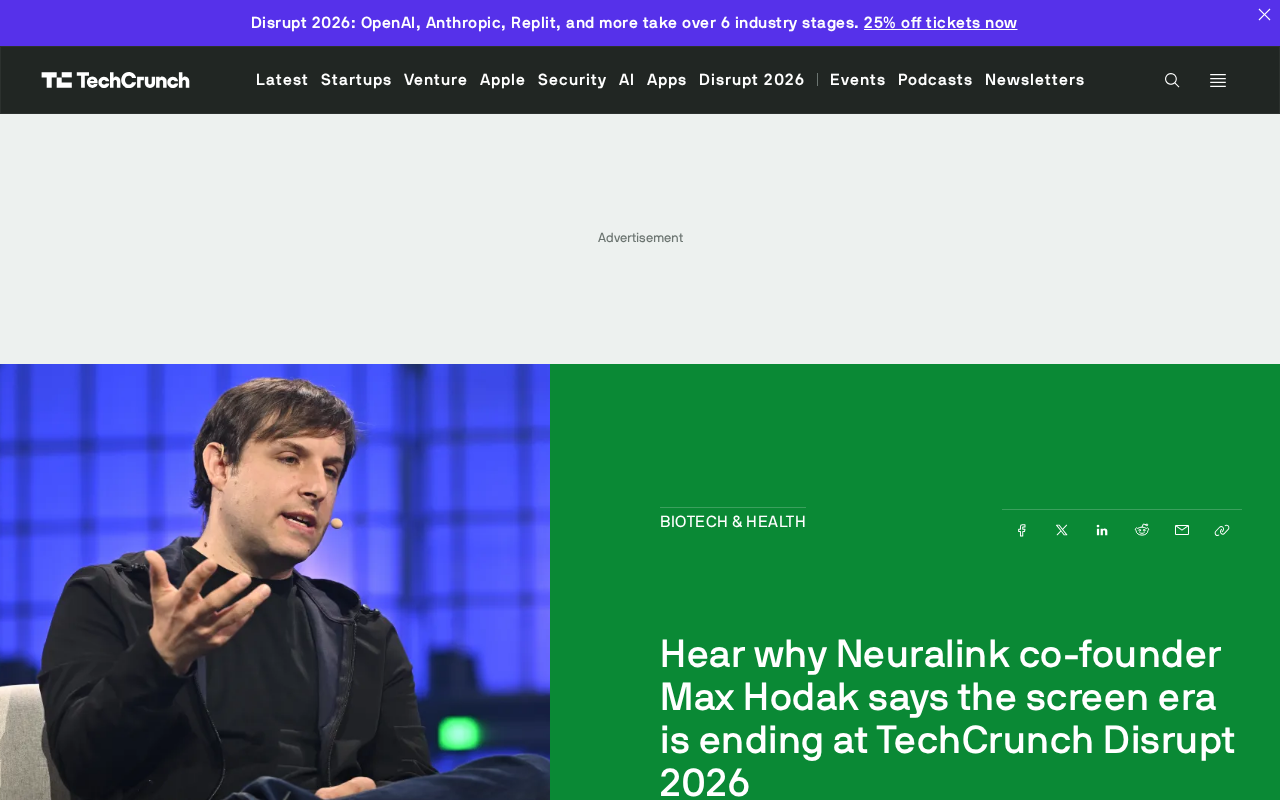
Neuralink co-founder Max Hodak declares the screen era is ending, with BCIs as the next human-computer interface.
Neuralink co-founder Max Hodak will make a bold claim at TechCrunch Disrupt 2026: the screen-centric paradigm of human-computer interaction is coming to an end. His vision of "screen-free interfaces" is grounded in BCI technology, connecting the human brain directly to the digital world via neural signals — bypassing the screen as a traditional intermediary. Uniquely, this vision extends beyond interaction efficiency to include medical functionality, with BCIs already showing clinical promise in restoring senses, aiding motor-impaired patients, and treating neurological conditions. However, precise neural decoding, long-term implant safety, and ethical regulatory frameworks remain major hurdles before large-scale adoption becomes feasible.
Beyond Screens: How Brain-Computer Interfaces Could Reshape Human-Computer Interaction
At the upcoming TechCrunch Disrupt 2026 conference, Neuralink co-founder Max Hodak will take the stage to present a strikingly disruptive argument: the era of screen-centric human-computer interaction is drawing to a close. In its place, an entirely new class of screen-free interfaces is emerging — ones that could not only transform how we access information, but potentially deliver medical benefits directly.
This topic cuts to the heart of one of the most sensitive intersections between consumer electronics and biotechnology. From personal computers to smartphones, tablets, and wearables, nearly all of humanity's dialogue with the digital world over the past several decades has been mediated by glowing rectangles of glass. The "screen-free interaction" Hodak envisions is fundamentally asking: when computing power can interface directly with the nervous system, is there still a need for the screen as an intermediary layer?
The Technical Logic Behind Moving from Neuralink to Screen-Free Interfaces
As a co-founder of Neuralink, Max Hodak's perspective is grounded in substance. The core goal of brain-computer interface (BCI) technology is to establish a direct information channel between the brain and external devices. Once that channel becomes sufficiently stable and high-bandwidth, the traditional paradigm of "eyes on screen, fingers on touchpad" could theoretically be replaced by more direct neural signal interaction.
Notably, Hodak is emphasizing not just interaction efficiency, but also the dimension of "medical assistance." This suggests that the value of screen-free interfaces could far exceed consumer entertainment — BCIs have already demonstrated clear clinical potential in restoring sensory function, assisting patients with motor disabilities, and even intervening in neurological disorders. Merging the interaction interface with medical capability is precisely what distinguishes this class of technology from ordinary consumer electronics.
That said, there remains considerable distance between vision and reality. Precise decoding of neural signals, long-term implant safety, and the ethical and regulatory frameworks required for large-scale deployment are all very real thresholds standing between today and the "end of the screen era." Hodak's talk is more likely to be a directional declaration than the unveiling of a product roadmap.
BCIs fall into two major categories based on signal acquisition method: invasive and non-invasive. Neuralink takes the invasive approach — surgically implanting a miniature electrode array into the cerebral cortex to directly read neuronal firing signals, achieving spatial resolution and signal-to-noise ratios far superior to scalp electroencephalography (EEG). Neuralink's N1 chip features 1,024 electrode channels, implanted with the aid of a custom surgical robot. In contrast, organizations like Meta and OpenBCI are investing in non-invasive approaches that rely on wearable sensor arrays. While these avoid surgical risks, their current signal quality and bandwidth still lag behind invasive methods by orders of magnitude. The two paths represent a fundamental trade-off between safety and performance ceiling, and determine their respective application boundaries in consumer and medical contexts.
Why Disrupt 2026 Is Worth Watching
TechCrunch Disrupt has long served as a premier annual stage for cutting-edge ideas and emerging companies in the tech and venture capital world. The inclusion of a Neuralink co-founder reflects how brain-computer interfaces are gradually moving from purely academic conversation into broader industrial and investment consideration.
For practitioners focused on the next generation of computing platforms, screen-free interaction and BCIs may represent yet another paradigm shift in human-computer interaction — on par with the rise of mobile internet. Regardless of whether this vision takes ten years or longer to materialize, understanding its technical trajectory and commercial potential has real practical value.
According to official information, attendees who register before September 25 can save up to $200 on ticket prices.
Beyond Neuralink, the BCI landscape already has several notable reference points. Synchron completed the world's first endovascular BCI implant in a human in 2021 — its Stentrode device is delivered to the brain via blood vessels, eliminating the need for open-brain surgery and dramatically reducing surgical risk. Blackrock Neurotech holds over 30 years of invasive BCI clinical records, and its Utah Array electrode remains one of the most widely used cortical interfaces in research settings. On the non-medical side, consumer-grade EEG headsets from companies like Emotiv and Muse have reached mass production, though their functionality remains limited to emotion monitoring and simple command recognition. This broader landscape makes clear that "screen-free interaction" is not a single company's long shot, but a technical frontier the entire field is collectively approaching.
Conclusion
Max Hodak's assertion that "the era of screens is ending" is both an optimistic bet on the future of BCI technology and a profound reflection on current human-computer interaction models. Whether screens will truly fade out remains an open question — but what is certain is that the exploration of more natural, more direct, and medically capable interaction interfaces is rapidly becoming a defining direction for the technology industry.
Related articles

AI Agent Developer Job Hunt Guide: Four Hard Standards to Clear Before You Apply
A practical guide for landing AI Agent developer roles: four measurable standards — project runs, problems debuggable, solution explainable, interviews survivable.

Multi-Agent Development Guide: From Monolithic AI to Team Collaboration in Practice
A beginner's guide to multi-agent development covering core advantages, common learning pain points, enterprise tech stacks, and engineering methodology for AI developers.

Agent Skill Routing: Retrieval vs. LLM vs. Two-Stage Architecture Compared
Retrieval or LLM for Agent skill routing? Compare coarse-filter vs. fine-select architectures on latency, accuracy, and cost — with 4 key production considerations.