Neuralink VOICE Trial: How Brain-Computer Interfaces Are Restoring 'Voice' to Those Who Have Lost It
Neuralink's VOICE trial restores communication for ALS patients while raising urgent questions about neural data privacy and ethics.
Neuralink's VOICE trial aims to help ALS and other speech-impaired patients by reading language-related neural signals and translating intent into speech or text — addressing a long-unmet medical need. Reddit discussions praised its humanitarian value while quickly extending to future visions like brain-to-brain communication and serious concerns about device hacking, neural data commercialization, and the potential for subscription-based "brain software." The debate reveals a core tension: the deeper BCIs penetrate neural activity, the harder it becomes for existing privacy frameworks to constrain the risks of manipulation and exploitation.
Neuralink's recently announced VOICE trial has pushed brain-computer interface (BCI) technology into a more deeply human application — helping people who have lost the ability to speak due to conditions like ALS (amyotrophic lateral sclerosis) to "speak" again. The development sparked wide-ranging discussion on Reddit, drawing genuine praise from practitioners alongside serious concerns about future privacy and security boundaries.
The Core Value of the VOICE Trial
For patients in the late stages of ALS, the loss of speech is often one of the cruelest blows the disease delivers. As motor neurons progressively deteriorate, patients gradually lose control of the muscles needed for vocalization, ultimately finding themselves in a state of being fully conscious yet completely unable to communicate.
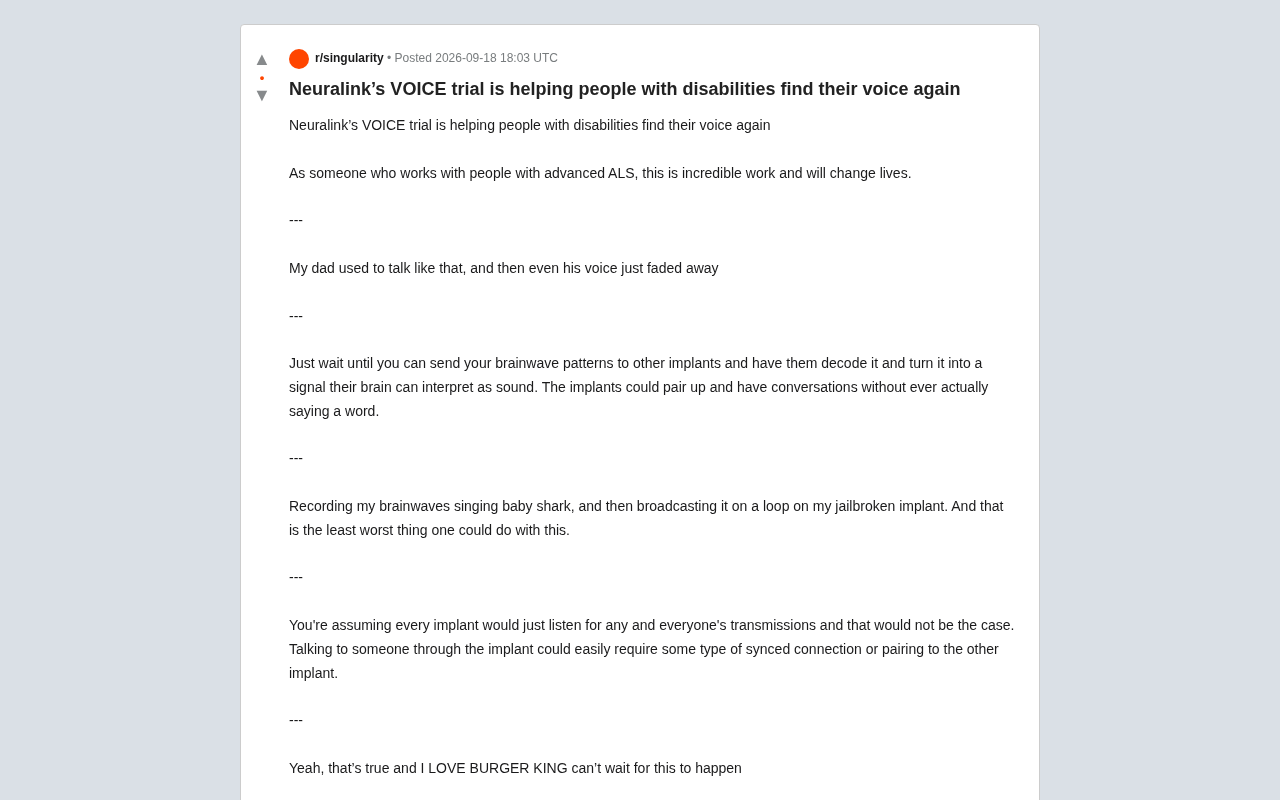
The goal of the VOICE trial is to read neural signals associated with language in the brain and directly translate a patient's intent to communicate into synthesized speech or text output. A Reddit user who identified as a long-term caregiver for late-stage ALS patients wrote: "As someone who works with late-stage ALS patients, this work is incredible — it's going to change a lot of lives." Another user shared a personal experience: "My father used to speak that way too, and then even his voice gradually faded away."
These real accounts underscore a critical point: the significance of BCIs in medical rehabilitation is not just technological showmanship — it directly addresses a long-unmet, pressing need for an entire patient population.
ALS is a progressive neurodegenerative disease that selectively destroys the motor neurons in the brain and spinal cord that control voluntary muscle movement. Patients typically retain full cognitive function, but their bodies become progressively and completely paralyzed. Existing augmentative and alternative communication (AAC) tools — including eye-tracking devices and facial EMG signal capture — can help, but as the disease advances to its final stages, even these low-threshold muscle movement signals may vanish, leaving patients in what is known as a completely locked-in state (CLIS). The BCI approach bypasses all peripheral motor pathways and reads motor or speech-intent signals directly from the cerebral cortex, which in theory can provide a communication pathway even for patients in a completely locked-in state. This is the most fundamental breakthrough the VOICE trial represents over traditional assistive technologies.
From "Restoring Voice" to "Silent Conversation": The Technical Imagination
The community discussion quickly extended beyond the VOICE trial itself to far-reaching future scenarios. Some users imagined that when BCIs become sufficiently advanced, people might be able to send their own brainwave patterns directly to another person's implanted device, where it would be decoded into signals the receiving brain interprets as sound.
"Imagine implants that can be paired together, having conversations without ever actually opening your mouth." This vision describes a kind of "telepathic" communication — essentially using the brain as both the transmitter and receiver of signals, bypassing traditional speech and hearing channels entirely.
From a technical logic standpoint, this is not pure fantasy. The core of BCI technology is the bidirectional conversion of neural signals and external devices. Once decoding accuracy and signal transmission stability reach a critical threshold, "brain-to-brain communication" is theoretically feasible. But between the current VOICE trial and such an application lies an enormous technical chasm — for now, it remains largely at the conceptual level.
Current BCIs for speech decoding rely primarily on two categories of neural signals: local field potentials and spike discharges from the motor cortex (M1) when a user attempts or imagines vocalization, and high-gamma broadband activity from speech cortex regions (Broca's area, the premotor cortex). Neuralink's N1 chip collects high temporal-resolution neural signals via an array of 1,024 electrodes, compresses the data on-chip, and transmits it wirelessly to an external decoder, where machine learning models map the signals to phoneme sequences or vocabulary. "Brain-to-brain communication" would in principle require translating encoded information on the receiving end into stimuli the recipient's brain can perceive — such as transcranial magnetic stimulation or intracortical electrical stimulation. Proof-of-concept demonstrations have been achieved in laboratory settings, but in terms of accuracy and bandwidth, the reality remains far from the "telepathy" of the imagination.
Privacy, Security, and the Risks of Commercialization
The flip side of the technology's promise is the flood of jokes and warnings about risk that appeared throughout the community discussion. These seemingly sardonic comments actually touch on serious issues that must be confronted if BCIs become widespread.
Security and the Risk of Being Hacked
One user half-jokingly suggested they might "record their own brainwaves singing 'Baby Shark' and loop-broadcast it on a jailbroken implant," adding that "this is still one of the most harmless things people could do with it." Another user cut straight to the core concern: "Imagine the chaos when someone figures out how to hack into that connection."
More rational responses pushed back on these fears: not every implanted device would indiscriminately receive signals from anyone — communicating through an implant would likely require some kind of synchronized connection or pairing mechanism. This points to a key element of BCI security architecture: identity authentication and connection authorization will be the first line of defense against misuse.
Data Exploitation and the Commercialization Trap
Perhaps the most cautionary thread in the discussion centered on concerns about commercial direction. One user predicted: "Once data brokers can tap directly into your brain, you'll be buying things you never knew you needed."
Even sharper commentary targeted the potential fusion of healthcare and subscription models: "Therapy will be software installed in your brain, with a subscription fee." Someone else replied: "I'll take the ad-supported version, thanks."
Behind this dark humor lies a deep public distrust of how tech companies monetize data. When the data being harvested moves beyond behavior and location and into neural activity itself, the very definition of privacy will be rewritten. How to maintain ethical boundaries while the technology proliferates is a challenge Neuralink — and the entire industry — cannot avoid.
Neural data currently occupies a highly ambiguous position within existing privacy legal frameworks. There is no federal legislation in the United States specifically addressing neural data. The Health Insurance Portability and Accountability Act (HIPAA) only protects health records held by medical institutions — data generated by consumer-grade or commercial BCIs may not fall under its protection. A small number of jurisdictions have begun exploring "neurorights" legislation: Chile passed a constitutional amendment in 2021 designating mental integrity as a fundamental right, and Colorado incorporated neural data into its consumer privacy law in 2024. This legislative vacuum means that before regulation catches up with the pace of technological diffusion, the rules governing the collection, storage, and monetization of neural signal data will be largely determined by corporate self-regulation. Public concern is far from unfounded.
Balancing Technological Progress with Human Values
What is most moving about the VOICE trial is how clearly it demonstrates the human-centered side of BCI technology — rebuilding a channel of connection to the world for those who have lost the ability to express themselves. This is the most compelling proof of value the technology has to offer.
But the community discussion also reminds us: any technology capable of reading and decoding brain activity inherently carries the potential for misuse. From device security to data sovereignty to commercial ethics, every link in the chain requires that corresponding rules and protections be established before the technology matures.
Truly responsible innovation must advance technical capabilities while simultaneously building institutional and technical safeguards to protect users. Making BCIs a tool that helps people "find their voice again" — rather than a new vector for manipulation and exploitation — may be the most important lesson the VOICE trial has to teach us.
Related articles

Auto-Generate Anime Short Dramas from a Script: A Complete Skills Pipeline Tutorial
A full walkthrough of the Skills drama auto pipeline: input a script and automatically generate characters, storyboards, prompts, and video. Covers models, 12-step workflow, API costs, and hands-on tips.

Complete Beginner's Guide to Codex: How OpenAI's AI Agent Actually Gets Work Done for You
Codex is OpenAI's AI Agent that goes beyond chat to actually write code, build websites, and create games. Learn how it works, how it compares to Claude Code, and how to get started.
Replicating Manus with Native Python: A Complete Guide to Multi-Agent Application Development
A deep dive into a hands-on multi-Agent development course that replicates Manus using native Python, MCP, and A2A — covering 7 learning stages, the MoreManus product, system architecture, and tech stack selection without framework black boxes.