NeuroHive: An Open-Source Python Orchestrator with Four-Agent Swarm and Sandboxed Execution

NeuroHive builds an open-source multi-agent code orchestrator with a four-agent relay and isolated subprocess sandbox.
NeuroHive is a Python-based open-source multi-agent swarm orchestrator that splits engineering tasks across four roles: Atlas designs architecture, Cygnus produces runnable code, Vanguard performs static security audits, and Sentinel executes in an isolated subprocess with timeout and memory limits. This separation of generation and trust creates a two-layer defense, though the author notes the isolation is engineering-level rather than VM-level and static auditing cannot catch hidden logic risks. It includes a cyberpunk-style Web Studio for real-time visualization, uses a lean stack of Python, WebSockets, and Linux subprocess primitives, is MIT-licensed, and starts locally in three commands.
NeuroHive: An Open-Source Python Orchestrator with Four-Agent Swarm and Sandboxed Execution
Letting multiple AI agents autonomously generate, review, and run code on real systems has always raised unavoidable concerns about security and stability. The open-source project NeuroHive offers an answer worth breaking down: a multi-agent swarm orchestrator built in Python, paired with a code execution Studio featuring an isolated sandbox.
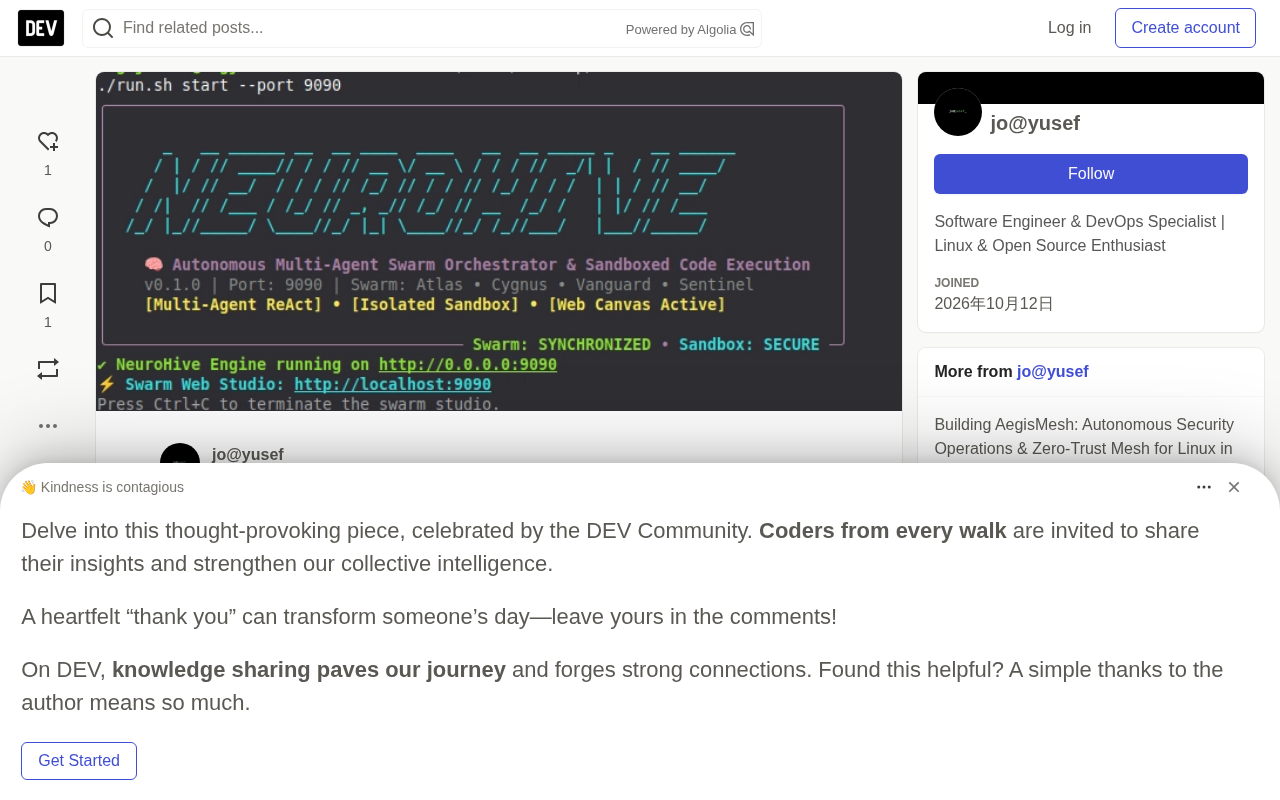
Four-Agent Division of Labor: A Role Chain from Architecture to Execution
NeuroHive's core design is to break an engineering task apart and hand it to four autonomous agents with clearly defined responsibilities, working in relay:
- Atlas (System Architect): responsible for decomposing complex goals, designing algorithm blueprints, and determining the execution flow.
- Cygnus (Lead Engineer): produces runnable, optimized Python code based on the architecture.
- Vanguard (Security Auditor): performs static security checks, scans for unsafe system calls, and blocks potentially malicious payloads.
- Sentinel (Execution Engine): runs validated code inside an isolated subprocess runtime with strict timeout and memory boundaries.
What makes this division of labor valuable is that it splits "generation" and "trust" into two separate steps. Most agent-based coding tools assume model-generated code can be run directly, whereas NeuroHive inserts a Vanguard audit in between and then uses Sentinel for runtime isolation, forming a two-layer defense.
Sandboxed Execution: The Security Foundation of Multi-Agent Systems
The project's author explicitly points out a real-world problem in the introduction: a multi-agent swarm that autonomously generates, reviews, and executes code on the host machine will face significant security, stability, and orchestration challenges. Sentinel's design is a direct response to this problem—execution only happens in isolated subprocesses, combined with timeout control and memory guards to prevent runaway code from affecting the host environment.
It should be viewed objectively: this isolation based on Linux subprocess primitives is "engineering-level protection," not the strong isolation of virtual machines or containers. It can effectively limit execution time and resource usage and reduce the risk of accidental errors, but against deliberately crafted escape attacks, the strength of protection depends on implementation details. It is reasonable to treat it as a reliable first line of defense, but overstating it as an absolute security boundary would be inaccurate.
What the Security Audit Layer Can Stop
Vanguard's static checks mainly cover unsafe system calls and obvious malicious payload patterns. Such checks act as a filter for common risks, but they cannot address subtle issues at the logic level. In practice, it is more accurate to think of it as "automated code review before code goes live": it can reduce low-level mistakes, but it cannot replace human judgment.
Linux subprocess primitives refer to capabilities provided directly by the operating system kernel, such as fork, exec, setrlimit, chroot, and namespaces. Unlike containers (which rely on a combination of cgroups and namespaces) and virtual machines (which rely on hardware virtualization), subprocess isolation shares the same kernel, and its boundary is thinner: it can limit CPU time, memory ceilings, and the number of open files, but it is difficult to completely block access to the file system or network unless seccomp is additionally layered on to filter system calls. This also explains why the article positions Sentinel as "engineering-level protection"—its actual strength depends heavily on whether the specific implementation combines resource limits, privilege reduction, and a system call allowlist.
Static security checks and runtime protection are two complementary paths. Static checks analyze source code before execution; common methods include AST parsing, blacklists of dangerous functions (such as os.system, subprocess, and eval), and pattern matching. Their advantages are zero runtime overhead and the ability to block issues in advance; their disadvantage is that they struggle against evasions such as string concatenation, dynamic imports, and obfuscation, and they cannot determine whether business logic is correct. Runtime protection (such as seccomp and audit logs), by contrast, intercepts during actual execution and can cover dynamic behavior that static analysis misses, but at the cost of performance overhead and more complex policy configuration. Only by combining both can a relatively complete defense line be formed.
A Cyberpunk-Style Real-Time Visualization Studio
NeuroHive provides a web-based Studio interface that displays communication between agents, the progression of reasoning, and code generation status in real time. For multi-agent systems, observability is often more important than the features themselves—when collaboration inside the swarm is a black box, it is hard to pinpoint which step's decision went off track when something goes wrong. Visualizing agent communication is like opening a crack in that black box.
On the technical stack, the project takes a lean approach, natively integrating Python, WebSockets, a JavaScript/HTML5 frontend, and Linux subprocess primitives, without introducing heavyweight frameworks. This "zero bloat" orientation also keeps local deployment costs very low.
Observability in multi-agent systems usually includes three layers: traces, namely the inputs, outputs, and tool call sequences of each agent; metrics, such as token consumption, task duration, and failure rate; and logs, which record exceptions and the basis for decisions. When agents collaborate through message passing, if there is no unified trace ID linking events together, a failure is often difficult to localize to a specific step. WebSocket is suitable for such scenarios because it provides a full-duplex long connection, allowing the server to proactively push updates when agent states change without frontend polling, thereby supporting a near-real-time display of communication flows.
Start in 60 Seconds: Extremely Low Deployment Barrier
NeuroHive uses the MIT license and is completely free and open source. Starting it takes only a few commands:
git clone https://github.com/EngJoDev/neurohive.git
cd neurohive
chmod +x run.sh
./run.sh start --port 9090
Clone the repository, grant execute permission to the script, and start it on a specified port—three steps to get it running locally. For developers who want to experiment hands-on with multi-agent orchestration, the barrier is quite friendly.
The MIT license is one of the most permissive open-source licenses, allowing users to freely modify, distribute, use commercially, and even re-release under a closed source license. The only requirement is to retain the original copyright notice and license text. For teams hoping to adapt NeuroHive into an internal tool or embed it in commercial products, this means almost no legal friction. It should be noted that the license covers only the project code itself; the model APIs called behind the agents remain subject to their respective terms of service, and areas involving data retention and billing need separate evaluation.
Positioning and Boundaries of Multi-Agent Autonomous Programming
NeuroHive is not positioned to replace developers, but to provide an observable and isolatable skeleton for multi-agent collaboration. The role chain of the four agents offers a clear engineering paradigm: planning, implementation, auditing, and execution each have their proper place, with clear inputs and outputs at every step.
For developers who want to study agent collaboration mechanisms or need to run AI-generated code within secure boundaries, this project provides a starting point that can be directly adapted. At the same time, it should be recognized that both sandbox strength and audit coverage still leave room for discussion, and a round of validation tailored to one's own scenario is worthwhile before use in production.
One-line Summary
NeuroHive uses a four-agent relay and isolated subprocess sandbox to build an open-source multi-agent code orchestrator.
Paragraph Summary
NeuroHive is a Python-based open-source multi-agent swarm orchestrator that breaks engineering tasks into a relay completed by four roles: Atlas handles architecture design, Cygnus produces runnable code, Vanguard performs static security auditing, and Sentinel executes in an isolated subprocess with timeout and memory limits. This "separation of generation and trust" design forms a two-layer defense, but the author also objectively notes that its isolation is engineering-level protection rather than VM-level strong isolation, and that static auditing cannot address hidden logic-layer risks. The project includes a cyberpunk-style Web Studio that visualizes agent communication and code generation in real time, improving observability of the multi-agent system. The technical stack is lean, natively integrating Python, WebSockets, and Linux subprocess primitives. It is open source under the MIT license and can be started locally with three commands. It is positioned as an observable and isolatable collaboration skeleton, suitable for experimentation and further adaptation, though validation for one's own scenario is still needed before production use.
Related articles

Python 3.15 New Feature: Is the sentinel Type Better Than None?
Python 3.15 adds the sentinel type, using named unique sentinel objects to replace None and bare object(), resolving confusion among missing values, explicit emptiness, and invalid input while avoiding type hint failures.

Deep Learning's Three Architectures and the Universal Approximation Theorem: A Complete Guide to MLPs, CNNs, and Transformers
Explaining the inductive bias differences among MLP, CNN, and Transformer, the existence meaning of the Universal Approximation Theorem (UAT), and the role of Taylor expansion in approximation analysis, while clearing up common misconceptions.

GitLab Emergency Patch Release: Analysis of Critical Security Fixes
GitLab releases critical patch 19.5.1, sparking 355 points of discussion on Hacker News. This article analyzes the background, upgrade steps for self-hosted instances, and verification points to help DevOps teams respond quickly to security updates.