Neurosymbolic Routing: Enabling Reliable Inference on Edge Devices with Small Models

A neurosymbolic router routes queries to the right solver, hitting 98.3% accuracy on Raspberry Pi at 8.8× the speed.
This arXiv preprint proposes a neurosymbolic router to address unreliable math and logic reasoning in edge SLMs. The key insight: many seemingly hard queries are structurally deterministic and solvable by symbolic engines — forcing a probabilistic model to handle them wastes compute and introduces errors. The router uses the L* algorithm to learn a DFA that dispatches structured queries to a deterministic engine (1–11ms) and reserves genuine word problems for the SLM. Tested on a Raspberry Pi 4B, it achieves 98.3% overall accuracy vs. 72% for Program-of-Thought, while running 8.8× faster and 2.8× more efficiently — though the 100-prompt evaluation warrants broader validation.
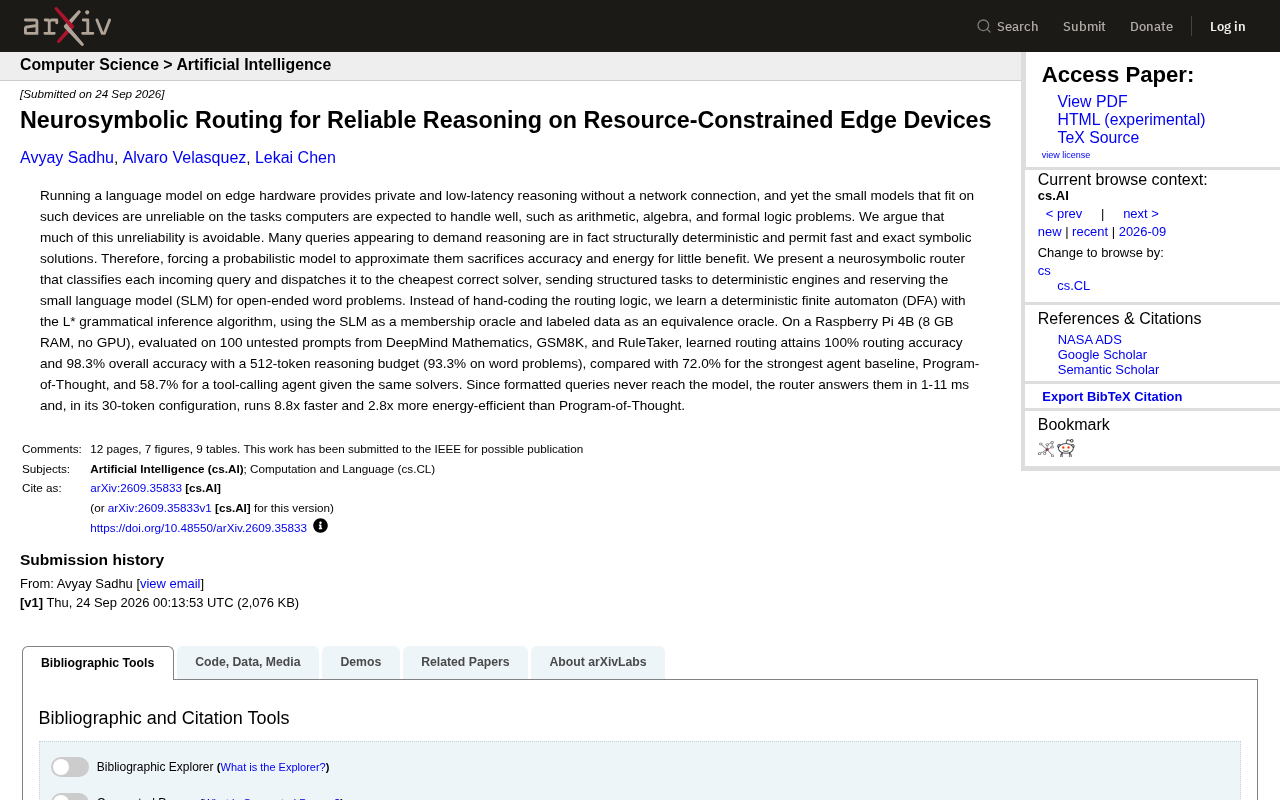
Running language models on edge hardware without a network connection offers the dual benefits of privacy protection and low-latency inference. But reality is harsh — small models that can fit on devices like a Raspberry Pi are notoriously unreliable at arithmetic, algebra, and formal logic: tasks that computers should excel at. A newly published arXiv paper (arXiv:2609.35833) proposes an elegant solution: instead of forcing a probabilistic model to approximate problems that can be solved exactly, teach the system to "triage" queries.
The Core Problem: Not All Reasoning Requires a Neural Network
The paper's central insight is a reframing of what "reasoning" tasks actually are. Many queries that appear to require reasoning are actually structurally deterministic — they have fast, exact symbolic solutions. A purely arithmetic problem or a formal logic derivation has a single, definitive answer that a deterministic engine can compute in milliseconds.
Forcing a small language model (SLM) to approximate these deterministic problems probabilistically fundamentally sacrifices accuracy and energy for negligible gain. The authors argue that most of the unreliability of edge SLMs is actually avoidable — provided you can identify which problems should be handed off to a symbolic engine, and which ones genuinely require a language model.
The Neurosymbolic Router: Send Each Query to the Cheapest Correct Solver
The research team designed a neurosymbolic router that classifies each incoming query and dispatches it to the "cheapest but correct" solver:
- Structured tasks (arithmetic, algebra, formal logic) → deterministic engine
- Open-ended word problems → small language model
The elegance of this design lies in its clear division of labor. The deterministic engine handles the precise computation it excels at, while the SLM focuses on open problems that genuinely require language understanding and flexible reasoning — eliminating resource misallocation.
Learning Routing Logic with the L* Algorithm — No Hand-Coding Required
The most obvious way to implement routing logic is to write rules by hand, but that approach is tedious and doesn't generalize well. The paper takes a more elegant approach: using the L* grammatical inference algorithm to learn a Deterministic Finite Automaton (DFA) that handles routing decisions.
In this learning framework:
- The SLM acts as a membership oracle — answering whether a given query belongs to a certain category
- Labeled data serves as an equivalence oracle — verifying whether the learned automaton is correct
This way, the routing policy is learned rather than manually defined, combining interpretability (a DFA is a transparent state machine) with data-driven adaptability.
The L* algorithm, introduced by Dana Angluin in 1987, is a classic active learning algorithm designed to infer a minimal DFA from a black-box system. Its core idea is to interact with a "teacher" (oracle) through two types of queries: membership queries (is this string accepted by the target language?) and equivalence queries (does the current hypothesized automaton exactly match the target language?). The algorithm maintains an "observation table," iteratively filling it with query results until it constructs a minimal DFA that correctly classifies all examples.
The key to applying L* for routing lies in finding oracle substitutes: traditional L* requires an omniscient teacher who knows the correct answers, but in this paper's setup, the SLM plays the role of the membership oracle — imperfect, but sufficient to provide the classification signal needed for routing decisions. The labeled dataset then serves as the basis for equivalence verification. The resulting DFA is a fully interpretable finite state machine: every state and transition edge has a clear meaning that can be inspected and debugged by humans — a stark contrast to the black-box nature of neural networks.
Benchmarks on Raspberry Pi: Accuracy and Energy Efficiency Both Beat Baselines
The validation platform was refreshingly down-to-earth: a Raspberry Pi 4B (8GB RAM, no GPU) — a quintessential resource-constrained edge device. Evaluation data came from 100 previously unseen prompts drawn from three datasets: DeepMind Mathematics, GSM8K, and RuleTaker.
The results are impressive:
| Metric | Learned Routing | Program-of-Thought | Tool-Calling Agent |
|---|---|---|---|
| Routing Accuracy | 100% | — | — |
| Overall Accuracy | 98.3% | 72.0% | 58.7% |
| Word Problem Accuracy | 93.3% | — | — |
Under a 512-token inference budget, the approach achieved 100% routing accuracy and 98.3% overall accuracy, with word problem accuracy reaching 93.3%. By comparison, the strongest agent baseline, Program-of-Thought, reached only 72.0%, while a tool-calling agent given the same solvers managed just 58.7%.
Speed and Energy: 8.8× Faster, 2.8× More Efficient
Because formatted, structured queries never reach the language model at all, the router can return answers in 1–11 milliseconds. Under a 30-token configuration, it is 8.8× faster than Program-of-Thought and 2.8× more energy-efficient.
For edge devices, energy efficiency translates directly to longer battery life and lower thermal load — factors as important as accuracy. The value of this approach isn't just "more accurate"; it's "faster and leaner."
GSM8K (Grade School Math 8K) is a benchmark released by OpenAI containing approximately 8,500 multi-step math word problems, and is a mainstream evaluation for language model mathematical reasoning. The DeepMind Mathematics dataset covers multiple subfields including arithmetic, algebra, and calculus, with a broader difficulty distribution. RuleTaker focuses on formal logical reasoning, testing whether models can make deductive inferences from a given set of rules. The combination of all three datasets ensures evaluation covers both pure computation (suited for symbolic engines) and language-understanding-driven word problems (suited for SLMs), providing a comprehensive test of routing across task types. Program-of-Thought is a prompting strategy that instructs language models to generate executable code rather than directly outputting answers — and is considered one of the stronger baselines for mathematical reasoning with small models.
Implications for Edge AI Deployment
This work points in a direction worth serious consideration: in the era of edge AI, blindly chasing larger models may not be the optimal strategy. Hybrid architectures — letting deterministic symbolic engines handle problems they can solve exactly, while reserving precious neural compute for tasks that are genuinely open and ambiguous — may be the right answer for resource-constrained deployments.
Replacing hand-coded routing rules with a learnable DFA also provides a path for neurosymbolic systems that balances accuracy, transparency, and engineering maintainability. For applications requiring localized, privacy-first, low-power inference — offline assistants, embedded devices, and the like — this kind of approach has direct practical relevance.
It's worth noting that this analysis is based on a single preprint, and the evaluation sample size (100 prompts) is relatively small — generalization at scale remains to be validated. But as a proof of concept, it clearly demonstrates the potential of neurosymbolic routing for edge inference.
Related articles

JobRunner MCP Server: AI Agents Can Now Fix Failed Java Jobs
JobRunner launches an open-source MCP server enabling AI agents to view cluster status, diagnose failures, and recover Java jobs—incident response from any cloud coding environment or existing agent.

MLAI Digital Launches 9 Security Agents: MCP Server Safeguards the Full Lifecycle of Agentic AI
MLAI Digital launches Security MCP Server with nine built-in specialized security agents covering vulnerability discovery, attack simulation, prompt injection detection, API and infrastructure assessment, and accelerated remediation—embedding security validation across the full Agentic AI lifecycle from development to production.

Running Isaac Lab on H100 GPUs: Exploring Better Approaches
Exploring optimization methods for running Isaac Lab on NVIDIA H100 GPUs, including MIG configuration, mixed precision, TensorRT acceleration, and community experience to improve robotics simulation and reinforcement learning efficiency.