New Apple TV 4K Features Built-in Microphone for Hands-Free Siri AI Conversations

Apple launches the fourth-gen Apple TV 4K with a built-in far-field microphone, first-ever Siri AI support, and a Find My-equipped remote.
Apple released the fourth-generation Apple TV 4K with three key changes: a built-in far-field microphone for hands-free Siri without the remote; it's the first Apple TV to support Siri AI, pairing hardware pickup with AI capabilities; and the new remote adds Find My for the first time, solving the long-standing issue of losing it. The article argues Apple is pushing Apple TV from a playback device toward a home AI terminal, making the living room a permanent entry point for Siri. However, details on pickup accuracy, false-wake control, Siri AI's TV-side latency and context, and privacy handling remain unconfirmed.
Apple today unveiled its next-generation Apple TV 4K, bringing two notable hardware changes: a built-in far-field microphone array in the device itself, allowing users to call on Siri directly without reaching for the remote; and the remote gaining Find My support for the first time. This fourth-generation Apple TV 4K made its debut at the Welcome Home event in New York, and it's also the first Apple TV model to support Siri AI.
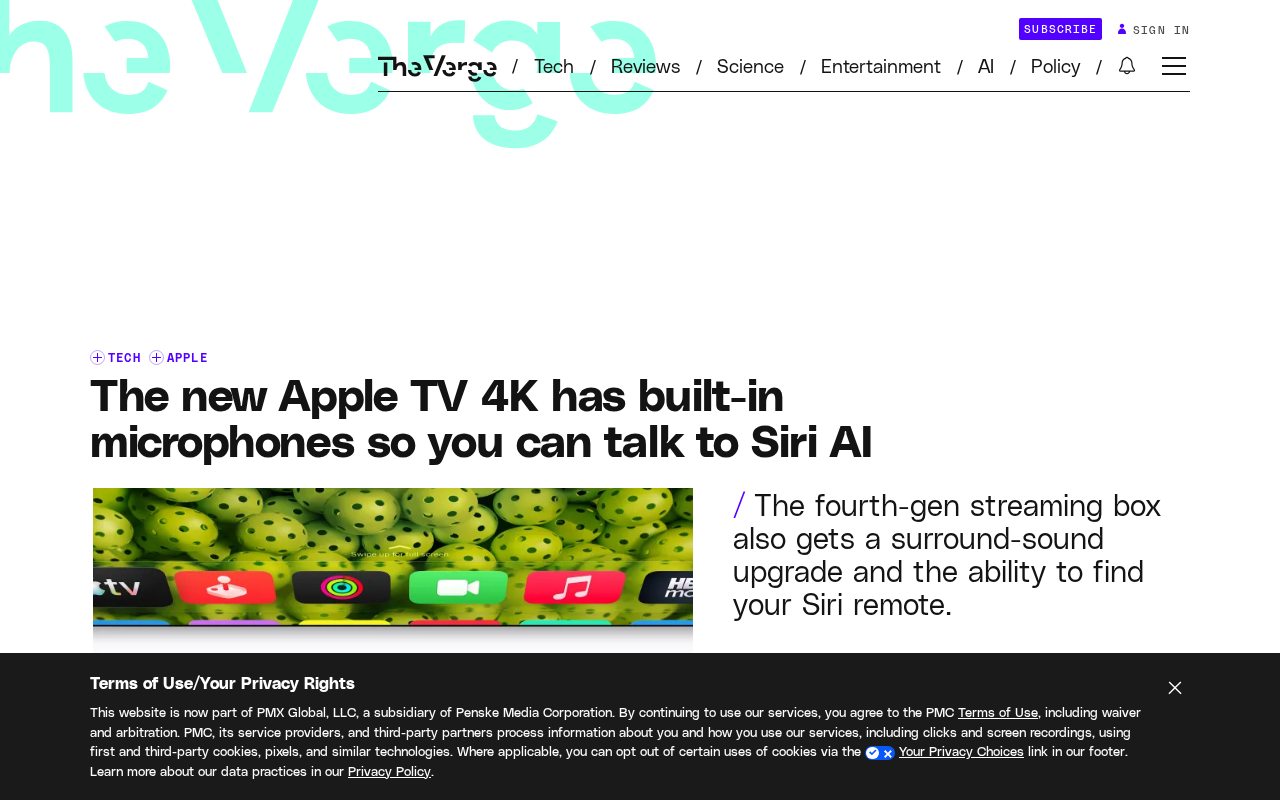
Far-Field Microphone: Turning the Living Room into a Voice Entry Point
Apple TV has long been seen as the "quietest device" in the living room—its interaction depends almost entirely on the remote. A built-in far-field microphone changes that premise. Far-field pickup means the device can recognize wake words and voice commands from several meters away, letting users start a conversation with Siri right from the couch, even with the remote out of reach.
This hardware change may seem minor, but it carries clear intent within Apple's AI narrative. HomePod has already proven the viability of far-field voice in home environments. With Apple TV adding this capability, the voice entry point in the living room shifts from "optional" to "always on by default." The device no longer requires users to locate the remote before it can respond, and Siri's presence in the home will become significantly more prominent.
Far-field Voice Pickup refers to the technology that enables a device to clearly recognize voice commands from several meters away, as opposed to the near-field microphones commonly found on phones and earbuds (which require the user to speak up close). In home settings, far-field pickup faces three core challenges: first, distance attenuation degrades the signal-to-noise ratio; second, room reverberation blurs the voice signal; and third, persistent ambient noise from TVs, air conditioners, and other sources interferes. Common technical countermeasures include multi-microphone arrays for beamforming—using phase differences to lock onto the speaker's direction while suppressing noise from other angles—and acoustic echo cancellation (AEC) to prevent the TV's own audio from being mistakenly captured as commands.
The wake word mechanism determines when the device starts "listening." Most products use a low-power, always-on local listener that only uploads subsequent speech after recognizing a specific wake word (such as "Hey Siri"), which reduces power consumption and minimizes privacy risks from continuous uploading. A far-field microphone's pickup range, wake-word accuracy, and false-wake rate typically require long-term testing in real home environments to evaluate.
Siri AI Comes to Apple TV for the First Time
The fourth-generation Apple TV 4K is the first Apple TV to support Siri AI. The original coverage notes that this support arrives alongside the built-in microphone—hardware handles "always hearing," while Siri AI handles "understanding and responding."
Previously, Siri capabilities on Apple TV were relatively limited, mainly used for content search and basic controls. The introduction of Siri AI means conversational interaction has a chance to enter the TV space: more natural follow-up questions, cross-app intent understanding, and commands that coordinate with other home devices. Of course, the actual experience depends on Siri AI's language support and feature availability across different regions—details Apple has not yet provided in its announcement.
Remote Gains Find My
The new remote includes Find My support. This is a feature users have complained about for years that's finally being addressed: the Apple TV remote is small and understated in color, making it highly prone to slipping into couch cushions. With Find My, users can locate the remote through the Find My network, similar to how AirTag works.
From a product strategy perspective, adding Find My also brings the remote into Apple's tracking ecosystem, creating a consistent recovery experience alongside AirTag, iPhone, and AirPods. For households that constantly lose the remote, this change may be just as practical as the microphone.
The Find My network is Apple's crowdsourced location system. Devices that support it (such as AirTag, AirPods, and iPhone) send anonymous encrypted beacons via Bluetooth to any nearby Apple devices, which then upload the encrypted location—ultimately, only the owner can decrypt and see the location in the Find My app. Its key characteristic is that location does not depend on GPS or cellular networks, but instead relies on hundreds of millions of Apple devices worldwide acting as "relays." So for small items without connectivity, like a remote, simply having a Find My-compatible chip inside allows it to be indirectly located through other people's devices.
One caveat: Find My's location accuracy depends on whether Apple devices pass nearby. If the remote sits in a corner where nobody goes for a long time, location updates may lag; however, combined with Precision Finding (UWB ultra-wideband) in Lost Mode, it can still guide users to within a few meters. This also explains why adding Find My to the remote delivers an experience highly consistent with AirTag.
The Competitive Stakes of the Living Room AI Entry Point
Putting the microphone, Siri AI, and Find My into the same generation makes Apple's thinking fairly clear: pushing Apple TV from a "playback device" further into a "home AI terminal." The TV is one of the largest-screen, most fixed-position, and longest-used devices in the home. If voice interaction is natural enough, it can take on more roles than it does now—controlling smart home devices, initiating queries, handling lightweight tasks.
However, there are several variables along this path. The far-field microphone's pickup accuracy and false-wake control need real-world verification; Siri AI's response latency and contextual capabilities on TV are also key; and how privacy is handled in home settings (whether the microphone is always on or uses local wake) will directly affect user acceptance. Complete information on these details is not yet available.
What is certain is that this Apple TV 4K update is not a routine chip iteration, but a step forward in how users interact with the device. For users already in the Apple ecosystem, hands-free Siri and a locatable remote are tangible changes; for Apple, this is a substantive step in bringing Siri AI into a core home scenario.
Making the TV a home AI terminal is essentially about competing for the position of "home voice entry point." The main competitors in this space include Amazon's Echo lineup (Alexa), Google's Nest speakers and Google TV, and Apple's own HomePod. The difference lies in this: speakers are purpose-built voice devices but have small screens, while TVs have large screens and fixed positions but have long lacked always-on voice capability. With Apple TV adding far-field microphones, it's effectively competing with smart speakers for the same set of living room commands.
Another key variable is the division of computing between on-device and cloud. Voice wake and initial recognition are well-suited to local processing to reduce latency and protect privacy; more complex semantic understanding and dialogue generation often require the cloud. Siri AI's response speed on TV, context memory length, and cross-device coordination capabilities depend on how Apple allocates these two computing tiers. Additionally, language support in different regions and data compliance requirements will also affect feature availability—which is part of the reason details are missing from the announcement.
One-line Summary
Apple launches the fourth-generation Apple TV 4K with a built-in far-field microphone, first-ever Siri AI support, and a remote with Find My.
Paragraph Summary
Apple has released the fourth-generation Apple TV 4K with three key changes: a built-in far-field microphone that lets users summon Siri without the remote; it's the first Apple TV model to support Siri AI, pairing hardware pickup with AI capabilities; and the new remote integrates Find My for the first time, addressing a long-standing pain point of losing it. The article argues Apple is using this to push Apple TV from a simple playback device toward a home AI terminal, making the living room a permanent entry point for Siri. However, the far-field microphone's pickup accuracy and false-wake control, Siri AI's response latency and contextual abilities on TV, and the privacy handling of an always-on microphone all lack complete information—real-world experience remains to be verified.
Related articles

Workbuddy for Absolute Beginners: How a Desktop AI Agent Fits Into Real Workflows
A beginner's guide to the Workbuddy desktop AI agent: installation, claiming credits, file management, and building automated workflows—compared with CodeX for fit and cost, helping professionals shift from AI question-askers to AI managers.

OpenAI's New Agent Stack: Computer Use, Decisions API, and Ultra-Fast Workflows
OpenAI Dev Day unveiled a new agent stack: Computer Use outperforms humans, Decisions API delivers ultra-low-latency classification via Luna, Agents API opens the same Computer Use capabilities, and GPT-6.1 Sol costs only one-seventh of Astra. Core updates, benchmark data, and developer insights.

Liang Wenfeng Open-Sources DeepInfo Inference Framework, Takes On U.S. Ban
DeepSeek open-sources its DeepInfo inference framework after its models, featuring GPU/CPU cross-pipelining, small-model prediction with large-model verification, and full Huawei Ascend and NVIDIA chip support—facing the U.S. federal ban head-on. This article analyzes its significance for AI deployment and open-source strategy.