New Approach to Autonomous Driving VLA Pruning: How MoOP Balances Reasoning and Action

MoOP fuses reasoning and action importance to prune VLAs, cutting 24% of parameters while improving performance and preserving reasoning.
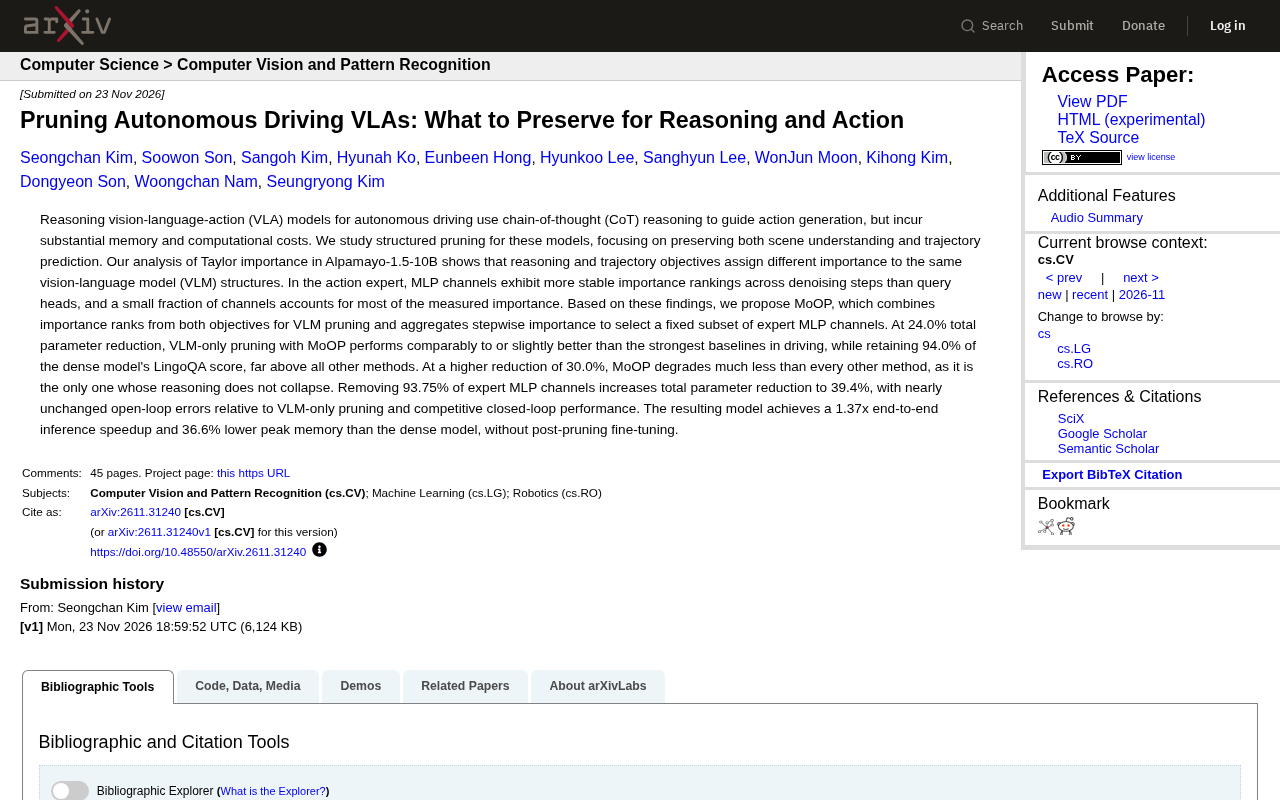
To address the memory and compute bottlenecks of chain-of-thought reasoning in autonomous driving VLA models, this study analyzes structured pruning on Alpamayo-1.5-10B and proposes MoOP. It finds that reasoning and trajectory prediction objectives rank VLM structure importance differently, so pruning only for driving harms reasoning. MoOP fuses both rankings for VLM pruning and exploits stable MLP channel importance across denoising steps in the action expert. At 24.0% parameter reduction, driving performance matches or slightly exceeds the strongest baseline while retaining 94.0% of the dense model's LingoQA score; at 30.0% reduction it is the only method whose reasoning does not collapse. The final model achieves 1.37× speedup and 36.6% peak memory reduction without fine-tuning.
Vision-Language-Action (VLA) models are becoming the mainstream paradigm for end-to-end autonomous driving, but the memory and compute overhead introduced by chain-of-thought (CoT) reasoning makes deployment extremely difficult. A new study conducts a structured pruning analysis of the Alpamayo-1.5-10B model and proposes a method called MoOP. With a 24.0% reduction in parameters, driving performance actually improves rather than degrades, and reasoning capability far exceeds comparable pruning schemes. This offers a new direction for lightweighting VLA models.
Divergence in the Importance of Reasoning and Action for VLM Structure
The research team first analyzed the distribution of Taylor importance on Alpamayo-1.5-10B and found a key contradiction: the importance rankings produced by the reasoning objective and the trajectory prediction objective for the same Vision-Language Model (VLM) structure are not consistent. This means that pruning solely for the driving task may damage the model's reasoning ability, and vice versa.
This finding explains why previous pruning methods performed poorly on reasoning benchmarks—they often optimized only the action objective while ignoring the structures on which CoT reasoning depends. The core idea of MoOP is precisely to consider the importance rankings of both objectives simultaneously and fuse them for VLM pruning.
Taylor importance is a structured pruning importance measure based on first-order Taylor expansion. It approximates the impact of removing a structural unit on the final loss by computing the product of the gradient of the loss function with respect to a channel or parameter and the value of that term (i.e., gradient × activation or gradient × weight). The larger the absolute value of Taylor importance, the more critical the channel is to the model output, and the higher priority it should be given during pruning. Compared with simple weight magnitude criteria, Taylor importance can incorporate the specific task loss, and is therefore closer to the actual performance change after pruning. In VLA models, because there are two different objectives—CoT reasoning and trajectory prediction—Taylor importance rankings computed from different losses will show systematic differences. This is exactly the technical premise for MoOP's need to fuse multi-objective importance.
Stability of MLP Channels in the Action Expert
In the action expert part, the study observed an interesting phenomenon: the importance rankings of MLP channels across denoising steps are more stable than those of query heads, and a small subset of channels contributes most of the importance. Based on this, MoOP aggregates step-wise importance and selects a fixed subset of expert MLP channels.
This design avoids frequently adjusting the pruning mask as denoising steps change, ensuring inference efficiency. Experiments show that even when 93.75% of expert MLP channels are removed, resulting in a total parameter reduction of 39.4%, the open-loop error is almost unchanged compared with pruning only the VLM, and closed-loop performance remains competitive.
The action expert is the module in the VLA architecture specifically responsible for generating continuous driving actions (such as trajectory points), usually decoupled from the VLM backbone responsible for vision-language understanding. In trajectory generation paradigms based on diffusion or denoising, the action expert progressively refines the action output through multi-step denoising iterations, with each step relying on internal MLP channels and query heads for feature transformation. Because the denoising process gradually approaches the final trajectory, the feature distributions between adjacent steps are highly correlated, so the importance rankings of MLP channels are more stable than those of query heads; query heads involve attention routing and are more sensitive to the noise level of the current step, leading to greater ranking fluctuation. This structural characteristic enables MoOP to aggregate importance across denoising steps and select a fixed subset of channels, thereby avoiding the extra overhead of recomputing masks step by step.
Performance Validation: Reasoning Does Not Collapse, Speed and Memory Both Improve
With a total parameter reduction of 24.0%, MoOP, which prunes only the VLM, is comparable to or slightly better than the strongest baseline on driving tasks, while retaining 94.0% of the dense model's LingoQA score, far higher than other methods. When the parameter reduction is increased to 30.0%, MoOP's performance drop is much smaller than that of all compared methods, and it is the only scheme whose reasoning ability does not collapse.
The final model achieves 1.37× end-to-end inference speedup and 36.6% peak memory reduction without post-pruning fine-tuning. These data show that MoOP achieves a good balance between compression rate and performance, making it especially suitable for autonomous driving scenarios with high real-time requirements.
LingoQA is a vision-language reasoning benchmark for autonomous driving scenarios. It requires the model to answer questions involving causal inference, risk identification, and commonsense explanation based on driving scenes, and is specifically used to evaluate the chain-of-thought reasoning ability of VLA or VLM models in driving contexts. Unlike open-loop trajectory error (such as L2 distance) and closed-loop driving scores, LingoQA measures the quality of the model's "thinking," so it is often used to detect whether pruning has damaged the CoT structure. MoOP retains 94.0% of the dense model's LingoQA score under a 24.0% parameter reduction, indicating that its pruning mask preserves reasoning-related channels relatively well; in contrast, comparison methods show large score drops at the same compression rate, reflecting that pruning solely according to driving loss systematically damages reasoning pathways.
Implications for VLA Deployment
This study sends a clear signal: VLA pruning cannot focus only on driving metrics; preserving reasoning ability is equally critical. Through multi-objective importance fusion and channel-level stable selection, MoOP enables the model to retain its thinking ability after "slimming down." For engineers trying to fit large models onto vehicle-side chips, this undoubtedly provides a reusable technical path.
However, the method has so far been validated only on Alpamayo-1.5-10B, and cross-model generalization still needs further exploration. Nevertheless, MoOP sets a baseline worth referencing for practical pruning of autonomous driving VLAs.
End-to-end inference speedup and peak memory reduction are two core metrics for assessing vehicle-side deployment feasibility. The former refers to the latency improvement of the entire forward pipeline from sensor input to trajectory output, directly affecting control frequency and real-time safety margins; the latter determines whether the model can share limited onboard memory with modules such as perception and planning. The 1.37× speedup and 36.6% peak memory reduction reported by MoOP are achieved without post-pruning fine-tuning, which means the compression pipeline can be completed offline and deployed plug-and-play, avoiding the cost of retraining on the vehicle side or in the cloud. Note, however, that these gains depend on whether the actual reduction in channel dimensions after structured pruning can be effectively exploited by the inference framework; if the hardware or compiler does not support sparse/variable-length channels, the theoretical speedup may be discounted.
One-line Summary
MoOP fuses reasoning and action importance to prune VLAs, cutting parameters by 24% while improving performance and preserving reasoning.
Paragraph Summary
To address the memory and compute bottlenecks caused by chain-of-thought reasoning in autonomous driving VLA models, this study conducts structured pruning analysis on Alpamayo-1.5-10B and proposes MoOP. The study finds that the importance rankings of the VLM structure differ between the reasoning objective and the trajectory prediction objective, and that pruning solely for the driving task damages reasoning ability. MoOP therefore fuses the importance rankings of both objectives to guide VLM pruning; in the action expert part, it exploits the stability of MLP channel importance across denoising steps to aggregate and select a fixed subset of channels. With a 24.0% total parameter reduction, MoOP's driving performance is comparable to or slightly better than the strongest baseline, retaining 94.0% of the dense model's LingoQA score; at 30.0% parameter reduction, it is the only scheme whose reasoning does not collapse. The final model achieves 1.37× inference speedup and 36.6% peak memory reduction without fine-tuning.
Related articles

Michael Nielsen Takes Down His Classic Neural Network Textbook, Sparking Community Discussion
Michael Nielsen's classic free textbook Neural Networks and Deep Learning has been taken offline, sparking discussion on Hacker News about the reasons and impact.

Inside the AI Training Data Market: The Trade-off Between Exclusivity and Discounts
G2i founder Gabe Greenberg reveals the dual-track pricing of the AI training data market: labs pay a premium for exclusive data or accept discounts that allow others to buy it.

SessionGraph: Unifying All Coding Agent Sessions in One Interactive Graph
SessionGraph aggregates coding agent sessions into an interactive graph, helping developers review, debug, and manage AI coding workflows across sessions. This article examines its positioning, value, and open questions.