New Benchmark for Industrial LLM Evaluation: IndustrialKnowEval Released

IndKnow decomposes industrial knowledge across four cognitive levels and uses ICCG to quantify when models can recite but can't apply.
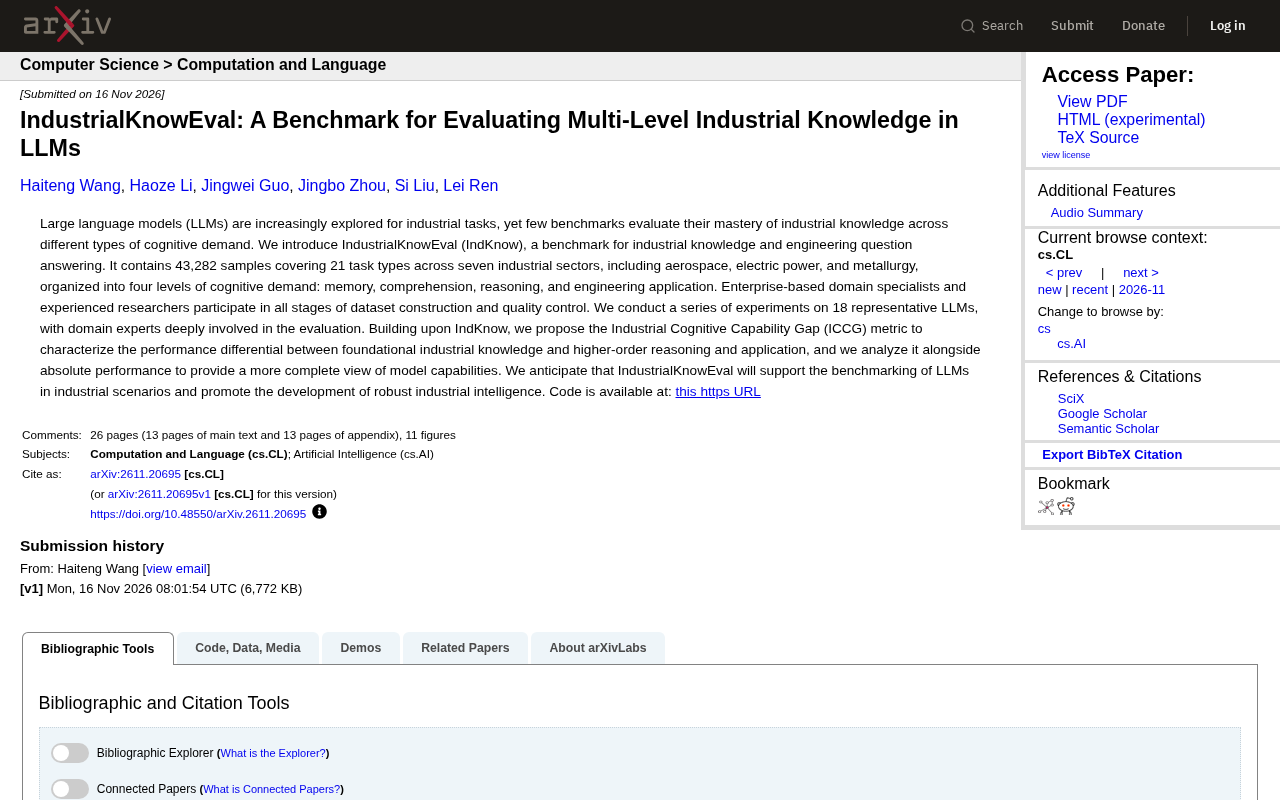
IndustrialKnowEval (IndKnow) is an LLM benchmark for industrial scenarios, covering seven sectors, 21 task types, and 43,282 samples organized across memory, understanding, reasoning, and engineering application levels. With expert involvement in construction and evaluation, it proposes the ICCG metric to quantify the gap between basic industrial knowledge and higher-order reasoning, preventing total scores from masking structural deficiencies.
Large language models are rapidly making inroads into industrial scenarios, but there has long been a lack of dedicated yardsticks for systematically evaluating their real capabilities in the industrial domain. The recently released IndustrialKnowEval (IndKnow) attempts to fill this gap—it is not just another knowledge QA dataset, but rather decomposes industrial knowledge along cognitive levels and proposes a new metric for measuring the "knowledge–reasoning gap."
What It Evaluates: Four Cognitive Levels and Seven Industries
IndKnow covers seven industrial sectors including aerospace, power, and metallurgy, contains 21 task types, and comprises a total of 43,282 samples. Unlike common single-type QA evaluations, it organizes questions into four levels of cognitive demand: memory, understanding, reasoning, and engineering application. The judgment behind this design is that being able to recite industrial parameters does not equal being able to solve engineering problems—the latter is the prerequisite for models to enter production environments.
Every stage of dataset construction involved enterprise domain experts and experienced researchers, with quality control maintained throughout. This is particularly critical in the industrial domain—many technical terms and subtle differences in operating procedures are difficult for general annotators to grasp.
Why Layering Matters More Than Volume
The particularity of industrial knowledge lies in its strong context dependence. The same parameter may have completely different meanings under different operating conditions, and mere expansion of the question bank cannot reflect this complexity. IndKnow's division by cognitive level allows evaluation results to pinpoint exactly where a model gets stuck: is it a lack of basic knowledge, or an inability to transfer knowledge to specific application scenarios?
Bloom's Taxonomy is a commonly used framework in education for classifying cognitive abilities, proposed by Benjamin Bloom in 1956 and later revised by Anderson and others. The revised version divides cognitive processes from lower to higher into six levels: remembering, understanding, applying, analyzing, evaluating, and creating. Lower levels are the foundation of higher levels, but mastering lower levels does not automatically mean possessing higher-level abilities. IndKnow's four-level design (memory, understanding, reasoning, engineering application) clearly draws on this line of thinking: memory corresponds to retrieval of factual knowledge, understanding to explanation and exemplification, reasoning to analysis, inference, and transfer, and engineering application to comprehensive decision-making under real-world constraints. Introducing this framework into LLM evaluation shifts capability diagnosis from "total score rankings" to "level profiles," making it easier to identify breakpoints in the model's cognitive chain.
The ICCG Metric: Quantifying "Can Recite but Can't Apply"
The research team conducted a series of experiments on 18 representative models and invited domain experts to participate deeply in the evaluation. On this basis, they proposed the Industrial Cognitive Capability Gap (ICCG) metric to characterize the performance difference between a model's basic industrial knowledge and its higher-order reasoning applications.
The practical value of this metric lies in examining absolute performance together with relative gaps. A model that scores high on the memory level but drops sharply on the engineering application level suggests it may be good at retrieval-style answering but lacks genuine reasoning ability. Looking only at total scores, such structural deficiencies are easily masked.
The Significance of Expert Participation in Evaluation
Answers in industrial scenarios often have no unique standard formulation, and scoring open-ended engineering questions relies heavily on professional judgment. By involving domain experts in the evaluation process, IndKnow alleviates to some extent the disconnect between automated evaluation and real engineering needs.
In evaluation methodology, absolute performance measures a model's score on a single task, while performance gap measures the score difference of the same model across tasks of different difficulty or type. Combining the two can reveal structural characteristics that are masked when looking only at total scores: if the total score is high but the gap between levels is large, capability distribution is uneven; if the total score is moderate but the gap is small, capabilities are relatively balanced. ICCG is essentially a gap-type metric, similar in spirit to the "knowledge–reasoning gap" measures commonly used in natural language processing. When using such metrics, two points require attention: first, the difficulty of questions at each level must be calibrated, otherwise the gap may stem from question difficulty rather than capability differences; second, gap values should be interpreted together with confidence intervals to avoid mistaking sampling fluctuation for structural deficiency.
Automated evaluation in LLM assessment typically relies on literal overlap metrics such as exact match, BLEU, and ROUGE, or uses another LLM as a judge (LLM-as-a-judge). The former is too strict for open-ended engineering questions, while the latter may suffer from systematic biases such as position bias, length bias, and self-preference bias. Human expert evaluation is regarded as a reference closer to real needs, but it is costly and difficult to ensure consistency. In practice, a combination of expert annotation and automated evaluation is often adopted, with expert scores used to calibrate automated scorers. In high-risk, highly specialized domains like industry, expert participation is not only a quality assurance measure but also an important basis for establishing the credibility of evaluation results.
Implications for Industrial AI Deployment
IndKnow's release points to a real problem: the current usability of models in industrial scenarios cannot be inferred from general-purpose leaderboards. The code has been open-sourced on GitHub, and the research team hopes this benchmark will promote standardization of LLM evaluation in industrial scenarios and advance robust industrial intelligence.
For enterprises, the reference value of such layered evaluation lies in its approach to model selection—rather than focusing on a model's ranking on general tests, it is better to examine its performance in one's own industry and at one's own required cognitive levels. The knowledge–application gap revealed by ICCG may also serve as a basis for judging whether a model needs additional fine-tuning or the introduction of a toolchain.
Whether the dataset and evaluation methodology can continue to expand into more industry segments will determine the long-term vitality of such benchmarks.
One-line Summary
IndKnow decomposes industrial knowledge across four cognitive levels and uses ICCG to quantify when models "can recite but can't apply."
Paragraph Summary
IndustrialKnowEval (IndKnow) is an LLM evaluation benchmark for industrial scenarios, covering seven industrial sectors including aerospace, power, and metallurgy, 21 task types, and 43,282 samples. It organizes questions across four cognitive levels—memory, understanding, reasoning, and engineering application—aiming to distinguish whether a model lacks knowledge or lacks knowledge-transfer ability. Enterprise domain experts participated in both dataset construction and evaluation. The research team conducted experiments on 18 representative models and proposed the Industrial Cognitive Capability Gap (ICCG) metric to quantify the performance gap between basic industrial knowledge and higher-order reasoning applications, preventing total scores from masking structural deficiencies. The benchmark code is open-sourced on GitHub, providing layered reference for industrial LLM selection and fine-tuning decisions.
Related articles

Prompt Engineering for Beginners: From Writing Prompts to Engineering Thinking
Starting from the essence and four functions of prompts, this article systematically explains the six-step process, four success criteria, learning value, and practical limitations of prompt engineering to help you build a complete understanding.

Anthropic Launches Nasdaq IPO: AI Giant's Listing and Risk Disclosures
Anthropic officially launches its Nasdaq IPO under ticker ANT, with market valuation expected to potentially exceed SpaceX's record. The prospectus devotes nearly 100 pages to AI risks, while first-half revenue grew over 14x but net losses widened sharply, reigniting the AI bubble debate.

Rust cURL Clone Uses 4,832 unsafe Blocks—Is the Memory Safety Myth Broken?
A Rust cURL clone uses 4,832 unsafe keywords, challenging Rust's memory safety narrative. We analyze what unsafe really means, compare Fil-C, and examine rewrite motives.