New Breakthrough in Multi-Manifold Clustering: Minimax Rates and Improved Spectral Convergence

New paper establishes minimax rates for Laplace-Beltrami eigenpair estimation in multi-manifold clustering and improves manifold-agnostic graph Laplacian spectral convergence to n^{-1/(2.5d-1)}.
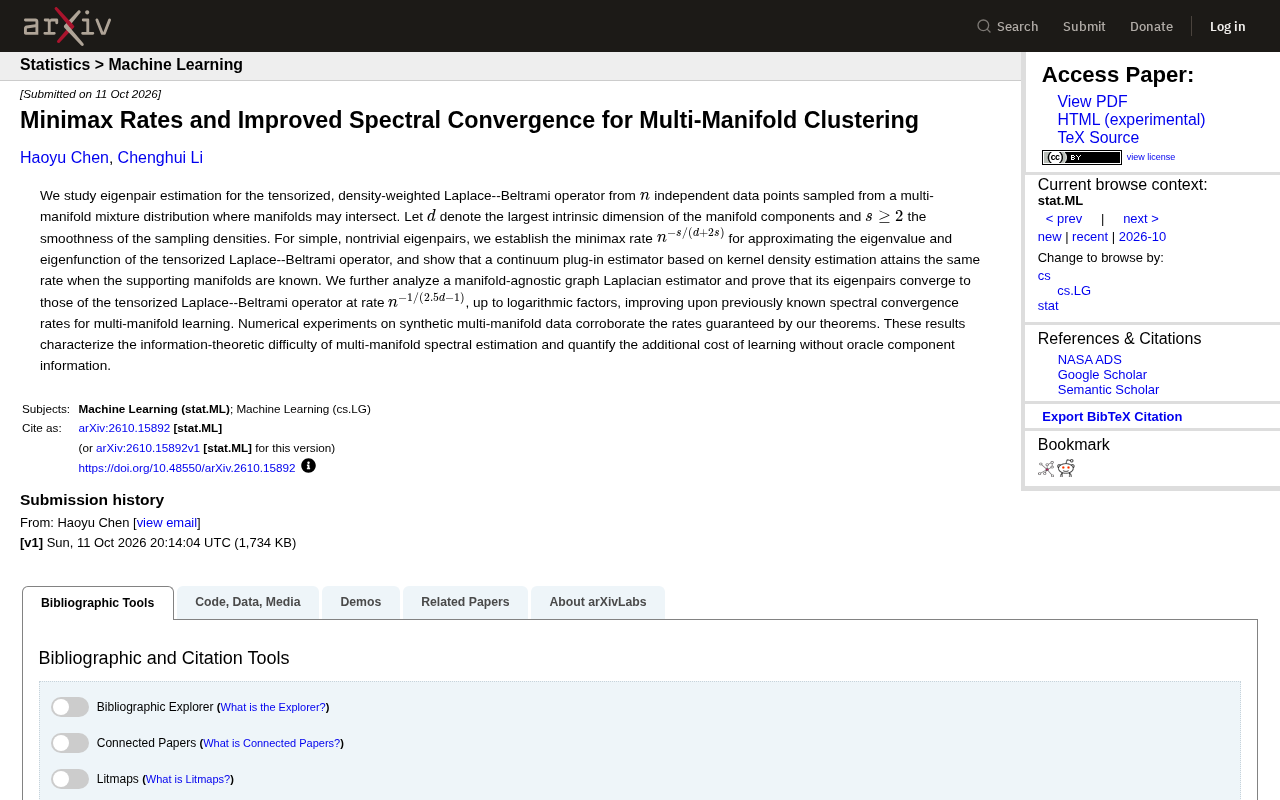
This paper studies spectral structure estimation under multi-manifold mixture distributions, where data lies on multiple possibly intersecting low-dimensional manifolds. The authors establish a minimax rate n^{-s/(d+2s)} for estimating eigenpairs of the tensorized density-weighted Laplace-Beltrami operator, where d is the maximum intrinsic dimension and s the density smoothness, and prove a plug-in estimator based on kernel density estimation achieves this optimal rate when manifolds are known. They then analyze the manifold-agnostic graph Laplacian estimator, proving a convergence rate of n^{-1/(2.5d-1)}, significantly improving prior multi-manifold spectral convergence rates. The paper also quantifies the extra cost of lacking manifold information: the rate exponent degrades from s/(d+2s) to about 1/(2.5d). Synthetic experiments validate the theory, providing a solid foundation and benchmark for multi-manifold clustering and spectral estimation.
Multi-manifold clustering is a fundamental yet challenging problem in machine learning: when data is distributed across multiple possibly intersecting low-dimensional manifolds, can we accurately estimate the spectral structure that describes these manifolds? A new paper, "Minimax Rates and Improved Spectral Convergence for Multi-Manifold Clustering," provides a theoretical answer. It not only establishes minimax rates for estimating eigenpairs of the tensorized density-weighted Laplace-Beltrami operator, but also improves the spectral convergence rate of manifold-agnostic graph Laplacian estimators.
Problem Setup: Estimating Spectra from Multi-Manifold Mixture Distributions
The paper considers n data points independently sampled from a multi-manifold mixture distribution, where the manifolds may intersect. Let d be the maximum intrinsic dimension of the manifold components, and s ≥ 2 the smoothness of the sampling density. The goal is to estimate the eigenpairs of the tensorized, density-weighted Laplace-Beltrami operator, which is equivalent to capturing the diffusion geometry structure on each manifold.
This setup differs from classical single-manifold learning: intersecting manifolds mean that local neighborhoods may mix points from different manifolds, introducing fundamental difficulties for spectral estimation. The paper focuses on simple non-trivial eigenpairs and provides the first minimax lower bound for this problem, thereby characterizing the statistical difficulty in the information-theoretic sense.
The Laplace-Beltrami operator is a second-order elliptic differential operator defined on Riemannian manifolds, which can be viewed as a generalization of the Euclidean Laplacian to curved spaces. In manifold learning, it characterizes the heat diffusion process on the manifold, and its eigenfunctions form an orthogonal basis on the manifold, thereby capturing the "diffusion geometry" structure of the data—that is, the diffusion distance between any two points. For a multi-manifold mixture distribution, each manifold component corresponds to a Laplace-Beltrami operator, and its spectral structure (eigenvalues and eigenfunctions) reflects the geometric shape of that manifold itself. The term "tensorized" here refers to combining these operators into a block-diagonal form, so that the joint spectrum contains information from each manifold component; "density-weighted" refers to the fact that the data is sampled according to some density, and the operator needs to be adjusted by the sampling density, otherwise spectral estimation would be biased toward high-density regions.
The minimax rate is a core concept in statistical estimation theory, used to characterize the optimal convergence rate achievable among all estimators over all possible data-generating distributions. Specifically, the minimax risk is defined as the optimal error obtained by taking the supremum over all parameters and the infimum over all estimators. A minimax lower bound states that no estimator can converge faster than this rate, while an upper bound states that there exists an estimator achieving this rate. Therefore, the minimax rate simultaneously provides a benchmark for the statistical difficulty of the problem and a performance standard for optimal algorithms. In the multi-manifold clustering problem, the rate n^{-s/(d+2s)} reveals an important phenomenon: estimation accuracy improves as the sample size n increases, but the rate of improvement is jointly constrained by the intrinsic dimension d and the density smoothness s.
Core Results: Minimax Rates and Plug-in Estimators
For simple non-trivial eigenpairs, the paper establishes a minimax rate of n^{-s/(d+2s)} for eigenvalue and eigenfunction approximation. This rate reflects the trade-off between smoothness s and intrinsic dimension d: the higher the dimension and the rougher the density, the harder the estimation.
More crucially, the paper proves that a continuous plug-in estimator based on kernel density estimation can achieve the same rate when the support manifolds are known. This means that, if one has a "god's-eye view" of each manifold's location, then from a statistical perspective, this rate is optimal.
This result sets a benchmark for multi-manifold spectral estimation: the performance gap of any practical algorithm (which does not know the manifold structure) can be measured against this optimal rate.
Plug-in estimators are a class of classical statistical inference methods: first estimate the unknown quantities in the model (such as the density) from data, then directly substitute the estimates into the expression of the target functional to obtain an estimate of the target quantity. In this paper, the plug-in estimator first estimates the sampling density using kernel density estimation, then substitutes the density estimate into the continuous expression of the density-weighted Laplace-Beltrami operator, and finally performs eigendecomposition on this operator to obtain estimates of the eigenpairs. This estimator is called "continuous" because it does not rely on constructing a graph or discretization, but acts directly on the continuous operator. The advantage of the plug-in method is that its theoretical analysis is relatively straightforward, and when the density estimate achieves the optimal rate, the estimate of the target functional can also inherit good convergence properties.
Kernel density estimation (KDE) is the most classical non-parametric density estimation method: place a kernel function (usually a symmetric probability density function, such as a Gaussian kernel) at each data point, then superimpose and normalize all kernel functions to obtain an estimate of the density. The convergence rate of kernel density estimation is determined by the bandwidth parameter: too large a bandwidth leads to over-smoothed estimates with large bias, while too small a bandwidth leads to large variance. Under the optimal bandwidth, kernel density estimation achieves a convergence rate of n^{-s/(2s+1)} on densities with smoothness s. In this paper, the minimax rate n^{-s/(d+2s)} achieved by the plug-in estimator is in the same vein, but additionally reflects the influence of the intrinsic dimension d.
Manifold-Agnostic Estimators: Convergence Rate Improved to n^{-1/(2.5d-1)}
In practical scenarios, we do not know the manifold information, so the paper further analyzes manifold-agnostic graph Laplacian estimators. The authors prove that the eigenpairs of this estimator converge to those of the tensorized Laplace-Beltrami operator at a rate of n^{-1/(2.5d-1)} (ignoring logarithmic factors).
Compared with previously known spectral convergence rates in multi-manifold learning, this is a significant improvement. For example, earlier results typically gave slower rates, especially when d is large. The new rate shows that even without manifold component information, the graph Laplacian method can still approximate the ideal spectrum at a relatively manageable cost.
The paper also quantifies the additional cost of "learning the manifold structure": compared with the optimal plug-in estimator when the manifold is known, the rate exponent of the manifold-agnostic method degrades from s/(d+2s) to approximately 1/(2.5d), embodying the concrete form of the curse of dimensionality in unsupervised geometric learning.
The graph Laplacian is a discrete operator constructed from data points, and is one of the most commonly used tools in manifold learning. Given n data points, first construct a weighted graph based on some similarity measure (such as a Gaussian kernel), then define the graph Laplacian matrix L = D - W (or its normalized version), where W is the weight matrix and D is the degree matrix. The eigenvalues and eigenvectors of the graph Laplacian matrix converge to the spectrum of the Laplace-Beltrami operator on the manifold as the sample size tends to infinity. This convergence property is the theoretical foundation of algorithms such as spectral clustering, diffusion maps, and Laplacian eigenmaps.
Manifold-agnostic means that the algorithm does not assume knowledge of the number, dimension, or location of manifolds, but instead directly constructs a graph from the data and computes the spectrum. This contrasts with the plug-in estimator, which requires a "god's-eye view" of each manifold's location. The practical advantage of manifold-agnostic methods lies in their strong operability, but because they must simultaneously learn the manifold structure and the spectrum from data, their convergence rate is inevitably slower than when the manifold is known. The rate n^{-1/(2.5d-1)} proved in the paper is precisely an accurate characterization of this "structure learning cost."
Spectral convergence refers to the process by which the discrete eigenpairs (eigenvalues, eigenvectors) of the graph Laplacian matrix converge to the eigenpairs of the continuous Laplace-Beltrami operator as the sample size increases. This concept is central to understanding the paper's improvement: earlier multi-manifold learning results typically gave slower convergence rates, while this paper, through more refined analysis, raises the rate exponent to 1/(2.5d-1), with particularly significant improvement when d is large.
Numerical Experiments Verify Theoretical Rates
The authors conducted numerical experiments on synthetic multi-manifold data, and the results are consistent with the theoretically guaranteed rates. The experiments covered settings with different intrinsic dimensions, smoothness levels, and degrees of manifold intersection, verifying the decay trend of estimation error with n under finite samples.
These experiments not only support the theoretical conclusions, but also suggest the sample size requirements in practical applications: when d is large, exponentially more samples are needed to achieve the same accuracy, consistent with the lower bound of the minimax rate.
Significance and Outlook
This work provides a solid theoretical foundation for multi-manifold clustering and spectral estimation: on the one hand, it gives information-theoretic lower bounds; on the other hand, it improves the convergence guarantees of practical algorithms and clarifies the additional cost of not having manifold knowledge.
Possible future directions include: extending the analysis to more complex eigenpairs (such as repeated eigenvalues), considering singularities at manifold intersections, and designing manifold-agnostic algorithms that achieve the minimax rate and are computationally feasible. For readers working on clustering, dimensionality reduction, and geometric deep learning, the rate results in this paper are worth using as a benchmark reference.
One-line Summary
A new paper establishes minimax rates for estimating eigenpairs of the Laplace-Beltrami operator in multi-manifold clustering, and improves the spectral convergence rate of manifold-agnostic graph Laplacian estimators to n^{-1/(2.5d-1)}.
Paragraph Summary
This paper studies the problem of spectral structure estimation under multi-manifold mixture distributions, where data is distributed across multiple possibly intersecting low-dimensional manifolds. The authors first establish a minimax rate of n^{-s/(d+2s)} for estimating eigenpairs of the tensorized density-weighted Laplace-Beltrami operator, where d is the maximum intrinsic dimension and s is the density smoothness, and prove that a plug-in estimator based on kernel density estimation achieves this optimal rate when the manifolds are known. Then, the paper analyzes the more commonly used manifold-agnostic graph Laplacian estimator in practice, proving its convergence rate to be n^{-1/(2.5d-1)}, significantly improving upon previous spectral convergence rates in multi-manifold learning. The paper also quantifies the additional cost of not having manifold information: the rate exponent degrades from s/(d+2s) to approximately 1/(2.5d). Synthetic data experiments verify the theoretical rates, providing a solid theoretical foundation and performance benchmark for multi-manifold clustering and spectral estimation.
Related articles

Workbuddy for Absolute Beginners: How a Desktop AI Agent Fits Into Real Workflows
A beginner's guide to the Workbuddy desktop AI agent: installation, claiming credits, file management, and building automated workflows—compared with CodeX for fit and cost, helping professionals shift from AI question-askers to AI managers.

OpenAI's New Agent Stack: Computer Use, Decisions API, and Ultra-Fast Workflows
OpenAI Dev Day unveiled a new agent stack: Computer Use outperforms humans, Decisions API delivers ultra-low-latency classification via Luna, Agents API opens the same Computer Use capabilities, and GPT-6.1 Sol costs only one-seventh of Astra. Core updates, benchmark data, and developer insights.

Liang Wenfeng Open-Sources DeepInfo Inference Framework, Takes On U.S. Ban
DeepSeek open-sources its DeepInfo inference framework after its models, featuring GPU/CPU cross-pipelining, small-model prediction with large-model verification, and full Huawei Ascend and NVIDIA chip support—facing the U.S. federal ban head-on. This article analyzes its significance for AI deployment and open-source strategy.