New Breakthrough in Multi-Turn Reinforcement Learning for LLM Agents: A State-Space Exploration Framework

An intrinsic reward that penalizes duplicate observations lets LLM agents explore purposefully in multi-turn RL and escape action loops.
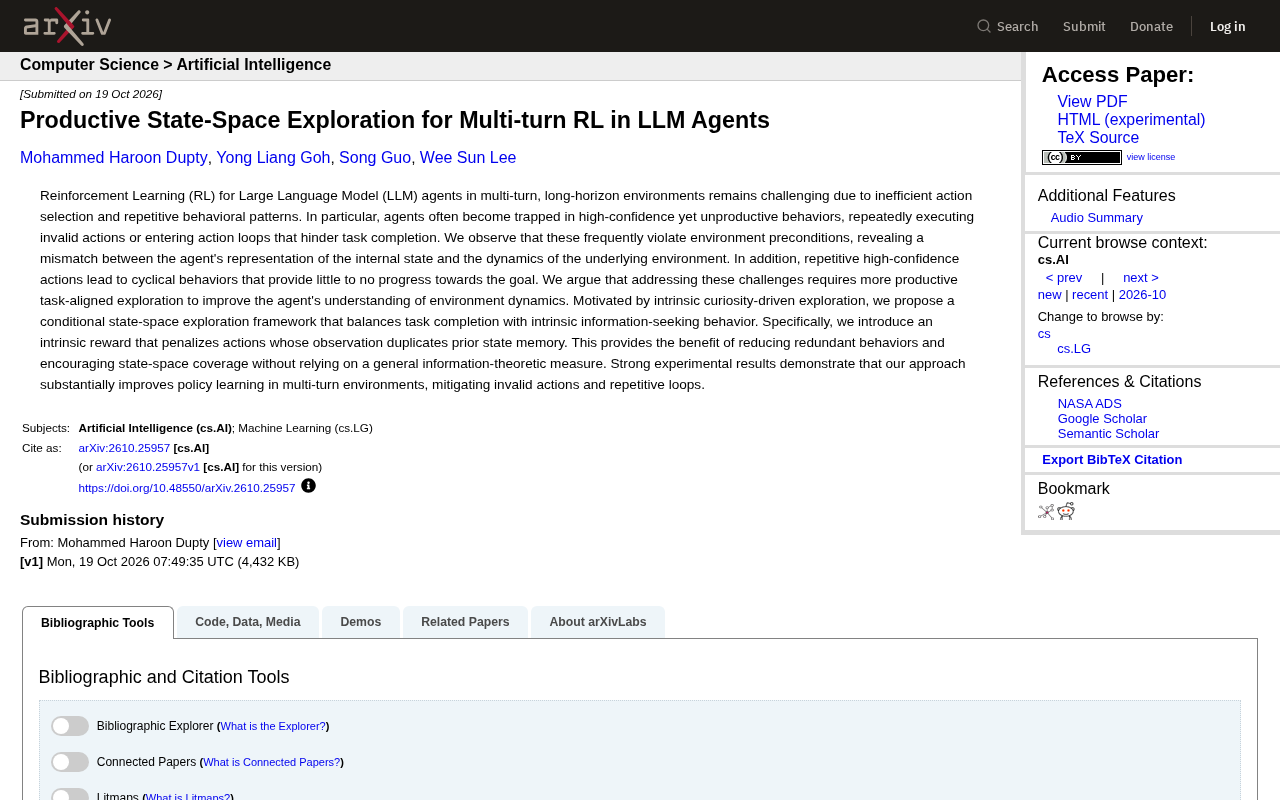
The article addresses LLM agents "spinning in place" in multi-turn, long-horizon RL: agents fall into high-confidence but unproductive patterns, repeatedly executing invalid actions that violate environment preconditions due to misalignment between internal state representation and environment dynamics. Arguing that randomness alone is futile, the authors propose a conditional state-space exploration framework centered on an intrinsic reward that penalizes duplicate observations, reducing redundancy and encouraging state coverage. Experiments show significantly fewer invalid actions and loops, improving policy learning.
Why Do LLM Agents Keep "Spinning in Place"?
Reinforcement learning (RL) in multi-turn, long-horizon environments has long been a pain point in LLM agent training. Agents frequently fall into high-confidence but unproductive behavioral patterns: repeatedly executing invalid actions and getting stuck in action loops, preventing task completion. According to research observations, these behaviors often violate the environment's preconditions, exposing a serious misalignment between the agent's representation of internal state and the environment dynamics. More troublesome still, repeated high-confidence actions form periodic behaviors that contribute almost nothing to goal progress.
Multi-turn, long-horizon reinforcement learning refers to an RL setting in which the agent must interact with the environment over multiple turns, and completing a single task requires spanning a long sequence of time steps (i.e., a "long horizon"). Unlike single-step decision tasks, rewards in long-horizon settings are often sparse and delayed, and the agent must maintain coherent tracking of the goal across dozens or even hundreds of interaction steps, or else it easily gets lost in intermediate steps. This is the fundamental reason LLM agent training is harder than traditional single-turn RL: the policy must not only react to the current observation but also implicitly maintain historical interaction information and plan future actions, which significantly raises the difficulty of state representation and credit assignment.
Preconditions in the context of reinforcement learning and planning refer to the environmental state constraints that must be satisfied for an action to be legally executed. For example, the "open door" action requires the door to be closed and unlocked, and "pick up object" requires the target object to be within reach. When an agent executes an action that violates preconditions, the environment typically returns failure feedback or produces no state change—but LLM agents may keep outputting these actions with high confidence due to language priors, trapping themselves in invalid loops. Recognizing and respecting preconditions is an important sign that an agent understands environment dynamics.
Core Insight: Exploration Needs to Be "Targeted"
Simply adding randomness does not solve the problem. Research points out that what agents need is productive exploration aligned with the task, so as to deepen their understanding of environment dynamics. Inspired by intrinsic curiosity-driven exploration, the authors propose a conditional state-space exploration framework that balances task completion with intrinsic information-seeking behavior.
The key design is an intrinsic reward: when the agent's new observation duplicates a prior state memory, the reward imposes a penalty. This yields two benefits: reducing redundant behavior and encouraging state-space coverage, all without relying on generic information-theoretic measures.
Intrinsic curiosity-driven exploration is a class of reinforcement learning methods that do not depend on external task rewards but instead generate "intrinsic rewards" from the agent itself to incentivize exploration. Typical approaches include prediction-error rewards (encouraging visits to states the model predicts poorly), information-gain rewards (encouraging reduction of uncertainty about the environment), and rewards based on state-visit counts (encouraging visits to rare states). The core assumption behind such methods is that sufficiently exploring the state space helps the agent build a more accurate environment model, thereby finding effective paths faster in sparse-reward tasks. What distinguishes this work is that instead of adopting a generic information-theoretic measure, it constructs rewards from a more direct and easily computable signal—whether a new observation duplicates historical state memory—making exploration better aligned with the needs of task progress.
Experimental Performance: Reducing Invalid Actions and Loops
Strong experimental results show that the method significantly improves policy learning in multi-turn environments, both alleviating the invalid-action problem and suppressing repetitive loops. For the "high-confidence trap" that has long plagued LLM agent training, this framework offers an actionable solution path.
Implications for AI Agent Development
The value of this work lies in turning "exploration" from a vague concept into a computable reward signal. For teams building multi-turn dialogue agents, automated workflows, or game AI, state-space coverage can serve as a practical training diagnostic metric. When an agent starts repeating the same actions, an intrinsic reward that penalizes duplicate observations can push it to try new paths rather than sinking deeper into a dead end.
However, the method's generality still needs validation across more environment types. How the weight of the intrinsic reward should be adjusted with task complexity is also a parameter worth attention during engineering deployment.
State-space coverage is a conceptual metric measuring the proportion of distinct environment states an agent has visited during training or operation relative to all reachable states. The higher the coverage, the more thoroughly the agent has explored the environment, and the less likely the policy is to become overconfident from "having seen only local states." In practice, coverage can be approximated using state hashing, clustering of observation embeddings, or deduplicated counts, and used as an auxiliary diagnostic for training curves: if coverage stagnates for a long time while task success rate fails to rise, it often means the agent has fallen into repetitive loops, and the weight of the exploration reward or the granularity of the memory mechanism needs adjustment.
One-line Summary
An intrinsic reward that penalizes duplicate observations lets LLM agents explore purposefully in multi-turn RL and escape action loops.
Paragraph Summary
The article focuses on the "spinning in place" problem of LLM agents in multi-turn, long-horizon reinforcement learning: agents often fall into high-confidence but unproductive behavioral patterns, repeatedly executing invalid actions that violate environment preconditions, rooted in a misalignment between internal state representation and environment dynamics. The authors point out that simply adding randomness is futile and that productive, task-aligned exploration is needed, and they propose a conditional state-space exploration framework whose core is an intrinsic reward—imposing a penalty when a new observation duplicates prior state memory, thereby reducing redundant behavior and encouraging state-space coverage. Experiments show the method significantly reduces invalid actions and repetitive loops and improves policy learning, offering actionable training diagnostics for multi-turn dialogue agents, automated workflows, and game AI.
Related articles

Chain of Thought Isn't Just for AI: How Humans Can Use CoT to Improve Thinking Quality
Chain of Thought isn't just a prompt trick for large models. Starting from a Hacker News discussion, this article analyzes why CoT works for human thinking too, breaks down actionable ways to transfer it, and highlights the key differences between human CoT and machine CoT.
Cloudflare Teams Up with OpenAI: Closi…
Cloudflare Teams Up with OpenAI: Closing the Loop from Vulnerability Discovery to Defense with AI
Cloudflare uses OpenAI Daybreak to investigate security vulnerabilities and generate reviewable remediation plans, while developers use Codex to boost coding efficiency and quality.

Orca Multi-Agent Orchestration in Practice: A Guide to Parallel Collaboration with Claude and Codex
Orca is Stable AI's free open-source agent workbench supporting 34 agents like Claude Code and Codex in parallel. Learn its Git worktree isolation, multi-model orchestration, and mobile management.