New Breakthrough in Parallel Speculative Decoding: CPA Uses Prefix Attention to Correct Drafts

CPA uses prefix-aware selection and autoregressive supervision to improve parallel speculative decoding draft quality, achieving up to 3.37× speedup.
Parallel speculative decoding generates an entire block of candidate tokens at once, but the lack of causal dependencies within the block means early errors cause subsequent suffixes to be rejected entirely, limiting accepted length and speedup. Corrective Prefix Attention (CPA) proposes two designs: a fixed candidate shortlist per position enabling pairwise interactions to be computed before selection, moving expensive neural computation earlier and leaving only cheap operations at selection; and an autoregressive auxiliary loss active only during training that strengthens the shared backbone's causal modeling on clean prefixes. On Qwen3-4B/8B across eight math/code/chat benchmarks, CPA commits 13–15% more tokens per round than DSpark and 25–26% more than DFlash, with average greedy speedups of 3.35× and 3.37× and 2.86× under sampling, validated on Ascend NPU. Capacity sweeps also reveal that higher acceptance rates do not necessarily yield faster decoding.
Title
New Breakthrough in Parallel Speculative Decoding: CPA Uses Prefix Attention to Correct Drafts
Meta Description
A new parallel speculative decoding method, CPA (Corrective Prefix Attention), combines prefix-aware selection with autoregressive supervision to let each candidate token attend to earlier choices within the block. On Qwen3-4B/8B it commits 13-15% more tokens than DSpark, achieving up to 3.35× greedy decoding speedup.
Article Content
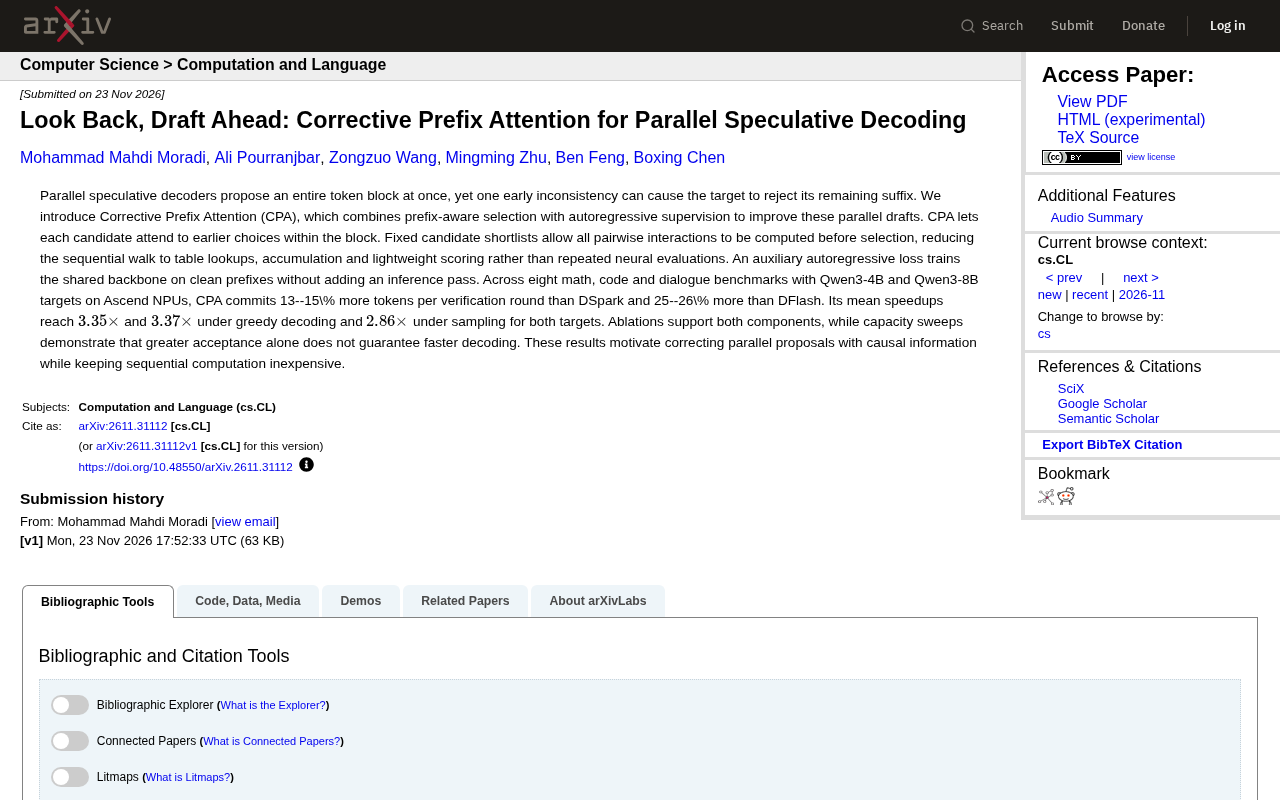
Parallel Speculative Decoding can generate an entire block of candidate tokens at once, but early inconsistencies often cause the target model to reject the remaining suffix, severely undermining the speedup. A new work from the research community proposes Corrective Prefix Attention (CPA), which combines prefix-aware selection with autoregressive supervision to significantly improve parallel draft quality. On Qwen3-4B and Qwen3-8B target models across eight math/code/chat benchmarks, CPA commits 13–15% more tokens per verification round than DSpark and 25–26% more than DFlash, achieving average speedups of 3.35× and 3.37× under greedy decoding, and 2.86× under sampling decoding.
The Pain Point of Parallel Drafts: One Error Ruins the Whole Block
The core idea of speculative decoding is to use a small model to quickly draft multiple tokens, then have a large model verify them in parallel. Parallel speculative decoding goes further by proposing an entire block of tokens at once, theoretically maximizing throughput. But the problem is that tokens within the block lack causal dependencies—once an early position is chosen incorrectly, subsequent tokens, even if reasonable in themselves, will be rejected entirely by the target model due to prefix inconsistency. This "one bad apple spoils the barrel" effect makes the accepted length of parallel drafts far lower than that of autoregressive drafts, greatly diminishing the speedup.
CPA's starting point is precisely to let candidate tokens "look back" during generation—each candidate can attend to earlier choices within the block, thereby introducing causal information at the draft stage and reducing rejections caused by prefix inconsistency.
Speculative Decoding is a technique that accelerates autoregressive generation without changing the target model's output distribution: a smaller, faster draft model autoregressively generates several candidate tokens, then the target model verifies these candidates in parallel in a single forward pass, deciding how long a prefix to accept according to acceptance criteria (e.g., position-by-position matching under greedy decoding, rejection sampling under sampling). Accepted tokens can be committed at once, compressing multiple serial decoding steps into a single target model forward pass. The speedup ceiling depends on the average accepted length and the relative computational costs of drafting versus verification.
Parallel speculative decoding makes the drafting stage itself no longer token-by-token serial, but instead outputs an entire block of candidates at once (e.g., via tree-based or slot-based parallel proposals). This further improves draft throughput, but at the cost of losing explicit causal dependencies among tokens within the block: each candidate position typically can only see the original prefix, not the tokens ultimately selected at earlier positions in the same block. Thus, once an earlier position in the block is chosen incorrectly, the prefixes of subsequent tokens become inconsistent with the target model's true context, and they are truncated entirely during verification. This is precisely the structural reason for the "low accepted length" of parallel drafts, and the core problem CPA attempts to fix with prefix attention.
How CPA Works: All Interactions Computed Before Selection
CPA's design contains two key components.
Prefix-Aware Selection and a Fixed Candidate Shortlist
CPA maintains a fixed candidate shortlist for each position. Since the candidate set is fixed, all pairwise interactions among candidates can be computed in one pass before selection. In this way, the serialization process that would otherwise require repeated neural network evaluations is reduced to table lookups, accumulation, and lightweight scoring. In other words, CPA moves expensive neural computation forward to a parallelizable stage, leaving only cheap operations at the selection stage, avoiding the repeated inference overhead common in parallel decoding.
Autoregressive Auxiliary Loss
Besides the selection mechanism, CPA also introduces an auxiliary autoregressive loss that trains the shared backbone on clean prefixes. This loss adds no extra inference pass—it only acts during training—yet it enables the backbone to better understand the relationship between prefixes and subsequent tokens. Ablation experiments show that both the prefix-aware selection and the autoregressive auxiliary loss contribute to the final results.
Auxiliary loss is a common regularization technique in multi-task or structured training: an additional loss term beyond the main objective, sharing the same backbone, to guide representations toward structures useful for downstream tasks without changing the inference-time computation graph. The key here is that it only takes effect during training and requires no extra forward pass at inference, so it does not increase decoding latency.
In CPA, the role of the auxiliary autoregressive loss is to let the shared backbone learn the causal correspondence between prefixes and subsequent tokens on "clean prefixes" (i.e., true, error-free context). This complements the prefix-aware selection at inference: the selection mechanism efficiently performs intra-block interactions over the fixed candidate shortlist, while the auxiliary loss improves the backbone's sensitivity to prefix conditions at the training level, making candidate scoring closer to the target model's preferences. Ablation experiments show that both components contribute, indicating that "structural causal modeling" and "training-time causal supervision" are both indispensable.
Experimental Results: More Tokens Accepted, Significant Speedup
The research team evaluated on Ascend NPU with Qwen3-4B and Qwen3-8B as target models, covering eight math, code, and chat benchmarks.
- Accepted length: CPA commits 13–15% more tokens per verification round than DSpark and 25–26% more than DFlash.
- Speedup: Under greedy decoding, the average speedups for the two target models are 3.35× and 3.37× respectively; under sampling decoding, 2.86×.
Interestingly, capacity sweeps reveal a counterintuitive phenomenon: a higher acceptance rate does not necessarily lead to faster decoding. This shows that in parallel speculative decoding, accepted length is only one factor in speedup—the computational overhead of candidate generation and verification is equally critical. CPA's design precisely controls sequential computation cost while improving the acceptance rate, thereby achieving end-to-end speedup.
Capacity sweeps refer to systematically varying a capacity-related parameter (such as candidate block length per round, shortlist size, draft budget, etc.) while holding other conditions fixed, and observing how accepted length and end-to-end throughput/latency change. It is often used to characterize the Pareto frontier of speculative decoding: the longer the block, the greater the potential gain per round, but the higher the probability of intra-block inconsistency, and the greater the computation for verification and candidate generation.
Thus, "a higher acceptance rate does not necessarily bring faster decoding" is not contradictory: accepted length measures how many tokens are committed at the verification stage, whereas end-to-end speedup also depends on the actual overhead of draft generation, pairwise interaction scoring, and target model verification. If the means of raising the acceptance rate introduces more sequential computation or a larger candidate set, total latency may instead increase. CPA's design goal is precisely to find a better trade-off point between accepted length and computational overhead on the capacity sweep curve, which also explains why the paper emphasizes that "cheap sequential computation" is as important as the acceptance rate.
Why It Matters: Balancing Causal Information and Cheap Sequential Computation
CPA's significance lies in offering a clear approach: use causal information to correct parallel proposals while keeping sequential computation cheap. Parallel speculative decoding has long faced the trade-off of "higher parallelism, worse draft quality." CPA moves interaction computation forward via a fixed candidate shortlist, then strengthens the backbone with an auxiliary loss, narrowing the quality gap with autoregressive drafts without sacrificing parallel efficiency.
For practical deployment, this means more stable speculative decoding speedups across diverse tasks such as math, code, and chat. Validation on domestic Ascend NPU also shows that the method does not depend on a specific hardware ecosystem.
Both of CPA's components—prefix-aware selection and autoregressive supervision—have been validated through ablation, while capacity sweeps remind researchers and engineers: optimizing speculative decoding cannot focus solely on the acceptance rate but must also attend to the overall computational pipeline. These results encourage introducing causal information into parallel proposals while keeping sequential computation low-cost, providing a reusable design paradigm for subsequent parallel speculative decoding research.
One-line Summary
CPA uses prefix-aware selection and autoregressive supervision to improve parallel speculative decoding draft quality, achieving up to 3.37× speedup.
Paragraph Summary
Parallel speculative decoding generates an entire block of candidate tokens at once, but the block lacks causal dependencies—early errors cause subsequent suffixes to be rejected entirely by the target model, limiting accepted length and speedup. Corrective Prefix Attention (CPA) proposes two designs: first, maintaining a fixed candidate shortlist for each position so that pairwise interactions among candidates can be computed in one pass before selection, moving expensive neural computation forward and leaving only cheap operations at the selection stage; second, introducing an autoregressive auxiliary loss that takes effect only during training, strengthening the shared backbone's modeling of causal relationships on clean prefixes. On Qwen3-4B/8B target models across eight math, code, and chat benchmarks, CPA commits 13–15% more tokens per round than DSpark and 25–26% more than DFlash, with average greedy decoding speedups of 3.35× and 3.37×, and 2.86× under sampling decoding, validated on Ascend NPU. Capacity sweeps also reveal that a higher acceptance rate does not necessarily bring faster decoding.
Related articles

From 0 to 1: Vibe Coding an AI Knowledge Base — A Practical Retrospective and Tech Stack Breakdown
A retrospective on building the AI knowledge base OilBook from scratch with Vibe Coding: Next.js+Neon stack, Oil Dev Skill workflow, Stripe paywall security, interview-style writing, AI-flavor control, and Vercel deployment.

GLM-5.4 Hands-On: Native Vision Meets a New Vibe Coding Workflow
Hands-on with Zhipu GLM-5.4: native vision tested across a 3D product demo, pure-code video generation, and remote-control Vibe Coding, compared with GPT-6.2 and Gemini Neon.

AI and Humans Claim to Prove the Riemann Hypothesis: Machine-Verified, Yet Nobody Can Understand It
Anthropic mathematician and AI Claude claim to prove the Riemann Hypothesis with 17 million lines of Lean code, machine-verified but unreadable by humans. This article analyzes the event, the zero proportion record from 41.6% to 67.2%, and the gap between machine verification and human understanding.