New Breakthrough in Zero-Knowledge Proofs: Floating-Point LLM Inference Verification in Just 19 Minutes

New method proves correctly rounded floating-point matrix multiplication, zero-knowledge proving GPT-2 small forward pass in 19 minutes with accuracy comparable to standard 16-bit inference.
This article introduces a zero-knowledge proof scheme called "Ziv Meets Sumcheck" that solves the efficiency challenge in proving floating-point neural network inference caused by rounding order dependence. By proving correctly rounded products—each dot product computed exactly and rounded only once—it avoids op-by-op rounding tracking, bringing proof cost close to integer matrix multiplication with about a thousand times fewer commitments. The team extends the proof to every Transformer layer and builds a privacy-preserving scheme. Tests show the full GPT-2 small forward pass (twelve blocks plus full-vocabulary output) can be proven on a dual-core processor in 19 minutes and verified in 21 seconds, with all 236 attacks rejected and accuracy at least as good as standard 16-bit inference. Although proof time is still long and the zero-knowledge property relies on explicit assumptions, the work offers a feasible path for verifiable floating-point AI inference.
Title
New Breakthrough in Zero-Knowledge Proofs: Floating-Point LLM Inference Verification in Just 19 Minutes
Meta Description
A new zero-knowledge proof method for floating-point LLM inference: correctly rounded products bypass order dependence, requires ~1000x fewer commitments, proves full GPT-2 small forward pass in just 19 minutes, verifies in 21 seconds, and rejects all 236 attacks.
Article Content
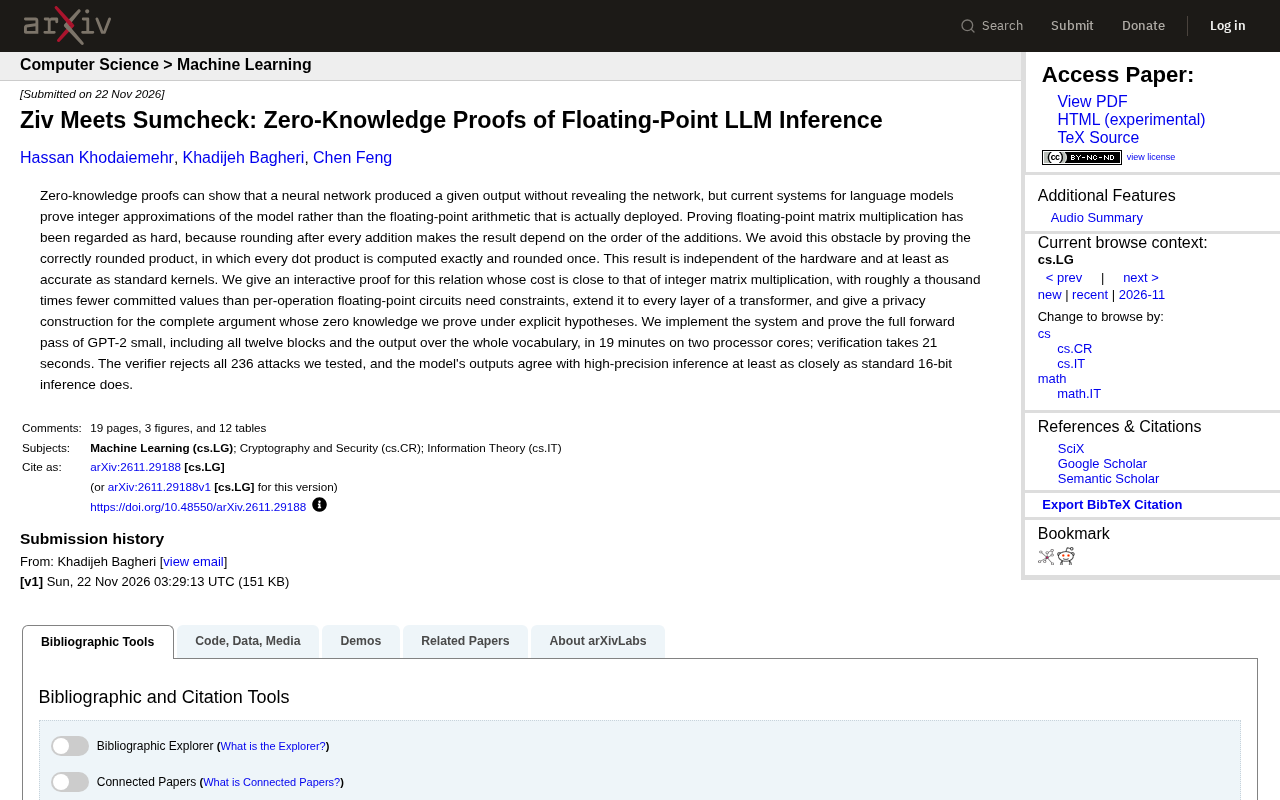
Zero-knowledge proofs (ZKPs) applied to neural network inference verification have long faced an awkward reality: current systems prove integer approximations of a model's computation, while what is actually deployed is floating-point arithmetic. Floating-point matrix multiplication has long been considered difficult to prove because rounding after each addition makes the result depend on the order of additions. A recent study proposes a scheme called "Ziv Meets Sumcheck," which sidesteps this obstacle by proving correctly rounded products—each dot product is computed exactly and rounded only once. The cost of this proof approaches that of integer matrix multiplication, and the number of commitments is about a thousand times fewer than an op-by-op floating-point circuit. The research team implemented a complete system and proved the entire forward pass of GPT-2 small (including twelve blocks and full-vocabulary output) on a dual-core processor in just 19 minutes, with verification taking 21 seconds; the verifier rejected all 236 attacks in the test, and the model output matched high-precision inference at least as well as standard 16-bit inference.
Why Floating-Point Proofs Are So Tricky
Zero-knowledge proofs can demonstrate that a neural network produced a given output without revealing the network itself, but most existing systems prove integer-approximation models rather than the floating-point arithmetic that is actually deployed. In floating-point matrix multiplication, the rounding step after each addition makes the final result depend on the order of additions, which breaks the assumption of deterministic computation traces in traditional proof systems. Although an op-by-op floating-point circuit can model this precisely, the number of constraints is enormous, making proof costs unacceptable.
Correctly Rounded Products: Sidestepping Order Dependence
The core of the new method is to prove "correctly rounded products": each dot product is computed exactly and then rounded only once. The resulting output is hardware-independent and at least as accurate as standard kernels. Since there is no longer any need to track rounding at every step, the proof relation becomes concise and can be combined with the Sumcheck protocol, bringing costs down to a level close to integer matrix multiplication. The paper emphasizes that this scheme requires about a thousand times fewer commitments than an op-by-op floating-point circuit—this is the key source of the efficiency gain.
Zero-knowledge proofs (ZKPs) are cryptographic protocols that allow a prover to convince a verifier that a statement is true without revealing anything beyond the truth of that statement. In neural network inference scenarios, ZKPs can be used to prove that a model produced a specific output on a given input while hiding the model weights and input data. However, traditional ZKP systems (such as zk-SNARKs) are mainly designed for arithmetic circuits, whose constraint systems are naturally suited to integer or finite-field operations. The rounding and order dependence of floating-point arithmetic conflict with the deterministic assumptions of these systems, so directly proving floating-point computation requires introducing a large number of extra constraints and is extremely inefficient.
The Sumcheck protocol is an interactive proof protocol used to verify the correctness of sums of multivariate polynomials. Its core idea is to gradually reduce a claim about a sum over a polynomial to a claim about evaluation at a single point, greatly reducing verification complexity through multiple rounds of interaction. Because of its efficiency and flexibility, the Sumcheck protocol is often used as a low-level component for building more complex proof systems. In this work, the Sumcheck protocol is used to efficiently verify dot-product computations in matrix multiplication by expressing the dot-product accumulation process as a polynomial sum, avoiding the burden of tracking rounding op by op.
From Matrix Multiplication to a Full Transformer
Extending the proof of matrix multiplication to every layer of a Transformer is not easy. A Transformer contains components such as multi-head attention, layer normalization, residual connections, and activation functions, and each component must be expressed in the proof system. The research team provides an interactive proof that covers the complete forward pass from linear transformations to nonlinear activations, and further constructs a privacy-preserving scheme for the full argument, proving zero-knowledge under explicit assumptions.
Measured Results: Proving GPT-2 small in 19 Minutes
After implementing the system, the team conducted an end-to-end test with GPT-2 small: proving the full forward pass (all twelve blocks plus the output over the entire vocabulary) took 19 minutes on a dual-core processor, while verification required only 21 seconds. On the security side, the verifier rejected all 236 attacks in the test, showing that the proof system is robust against malicious provers. On accuracy, the model output matched high-precision inference at least as well as standard 16-bit inference—meaning the proof process did not sacrifice actual inference quality.
The core components of the Transformer model include multi-head attention, layer normalization, residual connections, and feedforward networks. The multi-head attention mechanism computes attention weights through matrix multiplication of queries, keys, and values, involving a large number of floating-point matrix operations; layer normalization normalizes the feature dimension of each sample, including mean and variance computation and division; residual connections add the input directly to the sublayer output, requiring the proof system to correctly handle addition operations; and activation functions (such as GELU) introduce nonlinear transformations. When expressing these components in a zero-knowledge proof system, each operation must be converted into an arithmetic circuit or constraint system. Matrix multiplication can be handled efficiently with the Sumcheck protocol, but division in layer normalization and nonlinear functions in activation functions require additional approximation or lookup techniques, all of which increase proof overhead. By carefully designing the proof relation, the research team unified all components under the same proof framework, ensuring the verifiability of the complete forward pass.
GPT-2 small is a language model released by OpenAI in 2019 with 117 million parameters, 12 Transformer blocks, a hidden dimension of 768, 12 attention heads, and a vocabulary size of about 50,000. Its forward pass involves dozens of matrix multiplications, layer normalizations, and activation function computations, with moderate computational cost, and it is often used as a benchmark for medium-scale models. In a zero-knowledge proof system, proof time is proportional to the number of model parameters and computational complexity. A dual-core proof time of 19 minutes means the proof system must handle constraints corresponding to about 117 million parameters, with each parameter on average producing several constraints, resulting in a total constraint count that can reach hundreds of millions. The verification time of 21 seconds reflects the number of proof elements the verifier must check; although far smaller than the proof time, it still introduces some latency for real-time applications. Compared with integer-approximation schemes, this system's proof time is on the same order of magnitude, but its accuracy is significantly improved.
Significance and Limitations
The value of this work lies in bridging the gap between zero-knowledge proofs and actually deployed floating-point models. Previously, zero-knowledge proofs for floating-point LLM inference were either impractical or could only prove integer approximations. The new scheme reduces costs to an acceptable range while maintaining accuracy, offering a new path for verifiable AI inference. However, a dual-core proof time of 19 minutes is still not fast enough for real-time applications; the zero-knowledge property of the privacy construction relies on explicit assumptions and has not yet been proven in the standard model; and the test covers only GPT-2 small, so the performance on larger models remains to be verified. But the direction is clear: zero-knowledge proofs for floating-point inference are moving from "infeasible" to "engineerable."
One-line Summary
A new method proves correctly rounded floating-point matrix multiplication, zero-knowledge proving the GPT-2 small forward pass in 19 minutes with accuracy comparable to standard 16-bit inference.
Paragraph Summary
This article introduces a zero-knowledge proof scheme called "Ziv Meets Sumcheck," aimed at solving the efficiency challenge in proving floating-point neural network inference caused by rounding order dependence. By proving "correctly rounded products"—each dot product is computed exactly and rounded only once—the method avoids the burden of tracking rounding op by op, bringing proof cost close to integer matrix multiplication and requiring about a thousand times fewer commitments than an op-by-op floating-point circuit. The research team extends the proof to every layer of a Transformer and constructs a privacy-preserving scheme. Measurements show that proving the full GPT-2 small forward pass (including twelve blocks and full-vocabulary output) on a dual-core processor takes only 19 minutes, with verification taking 21 seconds; the verifier rejected all 236 attacks, and the model output matches high-precision inference at least as well as standard 16-bit inference. Although proof time is still long and the zero-knowledge property relies on explicit assumptions, this work provides a feasible path for verifiable floating-point AI inference.
Related articles

From 0 to 1: Vibe Coding an AI Knowledge Base — A Practical Retrospective and Tech Stack Breakdown
A retrospective on building the AI knowledge base OilBook from scratch with Vibe Coding: Next.js+Neon stack, Oil Dev Skill workflow, Stripe paywall security, interview-style writing, AI-flavor control, and Vercel deployment.

GLM-5.4 Hands-On: Native Vision Meets a New Vibe Coding Workflow
Hands-on with Zhipu GLM-5.4: native vision tested across a 3D product demo, pure-code video generation, and remote-control Vibe Coding, compared with GPT-6.2 and Gemini Neon.

AI and Humans Claim to Prove the Riemann Hypothesis: Machine-Verified, Yet Nobody Can Understand It
Anthropic mathematician and AI Claude claim to prove the Riemann Hypothesis with 17 million lines of Lean code, machine-verified but unreadable by humans. This article analyzes the event, the zero proportion record from 41.6% to 67.2%, and the gap between machine verification and human understanding.